

🖼️ Monday Muse
The “Monday Muse” is a weekly collection of reminders, insights, and maxims on the art of living. The term “muse” has two meanings: (1) a state of deep thought; and (2) a source of inspiration. May the following (in a small way) be a source of contemplation and wisdom to live your highest good.
📌 Perennial Reminder(s)
The Greek philosopher and founder of Stoicism, Zeno of Citium (c. 334—262 BCE), on happiness:
Happiness is a good flow of life. This occurs when one lives in accordance with nature, which is reason and virtue. To live well is not to amass wealth or pleasures, but to fulfill one’s rational nature through self-discipline and moral integrity. A wise person is indifferent to pain, fortune, and death, because he understands they are not truly within his power.
— Lives of Eminent Philosophers (via Diogenes Laërtius)
“Happiness is a good flow of life.” This counterintuitive Stoic reminder prompts us to reconsider what it really means to live well. In a world where happiness is often judged by external achievements, Stoicism directs our attention inward, emphasizing character and discipline.
Although it’s crucial to understand that living in this “good flow” isn't passive resignation—it's active discernment. It involves developing indifference not as apathy, but as clarity: identifying what is within our power and what isn't. For instance, as Zeno mentions, “pain, fortune, and death” are beyond our control; therefore, the wise individual does not pin their happiness on them.
📜 Perennial Maxim(s)
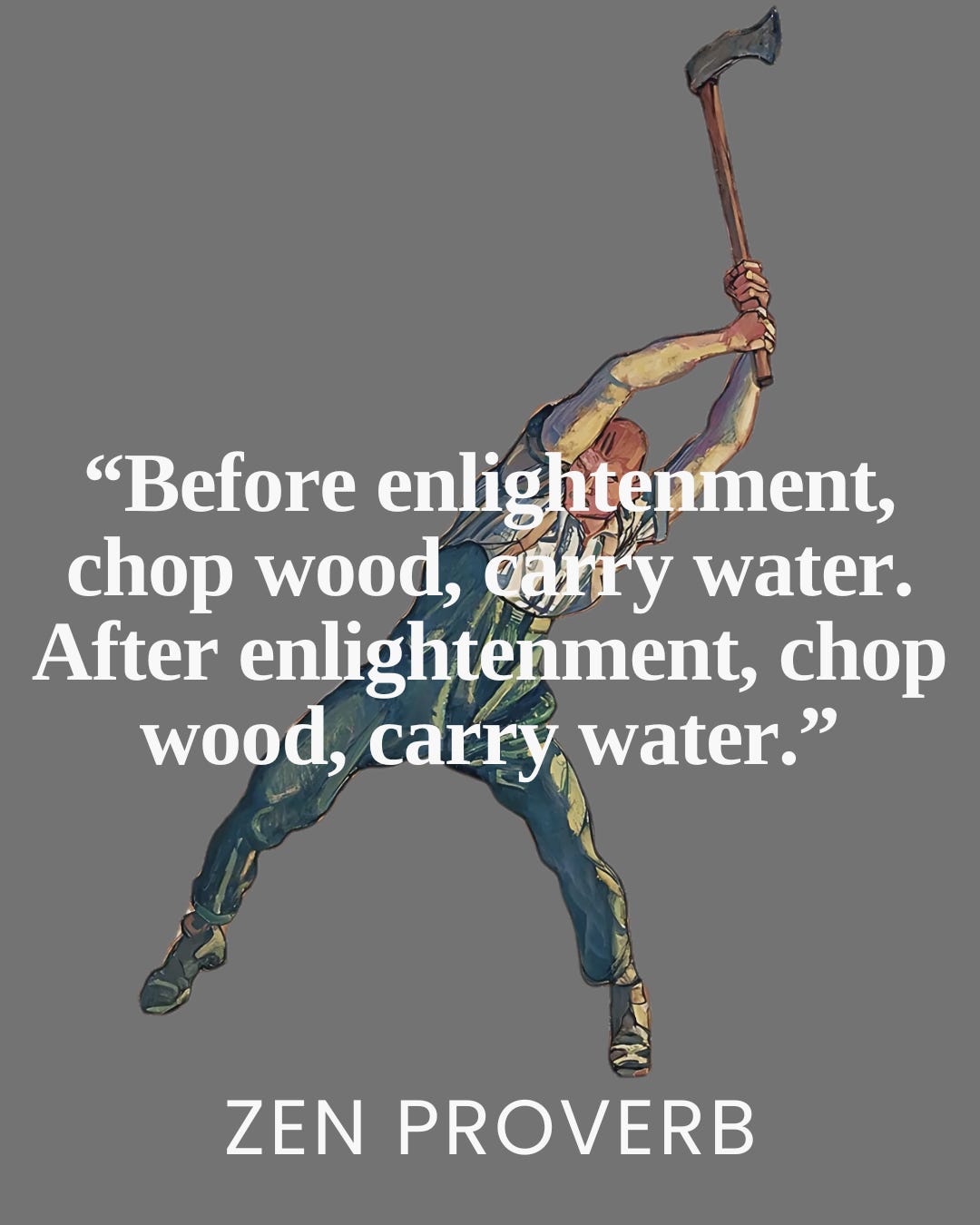
This Zen proverb illustrates that awakening, or gaining wisdom, does not serve as an escape from everyday life. Enlightenment does not elevate us above daily tasks; instead, it changes how we relate to them.
Follow: Instagram | Youtube | Notes
💡 Perennial Insight(s)
The Chinese philosopher Confucius (c. 551–479 BCE) on the power of rituals:
At fifteen, I set my heart on learning; at thirty, I stood firm; at forty, I had no more doubts; at fifty, I understood the will of Heaven; at sixty, I was ready to listen to it; at seventy, I could follow the desires of my heart without overstepping the line. — Analects
Wisdom, in the Confucian tradition, is not a bolt from the heavens. It is the slow unfolding of character over a lifetime — a patient alignment of heart, mind, and conduct. Each decade brings a deepening.
First, we learn. Then we stabilize. Then we begin to listen.
Confucius, the great teacher and moral philosopher of ancient China, valued the ordinary rhythms of life: the way one greets a parent, serves tea, observes seasons, or shows respect. These were not empty gestures. They were rituals—and for him, they were the soil in which virtue grows.
In modern culture, personal growth is often seen as a dramatic transformation. However, the Confucian approach is more nuanced: it involves shaping the self through consistency, humility, and reverence. Proper actions cultivate the heart, and with time, effort turns into instinct—what the tradition calls de, or moral strength.
The most powerful influences are often subtle, developed through daily routines, rooted in tradition, and gradually becoming personal. Consider reflecting on your rituals this week—the small repeated gestures that form your life.
—
Thank you for reading; I hope you found something useful.
Until next time, be wise and be well.
J.W. Bertolotti
P.S. Catch up on recent (and past) meditations in the archive!