

Hello Fellow Travelers,
Why is it that we can fully grasp the dichotomy of control—know exactly where the line lies and what belongs to us and what doesn't—and still find ourselves reaching across it?
Today, we’re revisiting one of Stoicism's most essential ideas, this time with Epictetus as our guide and a little help from Buddhist philosophy, to hopefully answer that question once and for all.
Be wise and be well,
J.W.

💀 Dying Every Day
Dying Every Day is a podcast by the Perennial Leader Project. Each episode turns a selected passage from Stoic philosophy into a guided meditation designed to help you (and me) learn how to live.
Listen on Apple Podcasts, Spotify, or wherever you listen to podcasts.
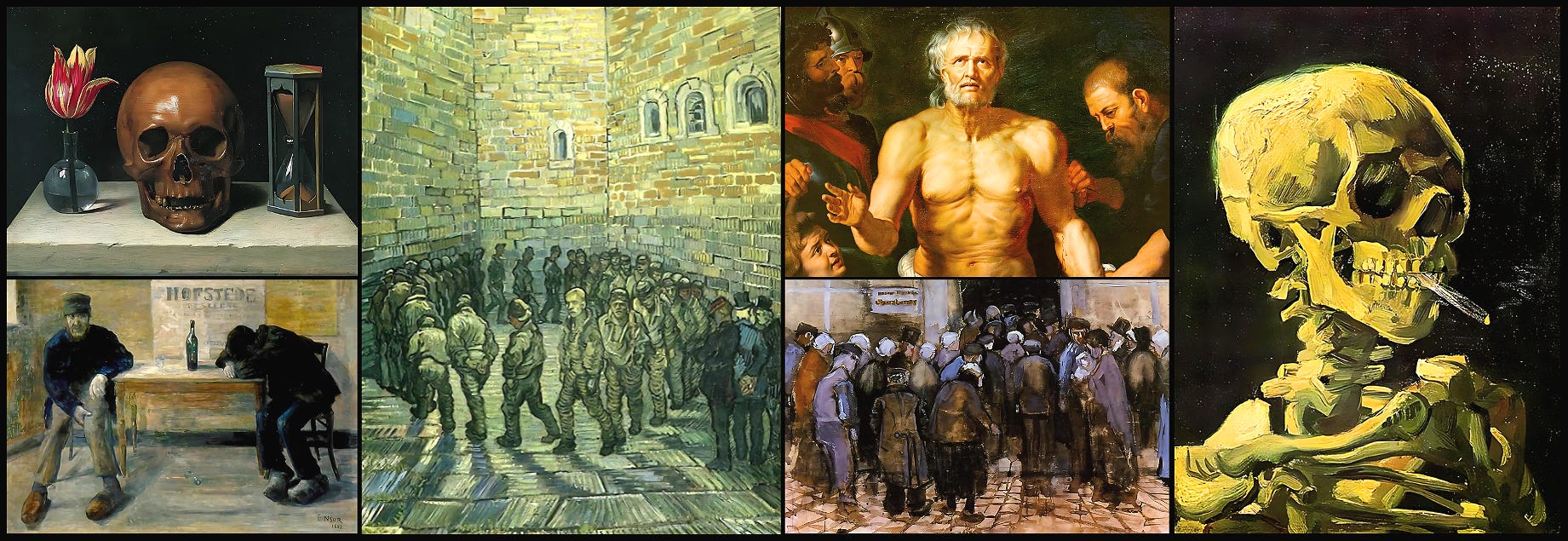
You Already Know This. So Why Doesn’t It Work?
Welcome to Dying Every Day. This is Day 143.
“Some things are within our power, while others are not. Within our power are opinion, motivation, desire, aversion, and, in a word, whatever is of our own doing; not within our power are our body, our property, reputation, office, and, in a word, whatever is not of our own doing.”
— Epictetus, Enchiridion
Contemplate this passage for a moment, but not as philosophy.
As a mirror.
Epictetus opens his handbook with this. Not a greeting, not a preamble—this. As if to say: before anything else, before you learn a single other thing, understand that there are two kinds of things in this world. And you have been confusing them your entire life.
He was a slave when he learned it. We do not know much about Epictetus’ early life, but we know enough. He was owned. His body was not his. His location was not his. His labor, his time, the conditions of his daily existence—none of it was his. His master, who was himself a freedman in the imperial household, held legal title to everything Epictetus was and had.
There is a story—likely true in spirit if not in exact detail—that his master once twisted Epictetus’ leg as a demonstration of power.
Epictetus said, calmly:
“You are going to break it.”
The master continued. It broke. Epictetus said,
“I told you so.”
What is remarkable about that story is not the response, though that is remarkable enough. What is remarkable is the quality of mind it reveals.
A man whose body was being broken, who understood with perfect clarity that his body was not his to protect, and who found in that understanding not despair but a strange, almost unassailable freedom. The leg did not belong to him. But the response to the breaking—the quality of attention, the steadiness, the refusal to be diminished—that belonged to Epictetus alone.
This is where the dichotomy of control was born. Not in a classroom. In a body that was owned by someone else.
Within your power: your opinions, your desires, your aversions, your choices. The activity of your own mind. What you reach for, what you recoil from, how you interpret what happens to you.
Not within your power: your body, your reputation, your property, what other people do, what the world gives and takes away.
The line is simple. And when Epictetus draws it, you feel, for a moment, the force of it—the enormous relief of it. All the things that have been tormenting you: your boss’s opinion, the diagnosis, the relationship that won’t resolve, the outcome you cannot guarantee—none of it was ever yours to control.
You have been suffering over things that were never in your possession to begin with. You have been reaching across a line that was always there, grasping at what was never yours, and calling the resulting pain your life.
Let yourself feel the seduction of that clarity. It’s real.
It’s why people encounter this passage and feel, sometimes for the first time in years, that something has shifted.
And then go back to your life. See how long it holds.
“Some things are within our power, while others are not.”
Here is the honest problem. Knowing the distinction does not enable one to live it. The gap between comprehension and practice is not a small one—it is, for most people, the work of a lifetime.
Epictetus was well aware of this. In the Discourses, he often expressed frustration with students who understood an argument intellectually but faltered when faced with real-life situations.
Some recognized in class that their reputation was beyond their control, yet spent restless nights worrying about others' opinions. Others knew in theory that their bodies were not entirely theirs but felt intense fear whenever illness struck.
He didn’t regard them as unintelligent, but as untrained, and he was correct in that assessment.
But there is something the Stoic framework names without fully explaining—something that tells us why the training is so relentlessly hard, why the same desires reassert themselves no matter how clearly we see through them, why knowing the line does not stop us from crossing it again and again.
The problem is not understanding.
The problem is older than understanding.
The Buddha called it tanha, meaning “craving” or “thirst.”
Not desire in the general sense—not every wanting. Tanha is a specific quality of reaching: the compulsive, reflexive grasping of a mind that cannot rest in what is, that perpetually strains toward what it lacks or recoils from what it fears.
It is not a thought. It is not a decision. It is a movement—prior to thought, prior to choice—that the mind makes constantly, automatically, without asking permission.
The Dhammapada (or sayings of the Buddha) describes it as an image that cannot be let go of.
“Beset by craving, people run about like an entrapped hare. Held fast by mental fetters, they come to suffering again and again...”
An entrapped hare. Not charging toward something. Not even hunting. Running in blind, frantic circles inside a snare—expending enormous energy, going nowhere, the motion itself a form of suffering. The hare does not run because it has reasoned its way to a bad conclusion.
It runs because it is caught, and being caught triggers the running, and the running tightens the snare.
This is what Epictetus describes when he speaks of people who reach for what is not theirs. They are not making a logical error that an argument can correct. They are caught in something older and deeper than logic—a conditioned reflex of craving and aversion that reasserts itself constantly, regardless of what they know or how many times they have drawn the line.
Tanha is why the clarity of today’s passage often does not hold. Not because the argument is wrong—it is exactly right. But because desire is not a rational faculty. It does not respond to being shown its own errors. It responds to practice, repetition, and the slow rewiring that comes only from returning to the same recognition ten thousand times in ten thousand ordinary moments.
Epictetus and the Buddha agree on the diagnosis. Human suffering arises from misplaced desire—from craving what lies outside our control, from building our peace on ground that will not hold. The entrapped hare and the man who treats what is not his as if it were are the same figure, seen from different traditions, separated by five centuries and half a world.
But here the agreement ends.
And the difference is not minor.
Epictetus says: redirect. The discipline of desire is not the elimination of wanting—it is the retraining of it. Align your desire with virtue, with what the rational will can actually produce. The will, rightly ordered, is not the problem. It is the instrument of the good life.
You don’t stop being a creature who wants.
You become a creature who wants the right things.
The Buddha says: release. Tanha is not to be redirected toward better objects. It is to be seen clearly, understood in its nature, and allowed to cease. The goal is not a will aimed at the right things but a mind that has loosened its grip on the habit of reaching altogether. Not desire reformed. Desire stilled.
The entrapped hare does not need a better direction to run.
It needs to stop running.
The main idea here is that closing the gap between knowing and truly experiencing the dichotomy of control isn't something that argument or reason alone can accomplish. Instead, it takes consistent practice—coming back again and again to the same realization. It's about noticing your impulses before they turn into grasping.
It's about feeling the pull of tanha—the familiar longing for what isn't truly yours—and gently meeting it with steadiness rather than reaction.
Daily Practice
What are you still reaching for that was never yours to hold?
Don’t answer in the abstract. Choose one thing—specific, present, real. Something alive in you right now. Then, ask the question Epictetus put at the center of everything: “Is this within my power, or not?”
Not partially. Fully. Does the outcome depend entirely on your own doing—or on your body, another person, an institution, or a result you can influence but not guarantee?
If it is not within your power—and most of what torments us is not—then sit with the harder question: “What am I attached to here?”
Not just what I want, but what I am gripping. What outcome, what image of how things should go, what need for the world to behave in a particular way?
Name it. Hold it clearly.
And then ask: “What is actually mine in this situation?”
Your response. Your quality of attention. The character you bring to what you cannot control. The refusal to let the snare make you the hare.
That is yours. Only that.
Epictetus learned it in chains. The Buddha discovered it under a tree. You can learn it right here and now, in the midst of an ordinary day.
Listen on Apple Podcasts, Spotify, or wherever you listen to podcasts.
—
Thank you for reading/listening; I hope you found something useful.
Until next time, be wise and be well.
J.W.
P.S. Catch up on recent (and past) meditations in the archive!
Both traditions are trying to solve the same problem from different angles. One says redirect the wanting. One says release it entirely. But there's a third possibility neither fully develops. What if the wanting itself could be educated until it naturally wanted the right things. No redirection needed. No releasing required. Just desire and reason finally pointing the same way. That's a different kind of work and it takes longer. But it's the only version where the war actually ends..
So good!