

🖼️ Monday Muse
The “Monday Muse” is a weekly collection of reminders, insights, and maxims on the art of living. The term “muse” has two meanings: (1) a state of deep thought; and (2) a source of inspiration. May the following (in a small way) be a source of contemplation and wisdom to live your highest good.
📌 Perennial Reminder(s)
The crowd is untruth. — Søren Kierkegaard
Kierkegaard, the Danish philosopher and Christian thinker, wrote mainly for individuals rather than the masses. He feared the crowd, not just as a collection of people but as a force that threatens the self. In crowds, we tend to lose accountability and become absorbed in consensus, avoiding the responsibility of introspection.
For Kierkegaard, being true to oneself isn’t about eccentricity or solitude; it's about accepting responsibility for one's life, which is reflected in genuine choices, beliefs, and authentic ways of being.
History backs up his warning; many tragedies—from moral failures in governments to everyday acts of cruelty—stem from the excuse, “Everyone else was doing it.” Thinking for yourself means acting on your deepest beliefs, even if they go against what’s popular, accepted, or praised.
Pause for a moment and ask yourself: Have you ever felt tempted to go along with something that didn't quite feel right? How can you remember to stay true to what you deeply know is right?
By embracing this inner honesty, we can begin to lead more authentic and intentional lives.
📜 Perennial Maxim(s)
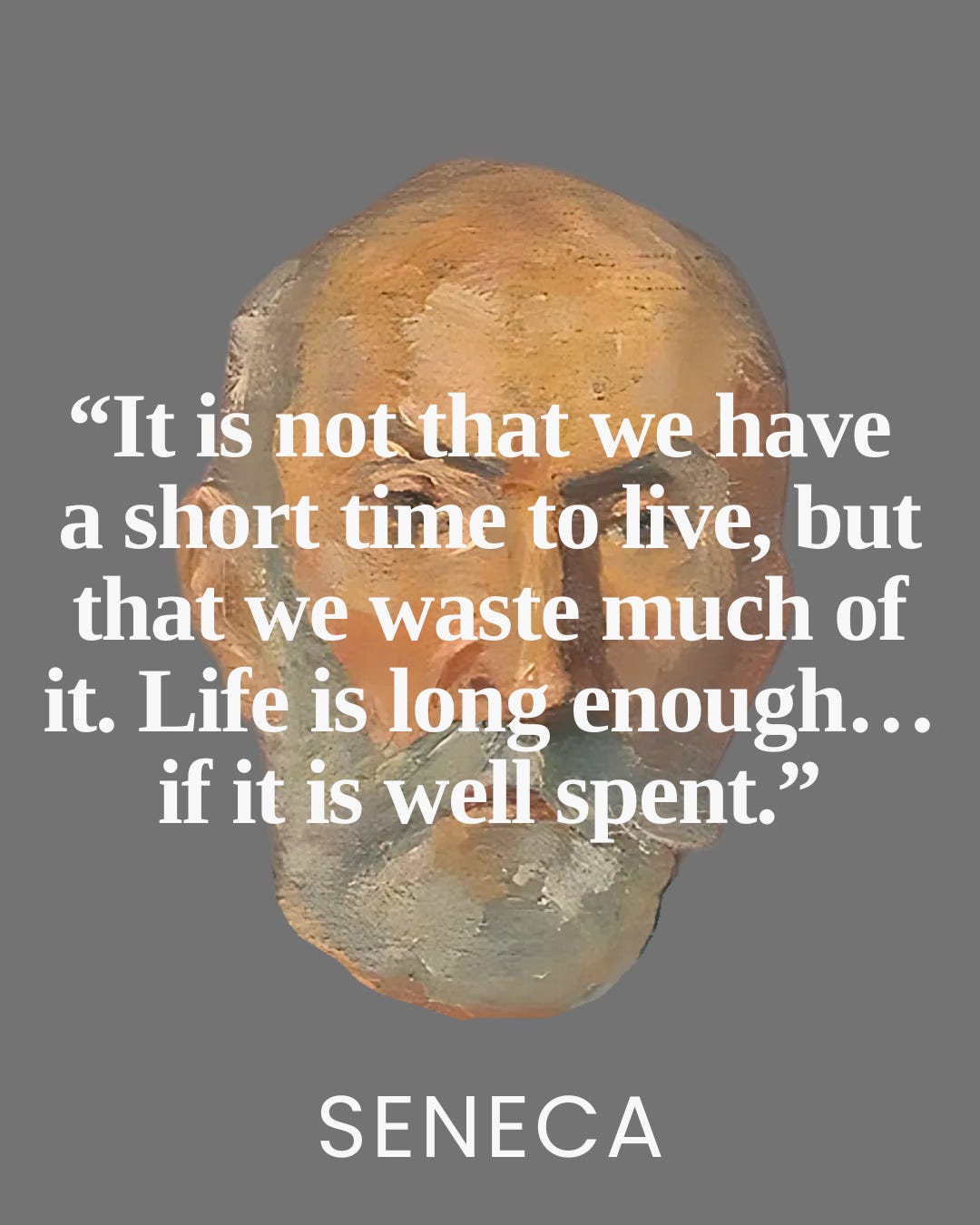
We often talk about not having enough time. But what if the real scarcity isn't time itself, but our attention? Or our clarity about what really matters?
Seneca, in On the Shortness of Life, presents time not as a commodity to be managed but as a matter of ethics. A wasted hour is not simply lost—it’s surrendered. A distracted life, he suggests, is not a life shortened by fate, but one made shallow through neglect.
But this maxim isn’t a call to frantic busyness; it's quite the opposite. It reminds us to live intentionally and to reflect on what fills our days and why.
Follow: Instagram | Youtube | Notes
💡 Perennial Insight(s)
Whoever clings to anything will never be free. — Meister Eckhart
Since childhood, we're told to stay in control: if we plan well, manage everything carefully, and prevent mistakes, everything will run smoothly. But life often proves otherwise—someone we care about gets sick, our plans fall apart, or a door we depended on suddenly shuts.
Meister Eckhart, a 13th-century Dominican mystic, reminds us that clinging—even to good things—can bind us. We often cling to outcomes, roles, identities, and expectations of how others should behave. But the more tightly we hold on, the more tension we create. And when life moves, as it always does, we suffer not because things change but because we resist.
Letting go isn't about giving up; it's about releasing the need for control and trusting that we can live and grow amidst uncertainty.
Consider identifying one thing you’re holding onto—whether it’s a belief, a plan, or an idea of how things should be.
What if freedom isn’t about fixing everything?
—
Thank you for reading; I hope you found something useful.
Until next time, be wise and be well.
J.W. Bertolotti
P.S. Catch up on recent (and past) meditations in the archive!