

🖼️ Monday Muse
The “Monday Muse” is a weekly collection of reminders, insights, and maxims on the art of living. The term “muse” has two meanings: (1) a state of deep thought; and (2) a source of inspiration. May the following (in a small way) be a source of contemplation and wisdom to live your highest good.
📌 Perennial Reminder(s)
The highest manifestation of life consists in this: that a being governs its own actions. A thing which is always subject to the direction of another is somewhat of a dead thing. — St. Thomas Aquinas
Humility is often misunderstood in the hierarchy of values. Many see it as weakness, self-neglect, or simply not wanting to stand out. However, Aquinas—an influential Christian theologian—viewed humility as a form of properly directed strength. It doesn't mean thinking less of oneself, but rather being free from the need to constantly prove oneself.
According to Aquinas, the highest expression of a living soul is to govern one’s actions freely—acting not out of compulsion, pride, or fear, but from wisdom and love. Humility makes this freedom possible.
Why? Pride enslaves an individual to comparison, superiority, and the need for praise. In contrast, the humble person is grounded, no longer dependent on external validation, and capable of genuine clarity and purpose.
In Buddhist thought, a similar insight emerges. In the Dhammapada, the Buddha warns, “Fools who know their foolishness are wise at least so far. But fools who think themselves wise—they are truly foolish.”
Humility clears the path to wisdom.
Consider this: were the wisest people you’ve met boastful? Or did they carry themselves with a quiet confidence, a groundedness that required no boasting?
Humility is not the end of growth. It is its beginning. It creates room for others and truth. It listens. It softens. It learns.
Today, pause when you feel the urge to be right, to be noticed, or to win. Ask: Which part of me feels insecure? What would humility look like here—not as a sign of weakness, but as wisdom?
📜 Perennial Maxim(s)
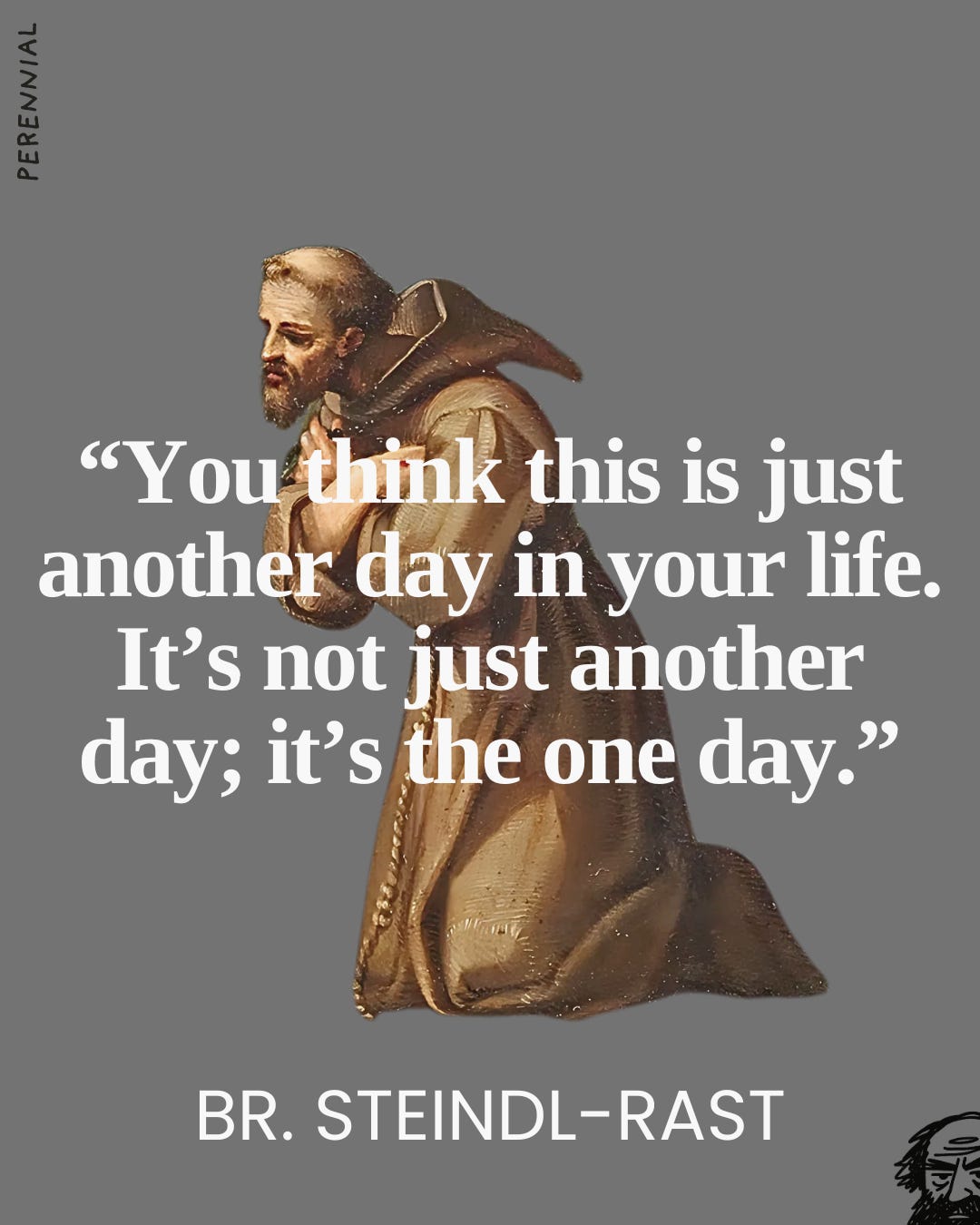
The Benedictine monk Brother David Steindl-Rast (1926—) on being grateful:
Follow: Instagram | Youtube | Notes
💡 Perennial Insight(s)
Keep reminding yourself of the way things are connected, of their relatedness. All things are implicated in one another and in sympathy with each other. This event is the consequence of some other one. Things push and pull on each other, and breathe together, and are one.
— Marcus Aurelius, Meditations, 6.38
When confronted with a problem, it can seem overwhelming. Every slight, delay, and fear seems to become permanent and inescapable.
But Marcus Aurelius—Roman emperor, philosopher, and soldier—practiced the habit of perspective. He would step back to see life not from the ground but from above. In doing so, he was able to view the chaos of the moment not as final, but as part of a greater whole.
This Stoic practice is sometimes referred to as “the view from above.” Imagine your worries as seen from the height of a mountain—or better, from the edge of the cosmos. How small they appear. How impermanent. And how much more clearly we begin to see what matters.
This exercise is not meant to undermine real pain or hardship. Instead, it aims to restore balance. Your life is part of something vast—a web of interdependence, movement, and change. What appears burdensome today could potentially serve as a pivotal moment, an act of grace, or simply a fleeting moment.
The poet Walt Whitman wrote, “I am large, I contain multitudes.” And so do you. You are not just your emotions, your titles, or your burdens. You are part of something vast—a universe that holds both stars and sorrows, and makes space for both.
When overwhelmed, take a step back. Not to escape, but to observe. Walk beneath the sky. Read a page of something eternal. Envision your life not as a closed circle but as a single thread in a vast, unfolding design.
🔥 Recommendation(s)
This week’s recommendation is an upcoming virtual event by The Plato's Academy Centre. It’s titled “Democracy and Tyranny” and takes place this Saturday (26 July). Learn more and register for free below:

—
Thank you for reading; I hope you found something useful.
Until next time, be wise and be well.
J.W. Bertolotti
P.S. Catch up on recent (and past) meditations in the archive!