

Reading & the Good Life
Join the conversation! Every Friday at noon EST, Perennial Meditations readers are welcome to gather for Reading & the Good Life (Register here), a space for connection, contemplation, and conversations on the art of living!
We are continuing our exploration of philosophy as a way of life and the notion of spiritual exercises through Philosophy as a Way of Life by the French philosopher and historian Pierre Hadot (1922—2010) through the end of April.
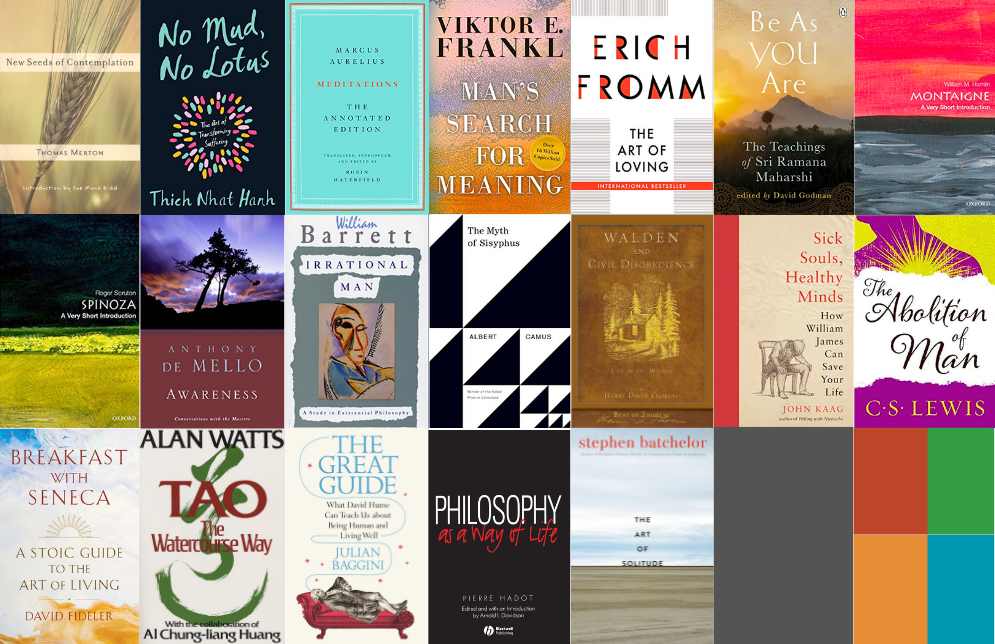
***For May, we’ll transition to the practice of solitude through Stephen Batchelor’s book The Art of Solitude.
Who is Pierre Hadot?
Pierre Hadot was a classical philosopher and historian of philosophy. He is best known for his conception of ancient philosophy as a bios or way of life. His work has been widely influential in classical studies and on thinkers. According to Hadot, modern academic philosophy has largely lost sight of its ancient origin in a set of spiritual practices that range from forms of dialogue via species of meditative reflection to theoretical contemplation. The goal of the ancient philosophies, Hadot argued, was to cultivate a specific, constant attitude toward existence by way of the rational comprehension of the nature of humanity and its place in the cosmos. […]
Learn more: https://iep.utm.edu/hadot/
What is a Philosophy of Life?
We all have a philosophy of life. The question is whether or not we have a good (or coherent) philosophy of life. Does our way of life align with how the world works? Do our principles and practices help us to navigate life in good and bad times?
In his book Philosophy and Life, the British philosopher A.C. Grayling suggests,
There is a question everyone has to ask and answer — in fact, has to keep on asking and keep on answering. It is, ‘How should I live my life?’ ‘What values shall I live by?’ ‘What sort of person should I be?’ ‘What shall I aim for?’ The great majority of people do not ask this question; they merely answer it unthinkingly by adopting conventional views of life. […]
Our way of life is a framework; it guides us in answering these types of perennial questions. A philosophy of life generally consists of three parts: metaphysics (i.e., an account of how the world works), ethics (i.e., a set of principles to live by), and practices (i.e., a set of exercises).
Selected Passages
The following passages from Philosophy as a Way of Life by Pierre Hadot will help guide our upcoming conversation (Register here). Consider reflecting on the following questions: (1) How would one embody these lessons in daily life? (2) What might make it challenging to implement these ideas? (3) How can the following insights help us to live the good life?
