

Perennial Wisdom
Perennial Wisdom is a podcast for seekers and curious minds. Each episode explores philosophical and spiritual traditions for universal truths and enduring ideas to help you (and me) never stop learning how to live.
Listen on Apple Podcasts, Spotify, or YouTube
The Saint’s Guide to Happiness
In this episode of Perennial Wisdom, we explore the profound and surprising vision of happiness taught by the 13th-century theologian and philosopher St. Thomas Aquinas. Long before modern self-help, Aquinas argued that most of our suffering comes not from pain itself, but from aiming our deepest desires at things too small to satisfy them.
Through three core ideas, we examine why:
No finite thing can be our final happiness
The human heart longs for something infinite
Virtue is not moralism, but the reordering of desire
Throughout our journey, we draw on insights from Aquinas’ Treatise on Happiness and the modern philosopher Josef Pieper, revealing a vision of happiness rooted not in stimulation or control, but in truth and contemplation.
Listen on Apple Podcasts, Spotify, or YouTube
Episode Transcript
The following is a transcript from “The Saint’s Guide to Happiness” on the Perennial Wisdom podcast (Ep. 255).
—
Today, we’re exploring a question that never leaves us alone.
What does it actually mean to be happy?
We use the word constantly. We chase it through comfort, success, relationships, productivity, and even pleasure. We organize entire lives around the promise that if we arrange the right conditions… then, finally, we will be happy.
And yet happiness is strangely hard to find.
We have more comfort, more choice, more stimulation than any generation in history. And still anxiety rises. Burnout spreads. And quiet feels unfamiliar.
Seven hundred years ago, long before therapy podcasts or dopamine research,
St. Thomas Aquinas saw this pattern with astonishing clarity.
He explained that our suffering would not mainly stem from pain, but from a fundamental error: directing our desire toward things that are too insignificant to fulfill it.
For Aquinas, happiness is not a mood, not a feeling, and not a moment of pleasure. It is the final end of human life—the deepest orientation of the soul toward what it was made for.
1. False Happiness
Aquinas begins in a way that feels surprisingly modern. Before he tells us what happiness is, he dismantles what we repeatedly mistake for it.
He looks one by one at the candidates we still worship today:
Money.
Status.
Power.
Pleasure.
And one by one, he says: “No.”
Not because these things are bad—but because they are too small.
He writes:
“It is impossible for man’s happiness to consist in wealth, because wealth is sought for the sake of something else. And happiness is supposed to be the last end.” — Summa Theologiae
Money always points beyond itself. We never want money just for money. We want what we think it can give us—security, comfort, freedom, control.
Honor fails because it depends on other people’s opinions. Power fails because it magnifies disorder as easily as goodness. Fame fails because it rests on misunderstanding. Pleasure fails because it fades almost as soon as it arrives.
Even knowledge fails—not because it is too high—but because it is never complete.
If you’d like to become a member, there are a few ways to do so: (1) subscribe for $5 a month or $39 a year; (2) use this 50% discount link if you need assistance; and (3) if you can’t afford it, please accept a complimentary membership.
Then Aquinas presents one of the most powerful statements in philosophy:
“It is impossible for any created good to constitute man’s happiness. For happiness must completely satisfy desire. Otherwise, it would not be the final end.”
Here is the principle that unravels so much modern confusion: If something leaves you still searching, it cannot be your happiness.
We feel this empirically now. Psychology calls it the hedonic treadmill.
Pleasure adapts.
Success normalizes.
And almost immediately, desire resets.
Aquinas concludes: Finite things cannot satisfy infinite longing.
2. The Structure of Desire
Why do we keep reaching for the wrong things? Because our desire itself is misunderstood.
Aquinas says something quietly radical: the will is naturally ordered toward happiness as its final end. We are not wrong to want happiness. We are wrong about where we think it lives.
He writes:
“Man’s will tends naturally toward happiness as its last end—but it may err in the choice of means.”
In other words, we don’t want too much. We want it from the wrong places.
Every disappointment teaches the same lesson. Every pleasure fades. Every achievement falls short of calming the heart. And no relationship can bear the weight we place on it.
We are not shallow because we desire deeply. We are restless because we desire infinitely.
That leads Aquinas to his central claim:
“Final and perfect happiness can consist in nothing else than the vision of the Divine Essence.”
For Aquinas, happiness is not something you own.
It is something you behold.
The intellect comes to rest not in a thing, but in Truth itself. The will comes to rest not in stimulation, but in Goodness without limit.
He continues:
“In that vision, the intellect attains to the very substance of God, and the will rests in perfect delight.”
Happiness here is not excitement.
It is rest after a long exile.
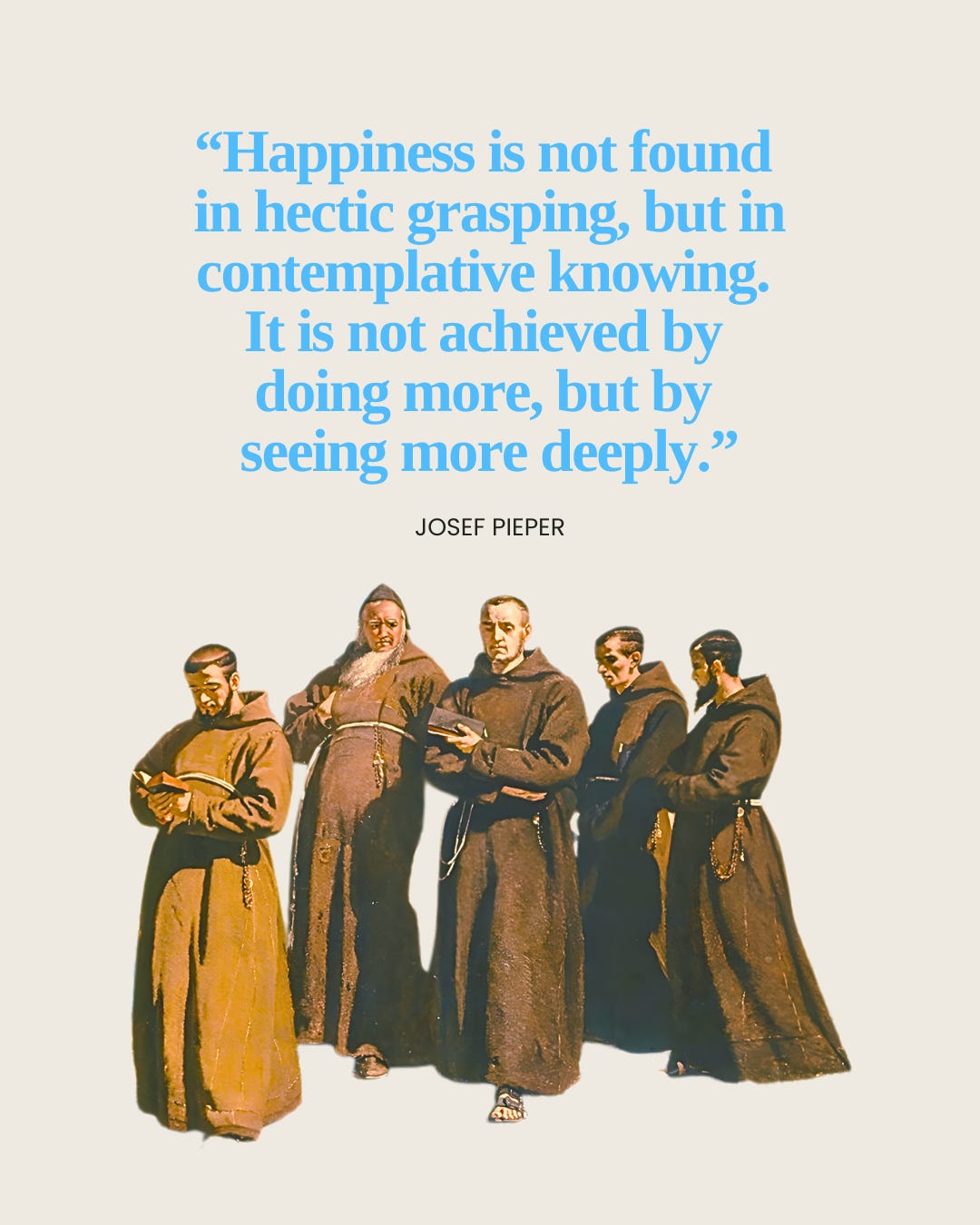
It's not about suppressing desire—rather, it's about realizing what that desire has been secretly longing for all along. Josef Pieper, the great modern interpreter of Aquinas, puts this into language we can feel:
“Happiness is not found in hectic grasping, but in contemplative knowing. It is not achieved by doing more, but by seeing more deeply.”
We believe happiness will arrive when we finally control enough, accomplish enough, and secure enough.
3. The Architecture of Joy
If perfect happiness lies beyond this life, does that mean we are condemned to frustration here? Not at all.
Aquinas makes a beautiful distinction: There is perfect happiness—the full vision of God. And there is imperfect happiness—the ordered life of virtue now.
Imperfect happiness does not lie in owning the right things. It lies in being rightly ordered within.
He writes:
“Man’s imperfect happiness consists in an operation of the intellect according to the moral and intellectual virtues.”
Virtue is not moral stubbornness.
It is integration.
It brings the fragmented self into unity. Reason learns to see clearly. The will learns to choose wisely. Desire learns it won’t betray itself.
This is why Aquinas refuses to call pleasure happiness:
“Bodily pleasure cannot be man’s happiness, because it belongs to the senses, whereas happiness belongs to the intellect.”
Pleasure is not evil. It is just not sovereign. It follows happiness. It does not create it.
Pieper expresses his point with complete simplicity:
“At bottom, happiness is the serene assent to reality.”
Sin promises joy without order. Virtue offers order that quietly gives rise to joy. Where sin fragments the soul, virtue unifies it. And for Aquinas, unity is already a form of happiness.
One of the quiet miracles of the Christian tradition is how often the saints speak of joy without frenzy. Aquinas helps us understand why.
Their happiness is not rooted in control, comfort, success, or escape. It is rooted in participation. They no longer demand that finite goods carry infinite meaning.
We, on the other hand, ask our careers to save us.
We ask romance to complete us.
We ask productivity to justify us.
We ask for pleasure to calm us.
And when these collapse under the weight of those expectations, we usually don’t question our aim. We double our effort.
Aquinas would remind us: The real work of happiness is not building a better ladder. It is making sure the ladder is leaning against the right wall.
The Practice
If we had to summarize Aquinas’ entire view of happiness in three lines, it would be this:
(1) No created thing is large enough to be the final end of a human life.
(2) The human heart is ordered toward what is infinite.
(3) Virtue is the discipline that begins aligning us with that truth even now.
Or even more simply: You cannot be satisfied by what you were not created for.
Modern happiness is loud. The saint’s guide to happiness is quiet. It rests. It receives. It consents to reality rather than trying to conquer it.
One tries to master the world.
The other tries to be rightly ordered within it.
And only one actually brings happiness. In this world, and beyond
—
Thank you for reading/listening; I hope you found something useful.
Until next time, be wise and be well.
J.W.
P.S. If you enjoyed it, consider supporting the podcast or leaving a rating on Apple Podcasts or Spotify.
Thank you.
I almost feel I'm a better person for reading this inspirational essay.
This was a beautifully written essay. I’m in my 80s and when I was 17 I went to a Catholic university and we studied Thomas Aquinas. It’s been a long time since I have read his material. I will definitely revisit him. Thank you.