

Perennial Wisdom
Join the search! Perennial Wisdom (formerly In Search of Wisdom) is a podcast for seekers and curious minds. Each episode explores philosophical and spiritual traditions for practical wisdom for modern living.
Listen on Apple Podcasts, Spotify, or YouTube
The Philosophy of Gratitude—An Ancient Guide to a Grateful Life
In this episode of the Perennial Wisdom podcast, we search for insights into the nature of suffering, gratitude, and the good life. Expect to learn why the Buddha said, “Life is suffering,” along with what philosophers and theologians can teach about gratitude and meditating on one’s life.
Key Takeaways
The Roots of Suffering
The Art of Being Grateful
Meditating on Life
Support the Project
If you’d like to become a member, I’ve created three options: (1) Become a member at $5 a month or $39 for the year; (2) If you need assistance, you can use this 50% discount link; and (3) If you can’t afford it — please accept a complimentary membership.
If you enjoy these video essays, here are a couple of previous editions in case you missed them:
Episode Transcript
The following is a transcript from “The Philosophy of Gratitude — An Ancient Guide to a Grateful Life” from the Perennial Wisdom podcast.
—
The wisdom (or practice) of being grateful appears across wisdom traditions. However, philosophers and theologians often speak of gratitude in different ways than we do in modern culture.
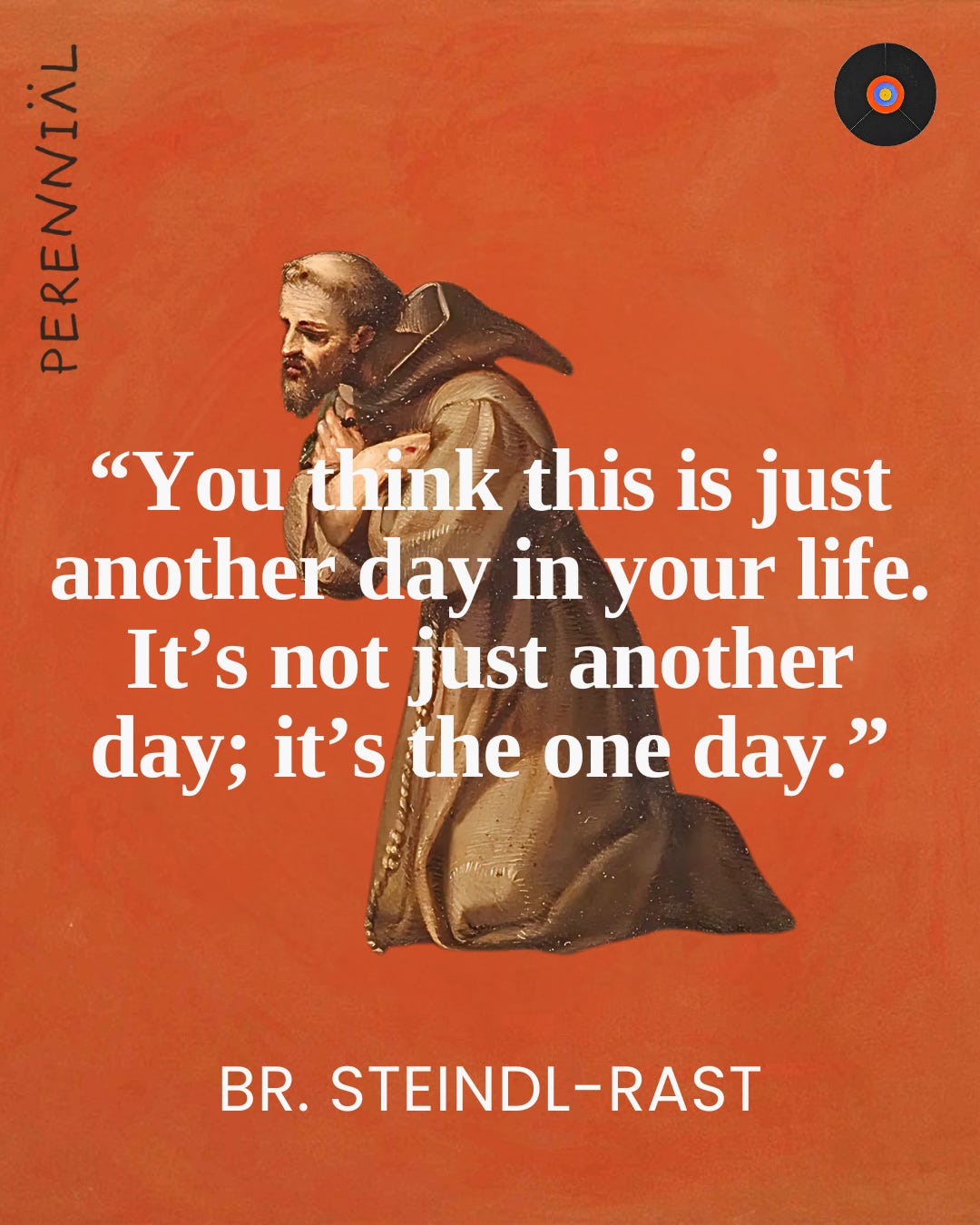
Take this insight from the Benedictine monk Brother David Steindl-Rast,
You think this is just another day in your life. It’s not just another day; it’s the one day. It’s the one day that is given to you today. It’s a gift. It’s the only gift you have right now — and the only appropriate response is gratefulness.
We generally know that “being grateful” is a wise and appropriate response to much of life. Modern researchers, ancient philosophers, and theologians acknowledge its role in the “good” life.
Yet, we often take much of life for granted. We tend to see what we don’t have instead of what we do. Even the great Chinese philosopher Confucius fell into the trap. He observed,
I was complaining that I had no shoes until I met a man who had no feet.
In this episode, we search philosophical and spiritual traditions for lessons on living a grateful life.

1. The Roots of Suffering
Around 2,500 years ago, there lived a man by the name of Siddartha Gautama. He is better known today as the Buddha. But the word Buddha is not a name; it’s a title that means “one who is awake.” The Buddha was born a prince in an ancient kingdom of northern India. As a youth, he was protected by his father in beautiful palaces. But as he grew older, the Buddha encountered what we must all face: “the inevitable sorrows of life.”
No one could tell him why anyone got sick, old, or died. The Buddha eventually left the palace and joined the ascetics (sannyasis) on a journey for answers.
