

Reading & the Good Life
Join the conversation! Every Friday at Noon EST (Join here), Perennial Meditations readers are welcome to gather for Reading & the Good Life. A space for connection, contemplation, and conversations on the art of living! This week we continue our exploration of existential philosophy with The Myth of Sisyphus by Albert Camus.
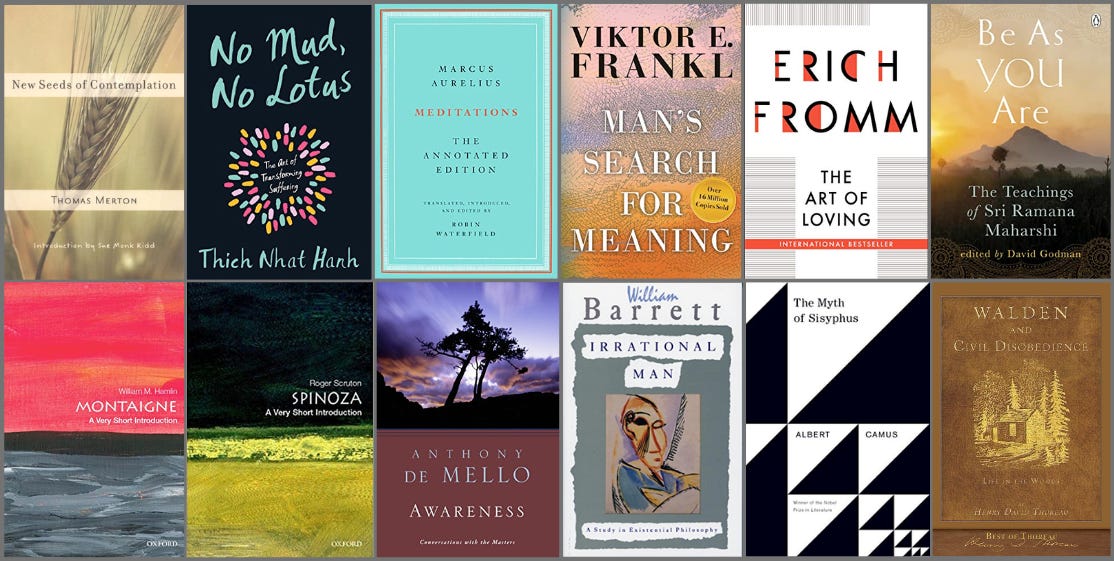
Check out our bookshelf below for previous and future reading!
A Study in Existential Philosophy
As discussed in How to Think Like an Existentialist, How to Be Yourself, How to Think, and Being in the World, and Condemned to Be Free, Existentialism is challenging to define. Existentialist thinkers explored a broad range of issues from meaning, purpose, anxiety and authenticity, freedom, absurdity, and the value of human existence. Among the earliest figures associated with Existentialism include: Søren Kierkegaard, Friedrich Nietzsche, and the novelist Fyodor Dostoevsky. In the 20th century, prominent existentialist thinkers included Jean-Paul Sartre, Albert Camus, Martin Heidegger, and Simone de Beauvoir.
Who is Albert Camus?
Albert Camus (1913—1960) was a French-Algerian journalist, playwright, novelist, philosophical essayist, and Nobel laureate. He spent the early years of his life in North Africa, where he worked at various jobs—at the weather bureau, an automobile-accessory firm, a shipping company—to help pay for his courses at the University of Algiers. He then turned to journalism as a career. His books include The Stranger, The Plague, The Fall, Exile and the Kingdom, and The Rebel. In 1957 Camus was awarded the Nobel Prize in Literature. His sudden death on January 4, 1960, cut short the career of one of the most important literary figures in the Western world. Read previous passages: The Myth of Sisyphus (Part I) and The Myth of Myth of Sisyphus (Part II).
Selected Passages
There always comes a time when one must choose between contemplation and action. This is called becoming a man. Such wrenches are dreadful. But for a proud heart there can be no compromise. There is God or time, that cross or this sword. This world has a higher meaning that transcends its worries, or nothing is true but those worries. One must live with time and die with it, or else elude it for a greater life. […]
— Albert Camus, Myth of Sisyphus
