

Dear Fellow Travelers,
Happy Easter to everyone celebrating this weekend! Today's meditation sits inside this season deliberately.
We are going to spend some time with two men who refused to look away from death: a Roman emperor writing alone in his journal, and a sixth-century monk writing rules for living. Both believed that keeping death close was not pessimism but rather the beginning of wisdom.
Be wise and be well.
J.W.
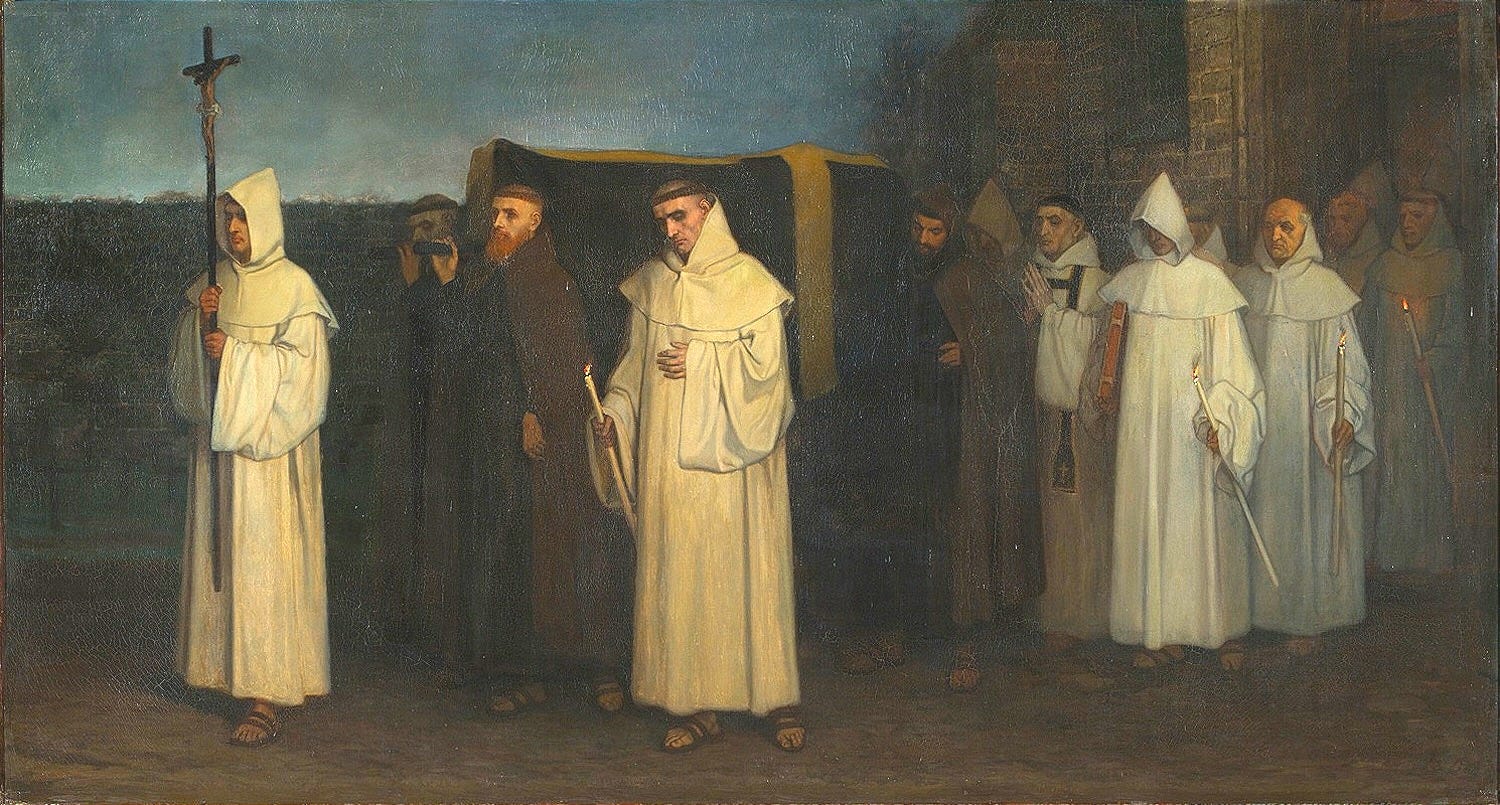
💀 Dying Every Day
Dying Every Day is a podcast by the Perennial Leader Project. Each episode turns a selected passage from Stoic philosophy into a guided meditation designed to help you (and me) learn how to live.
Listen on Apple Podcasts, Spotify, or wherever you listen to podcasts.
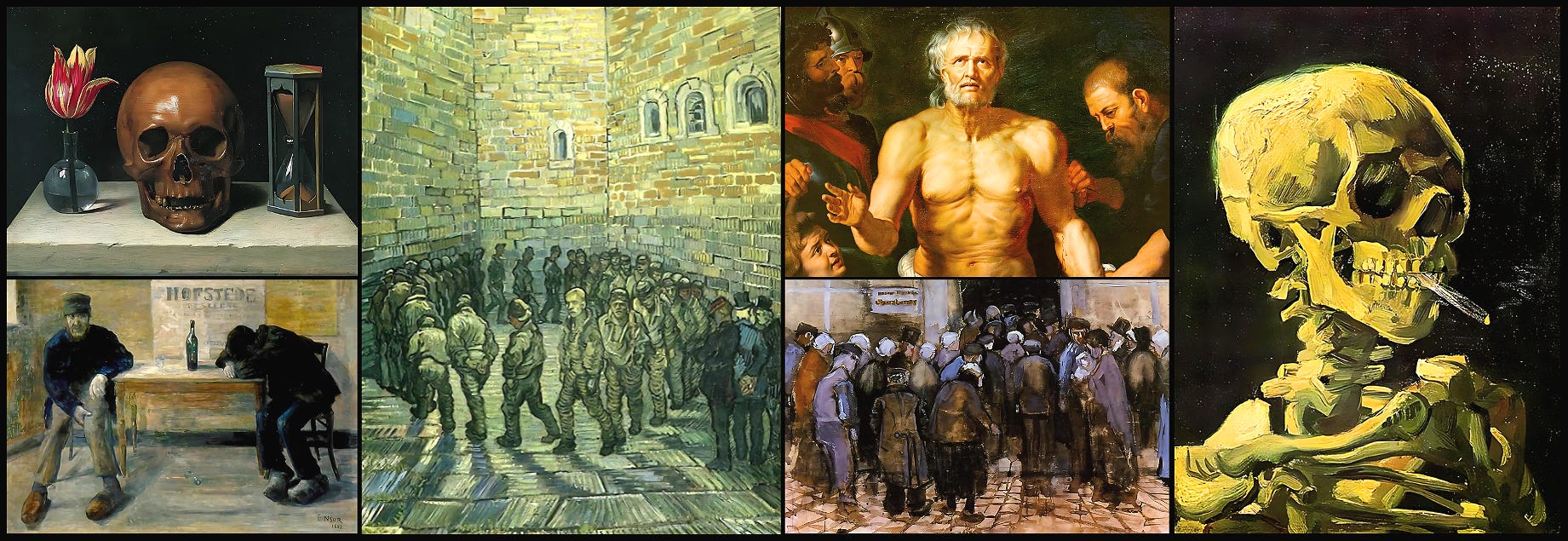
The Instruction No One Wants
Welcome to Dying Every Day. This is Day 140.
“You could leave life right now. Let that determine what you do and say and think.” — Meditations, 2.11
Marcus Aurelius wrote these words to himself—alone, in a private journal, at the edge of a military campaign. Not for publication. Not for us. And in that solitude, he pressed himself toward the one fact of human life that admits no exceptions, no delays, no negotiations: “You could leave right now.”
This is the Stoic practice of memento mori. Not a philosophy of despair but a discipline of attention. Death, held clearly in mind, cuts through everything that doesn’t matter and leaves only what does.
Marcus returned to it again and again throughout the Meditations—different formulations, the same pressure.
Time is short.
The present is all you have.
Do not waste it.
But then, later in the Meditations, Marcus reaches for something unexpected.
“So this is how a thoughtful person should await death: not with indifference, not with impatience, not with disdain, but simply viewing it as one of the things that happen to us. Now you anticipate the child’s emergence from its mother’s womb; that is how you should await the hour when your soul will emerge from its compartment.” — Meditations, 9.3
Stay with that image.
A child emerging from its mother’s womb.
Marcus is not describing annihilation. He is describing a passage—a threshold crossed from one state into another, expected, prepared for, met without violence. The soul emerging from its compartment. Something that has been enclosed is released.
He stops short of saying what it’s released into. He was a Stoic, and the Stoics held their beliefs about what follows death with philosophical humility—perhaps dissolution back into the universal logos, perhaps something else. Marcus does not press the point. What he presses is the quality of the waiting. Not indifference. Not impatience. Not disdain. Simply: this is one of the things that happens to us. Meet it as you would meet any natural threshold.
There is something almost tender in that. A man who governed the Roman Empire, who watched plague and war consume his world, who wrote his private thoughts in a journal he never meant anyone to read—and what he reached for, when he thought about his own death, was the image of a birth.
That image clarifies what Marcus means by letting death determine how you live. He is not asking for grimness. He is asking for the kind of clear-eyed presence that a person has when they know a threshold is approaching—when they understand that what they do now, in the time before the crossing, is the only time they will have to do it.
Death, for Marcus, clarifies.
It sharpens the present into something worth inhabiting.
For the Stoics, memento mori is a way to face death without flinching, without pretending, without the consolation of a clear answer about what comes next. It is enough, Marcus says, to live well now.
Now we turn to another voice. And this voice is not content to leave it there.
“To fear the day of judgment. To be in dread of hell. To desire eternal life with all spiritual longing. To keep death daily before one’s eyes. To keep constant guard over the actions of one’s life. To know for certain that God sees one everywhere.” — St. Benedict, Rule
This is St. Benedict of Nursia, a sixth-century monk and founder of several monasteries. And what he is writing here is a list. A rule. Instruments, he calls them—tools for good living, given to monks as their daily practice.
Notice what surrounds the line about keeping death before the eyes.
Before it: “to desire eternal life with all spiritual longing.” After it: “to keep constant guard over the actions of one’s life. To know for certain that God sees one everywhere.”
St. Benedict is not asking his monks to remember death as a philosophical discipline. He is asking them to hold it inside a complete theological frame—and he names that frame without apology. The day of judgment. Hell. Eternal life. God who sees everywhere, always. These are not metaphors for Benedictine monks. They are not an ambient backdrop. They are the architecture inside which the monk is expected to live every hour of every day.
This is where St. Benedict parts company with Marcus.
For Marcus, death clarifies. It sharpens the present, burns away the trivial, and leaves only what matters. That is its function—a lens, a discipline, an instrument of attention. A human life, well-lived in the light of its own finitude, is sufficient. Virtue is its own reward. The soul emerging from its compartment has done what it came to do.
For St. Benedict, death obligates. And the difference is not merely theological—it is a different understanding of what a human life is for.
The monk does not simply ask: Have I wasted this hour? He asks: Who am I becoming in the sight of God? And beneath that question is another, heavier one: will it be enough? Not enough by his own measure, but enough by the measure of a personal God who has seen him—all of him, the hidden parts especially—and who will one day call that account due.
That is not a comfortable question. St. Benedict does not intend it to be. The dread of hell is named plainly, as a tool—an instrument of good living, placed in the list alongside desiring eternal life, alongside keeping guard over one’s actions, alongside knowing that God sees everywhere.
St. Benedict is not using fear to paralyze. He is using it to wake people up. The same impulse as Marcus—do not sleepwalk through your days — but aimed at a different horizon, and carrying a different weight.
What both men share, across their centuries and their very different worlds, is the refusal to look away. The insistence that death is not a topic to be deferred until it is unavoidable, but a companion to be kept close—consulted daily, woven into the rhythm of the ordinary.
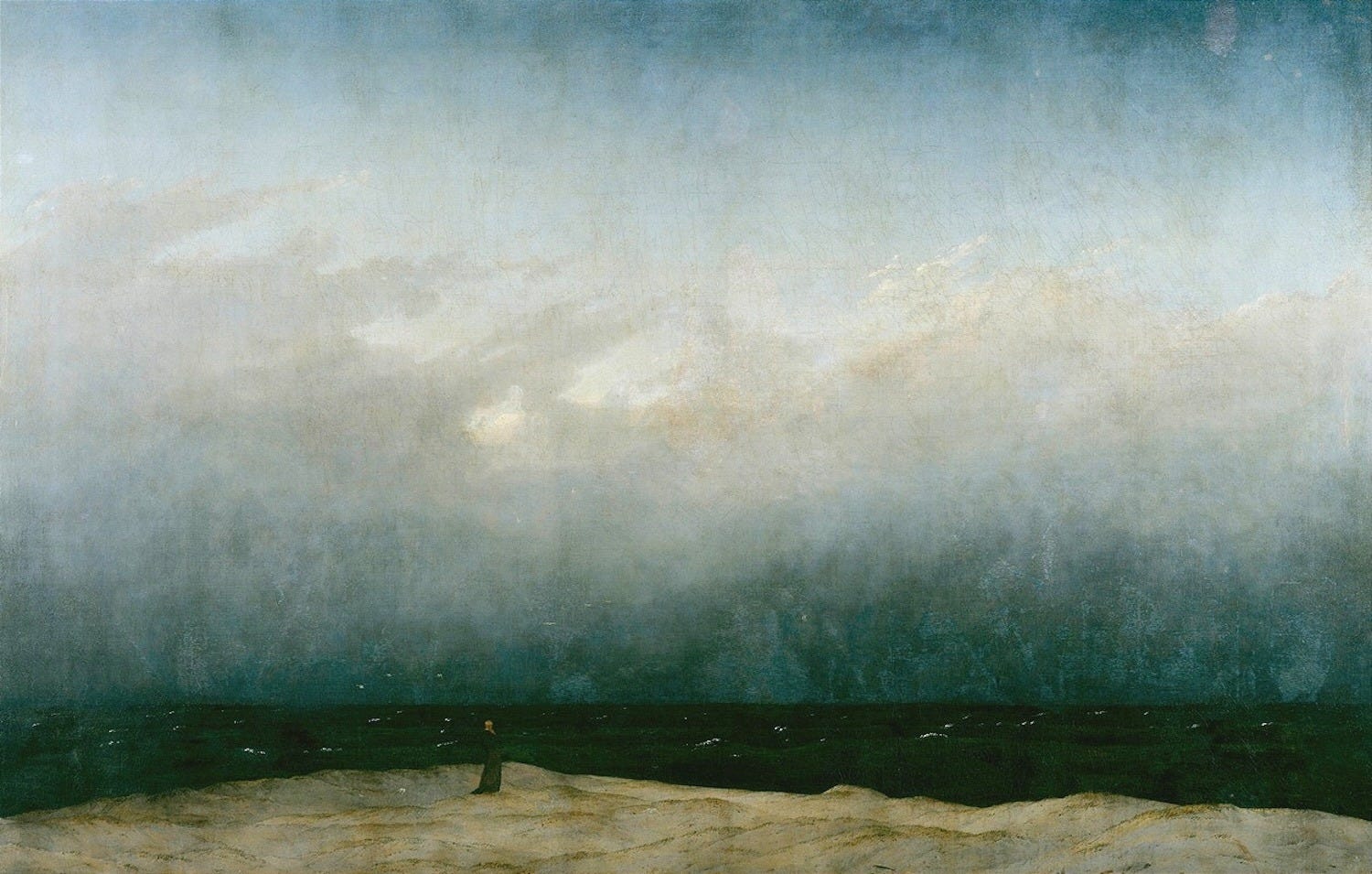
Daily Practice
Today’s daily practice is small and specific.
At some point today—this morning, this afternoon, before you sleep—stop fully. And ask yourself two questions, one from each tradition.
The first is inspired by the words of Marcus Aurelius:
If I could leave life right now, would I be satisfied with how I have spent this day? Not perfectly satisfied. But satisfied in the way a person is who has tried, who has paid attention, who has not squandered what was given.
The second echoes St. Benedict’s passage:
In the sight of God—who sees everywhere, always—how have I kept guard over my life today? Whatever the shape of your faith, let that question carry its full weight. Do not soften it. Let it land.
The distance between those two questions is real. It has not been resolved in two thousand years. You are not asked to resolve it today.
You are asked only to hold both—and in holding them, to practice what Marcus and St. Benedict both knew: that the day you are living right now is the only one you have, and it deserves to be lived as if that were true.
Listen on Apple Podcasts, Spotify, or wherever you listen to podcasts.
—
Thank you for reading/listening; I hope you found something useful.
Until next time, be wise and be well.
J.W.
P.S. Catch up on recent (and past) meditations in the archive!
"...the day you are living right now is the only one you have, and it deserves to be lived as if that were true."
Great comparison of two philosophical perspectives on death. Explaining the difference in perspective, but showing the overlap and critical idea of being mindful to living a virtuous life each and every moment.
To me this moment is our "heaven" our "eternity" right here right now. See it. Live it. Share it.