

💀 Dying Every Day
Dying Every Day is a podcast by the Perennial Leader Project. Each episode turns a selected passage from Stoic philosophy into a guided meditation designed to help you (and me) learn how to live.
Listen on Apple Podcasts, Spotify, or YouTube
The Hard Truth About Virtue
Welcome back to Dying Every Day. This is Day 131.
We live in a world where it’s easy to confuse learning with change. You can binge-watch lectures on Stoicism, highlight the right books, and share quotes about discipline—yet still lose your temper, avoid the hard things, and drift through the day on autopilot. The ancients saw this gap clearly.
Theory without practice, they said, doesn’t just fall short—it fails.
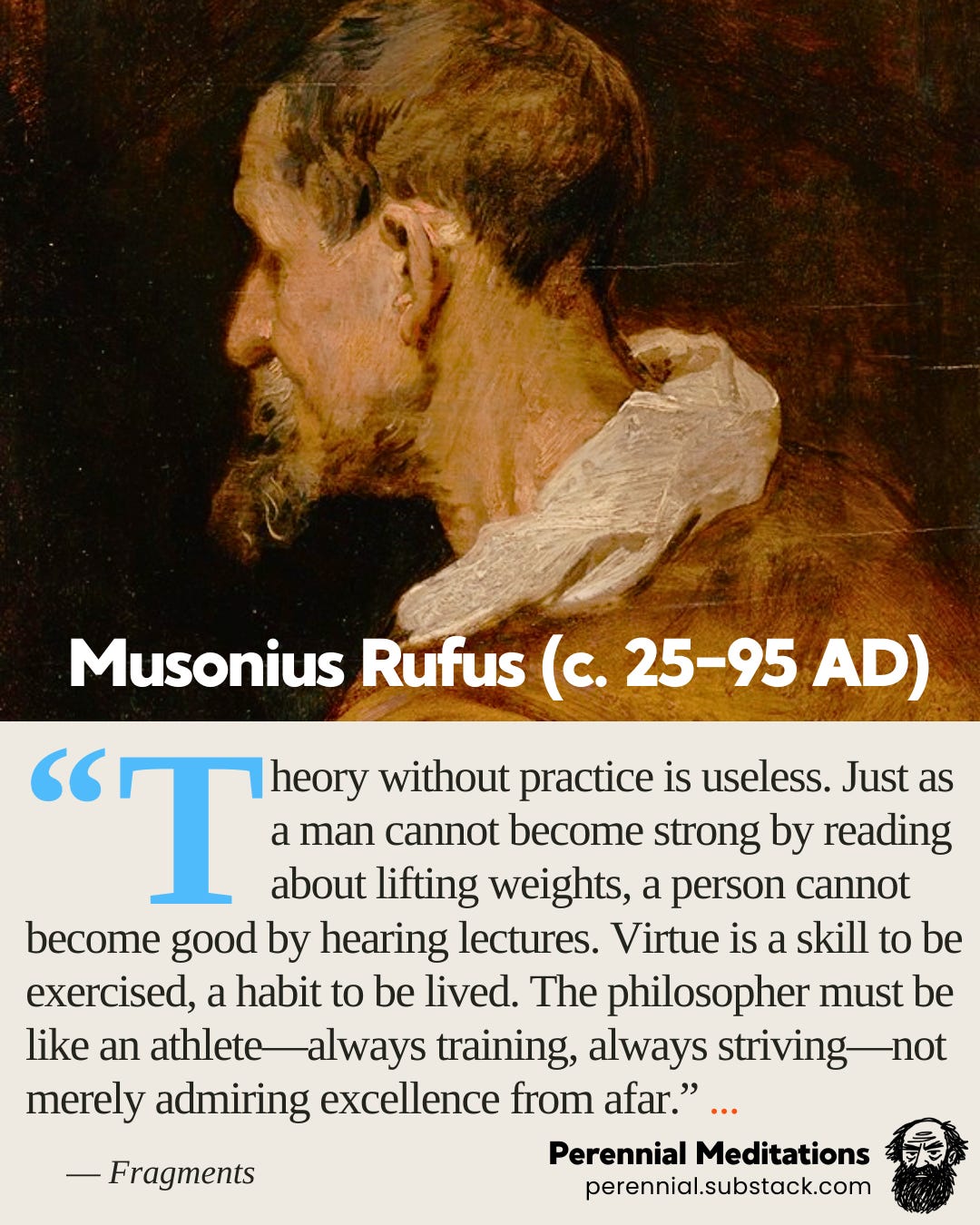
Put simply, you don’t become virtuous by listening to talks on virtue. Virtue is a skill to be exercised, a habit to be lived. If philosophy is to mean anything, it must be treated like training—not entertainment.
Aristotle provides the basic framework: we are what we repeatedly do; excellence is a habit, meaning that excellence emerges from repeated action. You become courageous by choosing courage when fear is present. You become patient by meeting irritation without surrender. Aristotle emphasizes that virtue is not an idea but a trained capacity, formed the same way we learn music or athletics: through consistent, deliberate practice.
Similarly, Musonius Rufus integrates this principle into the fabric of everyday life. Musonius lived what he taught. A Roman philosopher of the first century, exiled multiple times for speaking inconvenient truths, he thought it was absurd to call yourself a philosopher if your life didn’t show it.
He argued that the philosopher must be like an athlete—not merely admiring excellence from a distance, but always training, always striving. Philosophy, for him, was less like attending a lecture and more like stepping onto a practice field.
What does this look like in practical terms? Musonius emphasized that achieving virtue requires engaging in actions that foster virtue.
Want self-control? Then eat simply, drink moderately, and say “no” to unnecessary indulgence.
Want courage? Then accept difficulties and hardships instead of constantly arranging your life to avoid them.
Want justice? Then treat the people in your home, workplace, and neighborhood with fairness in the smallest, quietest interactions.
He believed that even our bodies should be trained for simplicity: a little cold, a little hunger, a little fatigue. Not as punishment, but as preparation. A person who has practiced going without is less ruled by fear when circumstances change. A person who has practiced restraint in ordinary things is less likely to collapse in extraordinary ones.
Musonius was also strikingly inclusive for his time. He argued that women should study philosophy just as seriously as men, because virtue is not a luxury or an ornament—it is the work of being human.
Goodness is not a theory for the few, but a discipline for anyone willing to train.
In this light, your opening line becomes his core principle: he believed that theory without practice is useless. Philosophy that remains on the page is like a training program you never actually do. The philosopher who only listens, agrees, and feels inspired is, in his view, like a spectator sitting in the stands and calling themselves an athlete.
Modern psychology backs this argument up. The American philosopher and psychologist William James wrote about habits as the “flywheel” of character. Our repeated actions—how we respond to frustration, how we manage our impulses, how we speak under pressure—slowly solidify into who we are. You can want to be different. You can understand the theory of being different. But until you practice being different, your habits remain the same.
James would have agreed with Musonius: the will is strengthened by exercise, not by admiration.
Think of a very ordinary test.
You believe in patience.
You like the idea of patience.
Then somebody is rude to you. In that moment, your body heats up, words rise to your tongue, and your old pattern starts to run. This is precisely the kind of situation Musonius would call “training.” If you restrain yourself here—if you choose calm instead of escalation—you have lifted the weight once. Do it again tomorrow and the next day, and gradually, patience shifts from theory to habit.
Musonius would say that the difference between admiring excellence and approaching it is simple: practice. He would ask not what you know, but what you are willing to do, repeatedly, especially when it costs you comfort.
Virtue is a skill. Virtue is a habit.
You don’t drift into it by accident.
You train into it.
Reflection Prompt
Here’s a short daily checklist to get you started:
(1) Ask the question: “If I truly desired virtue today, what would I do?”
(2) Choose one hard thing: Pick a small action you would normally avoid—an honest conversation, a moment of restraint, a bit of discomfort.
(3) Do it deliberately: Treat this one action as your training session.
(4) Evening review: “Did I choose what was easy or what was virtuous?”
Listen on Apple Podcasts, Spotify, or YouTube
—
Thank you for reading/listening; I hope you found something useful.
Until next time, be wise and be well.
J.W.
P.S. Catch up on recent (and past) meditations in the archive!