


🖼️ Monday Muse
The Monday Muse is a weekly collection of reminders, insights, and maxims on the art of living. The term “muse” has two meanings: (1) a state of deep thought; and (2) a source of inspiration. May the following (in a small way) be a source of contemplation, insight, and wisdom to live your highest good.
📌 Perennial Reminder(s)
The American social psychologist and author Jonathan Haidt on happiness hypothesis:
Buddha, Lao Tzu, and other sages of the East discovered a path to peace and tranquility, the path of letting go. They told us how to follow the path using meditation and stillness. Millions of people in the West have followed, and although few, if any, have reached Nirvana, many have found some degree of peace, happiness, and spiritual growth. So, I do not mean to question the value or relevance of Buddhism in the modern world or the importance of working on yourself in an effort to find happiness. Rather, I would like to suggest that the happiness hypothesis be extended—for now—into a yin-yang formulation: Happiness comes from within, and happiness comes from without.
To live both the yin and the yang, we need guidance. Buddha is history’s most perceptive guide to the first half; he is a constant but gentle reminder of the yin of internal work. But I believe that the Western ideal of action, striving, and passionate attachment is not as misguided as Buddhism suggests. We just need some balance (from the East) and some specific guidance (from modern psychology) about what to strive for. […]
Source: The Happiness Hypothesis
📜 Perennial Maxim(s)
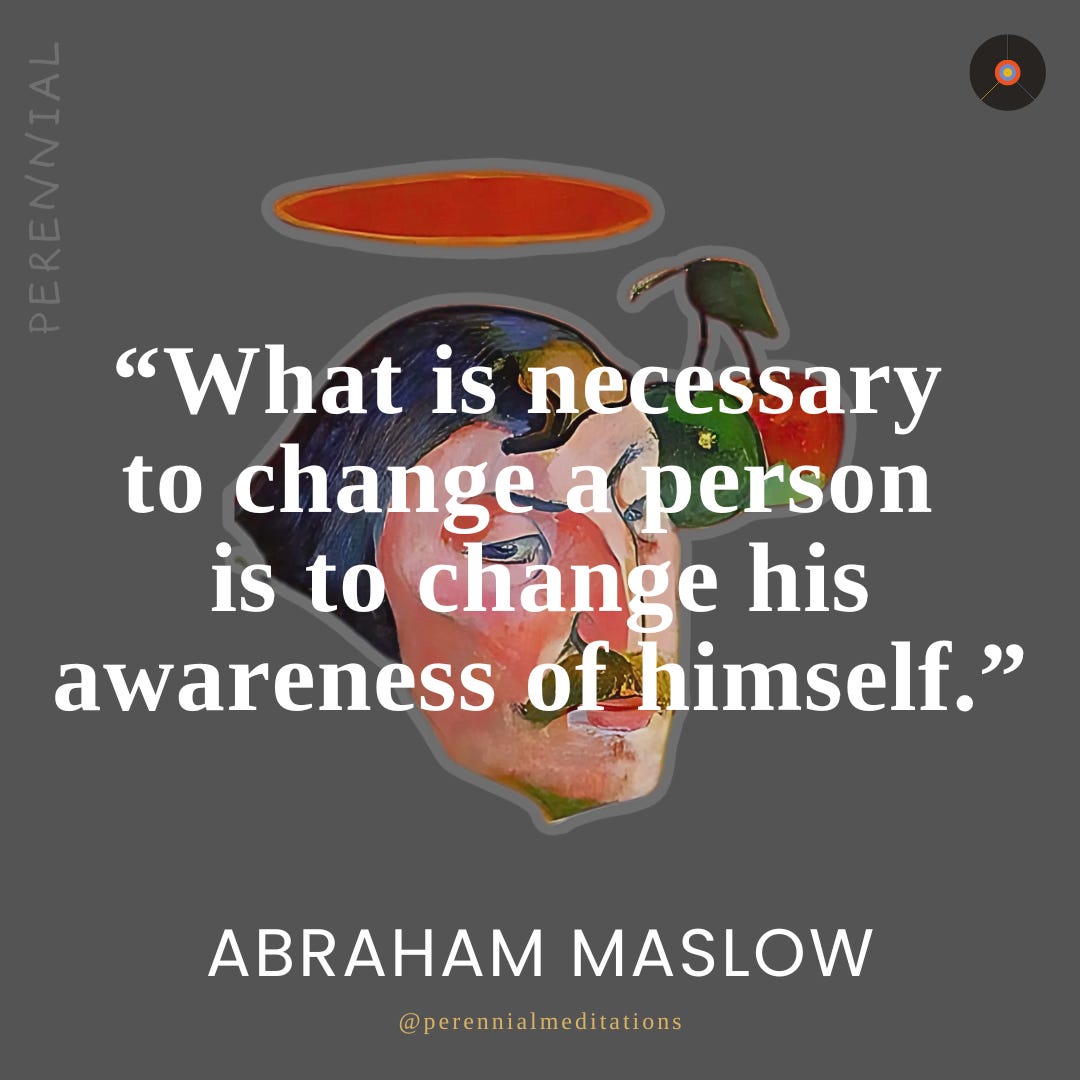
The American psychologist Abraham Maslow (1908—1970) on self-awareness:
Follow Us: Instagram | Youtube
💡 Perennial Insight(s)
The psychotherapist and author Bruce Tift on the positivity bias:
Over and over, we experience the simultaneity of awareness with that which we think, feel, and sense. Awareness, as I’ve mentioned, has no bias. It’s simply open to whatever happens. As it stands, however, most of us are trying to put our thoughts, feelings, and experiences into a context of positivity. …
This bias toward positive emotions, feelings, and experiences is pervasive in Western culture, perhaps especially in America. Many people come to therapy or spiritual work with the unexamined goal of having a life free of disturbance—a “happy” life. … But from the Buddhist point of view, self-improvement is never going to give rise to freedom. …
The content of our lives will sometimes be positive, sometimes negative. … When our circumstances and experiences are held in the context of open awareness, we are not captured or identified with them. We are no longer ‘inside’ the content; rather, we are ‘witnessing’ it within the context of awareness. With that shift in perception, we begin to have a choice about how to relate to our experience. […]
Source: Already Free
—
Thank you for reading; I hope you found something useful.
Until next time, be wise and be well,
J.W. Bertolotti
P.S. If you’re interested in becoming a member but cannot afford it, feel free to request a complimentary membership or use this discount link.