

🖼️ Monday Muse
The Monday Muse is a weekly collection of reminders, insights, and maxims on the art of living. The term “muse” has two meanings: (1) a state of deep thought; and (2) a source of inspiration. May the following (in a small way) be a source of contemplation, insight, and wisdom to live your highest good.
📌 Perennial Reminder(s)
The American philosophers Meghan Sullivan and Paul Blaschko on the good life:
For the ancients, the question was, Can people learn what it takes to have a good life? And if so, is it more like learning how to cook, or learning how to solve a math problem, or learning how to play in a band? The Greeks debated this relentlessly and concluded that happiness is a form of knowledge that combines the intellectual with everyday practices.
Their approach to philosophy is often called virtue ethics. The core idea is that there are goals for a good life, and achieving them requires developing certain habits and traits, which the ancients called virtues. Virtues appear in each domain of day-to-day life (our finances, child-rearing, and approach to education). The ‘ethics’ in virtue ethics is less a fixed system of rules and more like a ‘work ethic’—internal principles that drive you toward something. […]
Source: The Good Life Method (via In Search of Wisdom)
📜 Perennial Maxim(s)
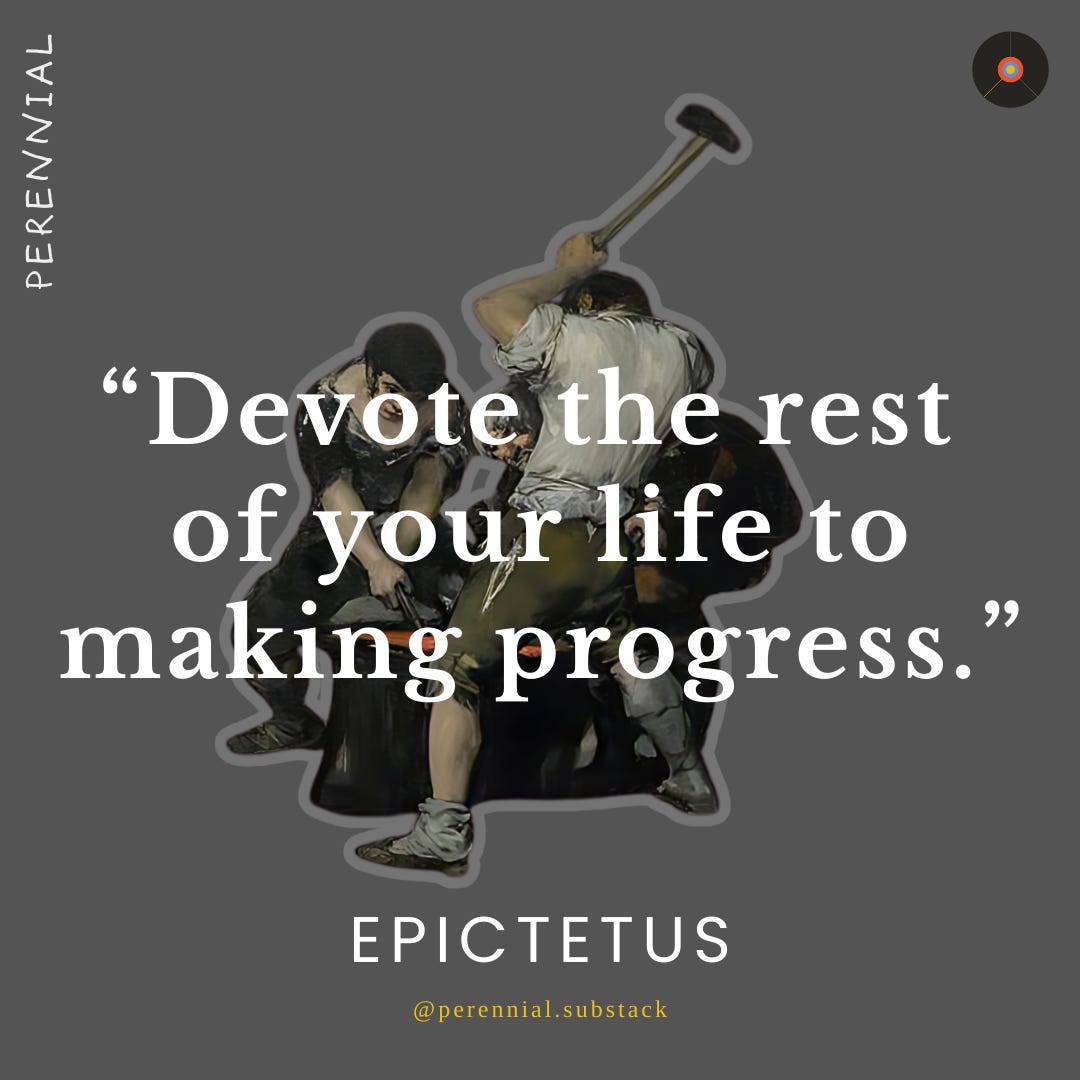
The Stoic philosopher Epictetus (c. 50—c. 135 AD) on making progress:
Follow Us: Instagram | Youtube
💡 Perennial Insight(s)
The English philosopher and writer Sir Roger Scruton (1944—2020) on Spinoza and becoming free:
Spinoza tells us that we are essentially desiring, acting creatures; but he also argues that ‘a desire that arises from reason cannot be excessive’. So long as we conduct our lives by the rule of reason, therefore, we shall be living in accordance with our true nature, and achieving fulfilment. …
The one who lives by the dictates of reason is the ‘free man’ – the person who is active rather than passive in all that involves him. … The ‘free man’, in Spinoza’s view, is a lofty but cheerful character, with no traces of Calvinist gloom. He ‘thinks of nothing less than of death, and his wisdom is a meditation on life, not on death.’ […]
Source: Spinoza: A Very Short Introduction
—
Thank you for reading; I hope you found something useful.
Until next time, be wise and be well,
J.W. Bertolotti
P.S. If you’re interested in becoming a member but cannot afford it, feel free to request a complimentary membership or use this discount link.