

🖼️ Monday Muse
The “Monday Muse” is a weekly collection of reminders, insights, and maxims on the art of living. The term “muse” has two meanings: (1) a state of deep thought; and (2) a source of inspiration. May the following (in a small way) be a source of contemplation and wisdom to live your highest good.
📌 Perennial Reminder(s)
In their book Stoic Ethics, Christopher Gill and Brittany Polat (a recent podcast guest) describe ethical development as follows:
Ethical development, for the Stoics, is not a purely rational or intellectual process, but one that involves all aspects of our psychological life, including our emotions and desires. The Stoics distinguish between ‘emotions’ (or ‘passions’) based on misguided ethical beliefs and ‘good emotions’, which express ethical understanding and virtue. What the Stoics call the ‘therapy’ or cure of misguided emotions is brought about by progress in ethical understanding and in properly conducted relationships with others.
The Stoics regard engagement in family, friendship and community as part of a full human life and they place a positive value on other‑benefiting actions and attitudes. They stress that our concern for others should be extended to those affected by our actions who fall outside our family and social or political context but who form part of the community of humankind. […]
Source: Stoic Ethics: The Basics
📜 Perennial Maxim(s)
The American Trappist monk and writer Thomas Merton (1915—1968) on human nature and rigidity:
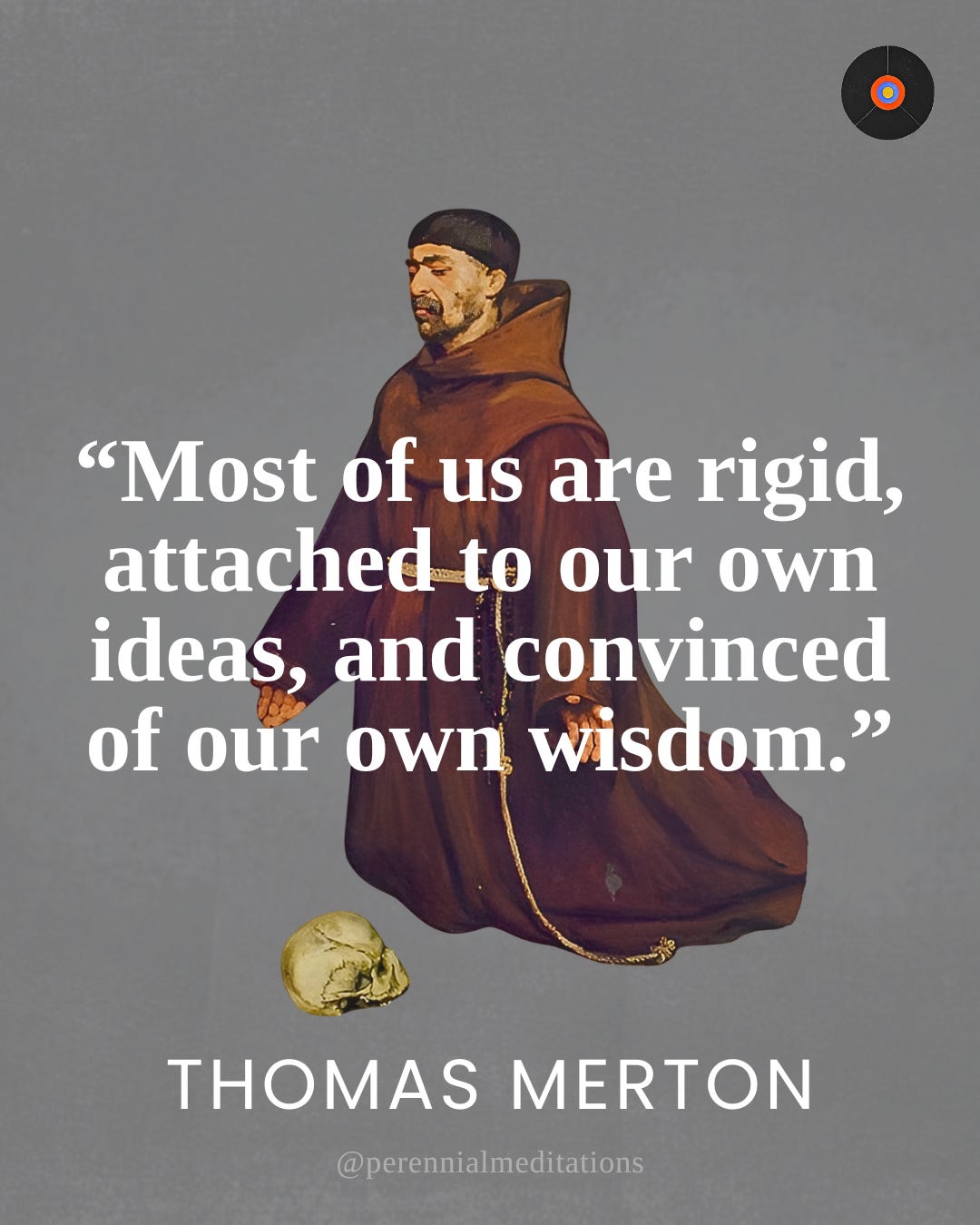
Would anyone describe you as “attached to your own ideas” or inflexible? It’s interesting to consider how comfortable we are with uncertainty. Or, put another way, “How well do I embody the virtue of humility?”
The Stoic philosopher Epictetus stressed to his students that the first step was to let go of conceit (or excessive pride). He observed, “It is impossible for a man to learn what he thinks he already knows.”
Follow: Instagram | Youtube | Notes
💡 Perennial Insight(s)
The French philosopher Michel de Montaigne (1533—1592) on mortality:
We do not know where death awaits us: so let us wait for it everywhere. To practice death is to practice freedom. A man who has learned how to die has unlearned how to be a slave. Knowing how to die gives us freedom from subjection and constraint. …
We are born for action: When I die, may I be in the midst of my work. I want us to be doing things, prolonging life’s duties as much as we can; I want Death to find me planting my cabbages, neither worrying about it nor the unfinished gardening. …
Death is one of the attributes you were created with; death is a part of you; you are running away from yourself; this being which you enjoy is equally divided between death and life. […]
Source: The Essays
💀 Dying Every Day
On a recent episode of Dying Every Day, we discussed the notion of doing less:
Listen to Dying Every Day on Apple Podcasts, Spotify, or YouTube
—
Thank you for reading; I hope you found something useful.
Until next time, be wise and be well,
J.W. Bertolotti
P.S. If you’re interested in becoming a member but cannot afford it, feel free to request a complimentary membership or use this discount link.