


Perennial Wisdom
Perennial Wisdom is a podcast for seekers and curious minds. Each episode explores philosophical and spiritual traditions for universal truths and enduring ideas to help you (and me) never stop learning how to live.
Listen on Apple Podcasts, Spotify, or YouTube
Sinner and Saint: The Paradox of Human Development
Before we begin, it may help to name the kind of territory we’re entering—because this essay (or episode) is all about paradoxes and polarities.
A paradox is two things that seem to oppose each other but are both true. Similarly, a polarity is a pair of truths that don’t cancel each other out—they balance each other.
You experience this every day. You can want independence and connection at the same time. You can feel confident in one moment and insecure in the next. You can love someone deeply and still feel frustrated by them.
Wisdom traditions say this is not a mistake. This is what being human feels like.
The Zen tradition captures the sentiment beautifully in a single line:
“You are perfect just as you are… and you could use a little improvement.”
At first, it sounds impossible.
But it points to something essential:
You are whole—and you’re still becoming.
You are worthy—and you’re unfinished.
You have goodness in you—and you have a shadow too.
Paradox isn’t a problem to solve.
It’s a tension to live in.
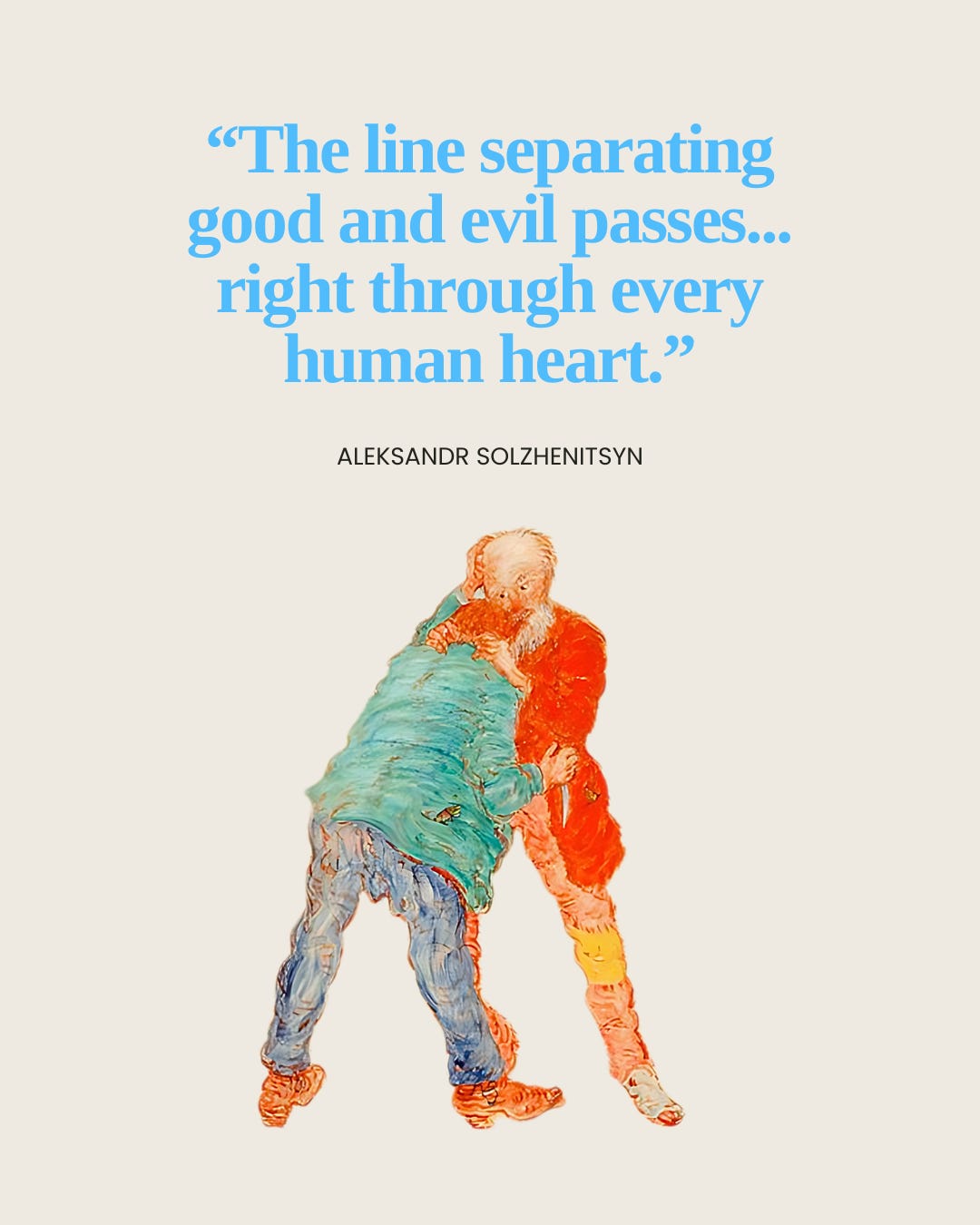
And this is the doorway into today’s episode: the deeper paradox that Aleksandr Solzhenitsyn pointed to when he said the line between good and evil doesn’t run between groups, but straight through every human heart.
Understanding that paradox and learning to hold it may be a crucial step toward becoming wiser.
Listen on Apple Podcasts, Spotify, or YouTube
Episode Transcript
The following is a transcript from “Sinner and Saint: The Paradox of Human Development” on the Perennial Wisdom podcast (Ep. 256).
—
It’s easy to believe the world is divided into two kinds of people when you’re warm, well-fed, and far from consequences.
It’s harder to believe it in a labor camp. Aleksandr Solzhenitsyn—a Russian novelist and dissident who survived the Soviet prison camp system—learned what a human being is when the human being is reduced: when the day is measured in hunger and humiliation, when the air itself feels like an accusation, when fear becomes a kind of weather. In that place, where the system tried to erase the soul, he discovered a truth about it.
We crave simple moral maps.
We want the clean relief of “good people” and “bad people.”
But the real border isn’t out there.
It’s inside.
“The line separating good and evil passes not through states, nor between classes, nor between political parties either—but right through every human heart.”
— Aleksandr Solzhenitsyn, The Gulag Archipelago
The idea doesn’t comfort.
It corrects.
It steals a pleasure from us—the pleasure of innocence, of projecting evil onto strangers, of imagining we are the exception. But it gives something back: a realism that makes repentance possible. If the line runs through every heart, then no one is pure enough to stop examining themselves.
And no one is ruined enough to stop hoping.
This is the paradox at the heart of the human condition: each of us is both sinner and saint. Not in alternating seasons, as if we can time the darkness. But simultaneously—like two currents in the same river.
And the paradox matters now because we live in an age that treats contradiction like a defect. We want identities that feel sealed. We want tribes that feel righteous. We want certainty that never trembles. But wisdom traditions—philosophical, spiritual, and even psychological—suggest that adulthood is the capacity to hold opposing truths without turning them into denial or self-hatred.

1. The Sinner
If the border runs through every heart, then no one gets to be a single story.
Not the visibly “good” person who quietly covets. Not the disciplined person whose discipline hides resentment. Not the helper who still needs to be seen as the helper. Not the wounded person who wounds back.
And not even the person who has done grave harm yet still—somewhere beneath the wreckage—can feel remorse like a small light under a door.
The Apostle St. Paul—a first-century Jewish teacher and early Christian missionary whose letters shaped the moral imagination of the West—sounds less like a theologian than a person whispering the truth after losing the energy to perform:
“I do not do what I want, but I do the very thing I hate… I have the desire to do what is right, but not the ability to carry it out… Wretched man that I am!”
— Romans 7:15–25
He describes the strange experience of wanting goodness with sincerity and still discovering another will inside—an undertow, a reflex, an appetite for the old cheap victories. The torment is not ignorance. It is division.
The Greek philosopher Plato tried to map the soul as carefully as he mapped the city, giving this division a mythic form: the soul as a charioteer pulled by two horses—one that strains upward, one that lunges to the side. It’s a picture of what we know privately: we can mean well and still sabotage; we can love and still manipulate; we can seek truth and still crave to be right.
St. Augustine—a late–Roman-era thinker whose spiritual autobiography remains one of the great studies of desire and self-deception—makes the division tender. The heart wants joy, rest, communion—but reaches for substitutes, then wonders why it stays thirsty.
“Our heart is restless until it rests in You.”
— Augustine, Confessions
Restlessness reveals itself: we were created for more than what we settle for. Even our sins can be misdirected prayers—desire aimed at the wrong target.
This is the sinner’s truth—not that we are cartoon villains, but that we are internally mixed. The line is not simply a moral boundary; it is a daily reality.
And this truth rescues us from two familiar collapses.
One is perfectionism, the belief that goodness means never struggling.
The other is despair, the belief that struggle means you are nothing but brokenness.
The paradox refuses both. It says: you are capable of both harm and holiness. So you must be humble—and you must not give up.
2. The Saint
Most people don’t ruin their lives because they’ve never encountered virtue. They ruin their lives because they couldn’t bear their own complexity.
They tried to become a pure story.
Some choose the story of sainthood: spotless, defended, brittle. Some choose the story of sin: resigned, sarcastic, trapped. Both are evasions. Both are ways of refusing the hard, interior work of integration.
So let’s name what “saint” means here. Not a person without conflict. Not a person without shadow. But a person becoming whole—someone learning to tell the truth about themselves without collapsing, and learning to aim their desire toward what is worthy.
Solzhenitsyn’s border is not a fence you walk past once. It’s a moving line. It shifts with what you feed. A person can be hardened by a thousand small permissions. A person can soften by a thousand small repairs.
St. Thomas Aquinas—a 13th-century theologian who described virtue with remarkable precision—offers a gentle realism that steadies the whole project:
“Grace does not destroy nature, but perfects it.”
— Thomas Aquinas, Summa Theologiae
Grace, at its best, is not spiritual paint over a cracked wall. It is healing. Ordering. Training desire until it can carry love without distortion.
Similarly, the Swiss psychologist Carl Jung warned that what we deny in ourselves doesn’t die; it goes underground—highlighting the danger of refusing this work. What you deny in yourself doesn’t simply disappear. It becomes a shadow—unseen, unacknowledged, and therefore more dangerous. The unacknowledged darkness doesn’t make you pure; it makes you blind.
This is why confession, examination, repentance, and forgiveness recur across traditions. They are not rituals of humiliation. They are practices of truth. They keep the saint from arrogance and the sinner from despair.
A saint who forgets they can fall risks becoming cruel in their certainty. Similarly, a sinner who forgets they can rise may become loyal to their chains.
Holding the paradox is not moral vagueness. It is moral strength: clear-eyed standards, honest self-knowledge, and the refusal to turn anyone—including yourself—into a parody.
3. The Scapegoat
Solzhenitsyn’s insight is personal, but it is not private. If the line between good and evil runs through every heart, then the most dangerous act is pretending it doesn’t—especially when we gather into a crowd.
This is where René Girard—a 20th-century French thinker who studied imitation, rivalry, and the scapegoat mechanism—makes the paradox sharper and darker.
Girard argued that communities often manage tension by finding someone—an individual or a group—who can carry the blame. When fear rises, when rivalry intensifies, when a society feels threatened or ashamed, it searches for relief.
And relief is easiest when it is simple: someone must be responsible.
So the community concentrates its anxiety onto a scapegoat. The scapegoat becomes the explanation for what feels chaotic and humiliating. And once a person or group is assigned that role, something intoxicating happens: the community experiences a rush of unity. The “we” becomes clearer because the “they” has been named.
Scapegoating is a shortcut to innocence. It is moral coherence without self-examination.
It is also the social version of the inner evasion St. Paul describes. Instead of facing the divided self—my mixed motives, my capacity for harm, my appetite for self-deception—we export the conflict. We make the darkness belong somewhere else. And as soon as evil is safely located outside the heart, the conscience relaxes. Contempt becomes easier. Cruelty can feel like virtue.
The genius—and tragedy—of scapegoating is that it often comes dressed in righteousness. It claims to defend the good. It speaks the language of justice. But beneath the slogans, it is often the oldest temptation: to live as saints by declaring someone else the sinner.
Girard’s insight also reframes Solzhenitsyn’s warning. If we ignore the line within, we don’t become pure. We become dangerous. Because the human need for moral clarity doesn’t disappear—it migrates outward.
What we refuse to confront internally, we hunt for externally.
This is why the sinner/saint paradox is more than a spiritual teaching. It is a philosophical discipline. It trains us to resist the ancient pressure of groups: the urge to secure unity through blame.
To hold the paradox is to say:
“I can identify wrongdoing without reducing a person to their worst actions.”
“I can seek justice without claiming my side is innocent.”
“I can stand against harm without needing a scapegoat to feel pure.”
As one might expect, holding the paradox is more difficult.
4. The Integrated Self
Here is the modern problem: our culture is training us out of paradox.
We are rewarded for certainty, outrage, and clear enemies and selves. We are encouraged to declare, perform, and condemn—often faster than we can think.
You can feel it: the rush of righteousness, the thrill of dismissal, the relief of being on the “right side.” It’s a kind of intoxication. And like most intoxicants, it comes with a cost: you stop examining yourself. You stop seeing the human being in front of you. You forget that the line runs through you too.
If Girard explains the social pressure to flee paradox—unity through blame—Robert Kegan helps explain the inner development required to resist it.
Kegan—a Harvard developmental psychologist known for studying how adults grow in complexity—argues that adulthood is not just about gaining information; it involves transforming the way we create meaning. Early meaning-making often combines identity with belonging: good is what “we” approve, and evil is what threatens “us.”
Contradiction feels dangerous because it risks exile. In that mode, a scapegoat is not merely convenient—it feels necessary. Complexity threatens coherence, and coherence can feel like survival.
But growth can lead to a self-authored stance—an internal compass that can withstand disapproval, accept failure without falling apart, and manage complexity without panic. And beyond that, a rarer skill: recognizing your own frameworks as partial, remaining open to correction, and holding opposing values without turning one into a weapon.
In simple terms: A less integrated self needs the world to be clear-cut—saints over here, sinners over there. A more integrated self can whisper: the line runs through me—and that makes me cautious. Not cautious in my beliefs. Careful in judgment. Careful with power. Careful with contempt.
In a culture hooked on certainty and outrage, integration is sobriety. And sobriety has practical consequences.
It teaches us to say:
I can seek justice without claiming perfection.
I can repent without falling into shame.
I can forgive without becoming naive.
This marks the true moral stage of adulthood, and increasingly, it also indicates the presence of moral wisdom.
Final Thoughts
We are living through a crisis of moral imagination.
Not because people don’t care about good and evil—but because we have grown addicted to simple versions of them. We want purity without confession, righteousness without humility, justice without self-examination. And so we keep offering the world scapegoats, as if blame could wash us clean.
Solzhenitsyn rejects that fantasy. “The line runs through you” acts as a safeguard. It is the inner discipline that makes individuals wiser and communities more just.
But it’s important to remember that the integrated self isn't someone who never makes mistakes. It's someone who can admit it, learn from it, and move on—without falling into shame or becoming hypocritical.
And maybe the clearest sign of wisdom is this: when tension rises, and a scapegoat appears, you can pause and remember where the line actually is.
—
Thank you for reading/listening; I hope you found something useful.
Until next time, be wise and be well.
J.W.
P.S. If you enjoyed it, consider supporting the podcast or leaving a rating on Apple Podcasts or Spotify.
This article comes at the perfet time, and I'm honestly wonder-struck by your articulation that paradox isn't a problem to solve but a tension to live in, which brilliantly reframes our continuous human compile-time errors as features of a robust, self-improving system.