

💀 Dying Every Day
Dying Every Day (Stoicism in a Year) is a podcast by the Perennial Leader Project. Each episode turns a selected passage from Stoic philosophy into a guided meditation designed to help you (and me) learn how to live.
Listen on Apple Podcasts, Spotify, or YouTube
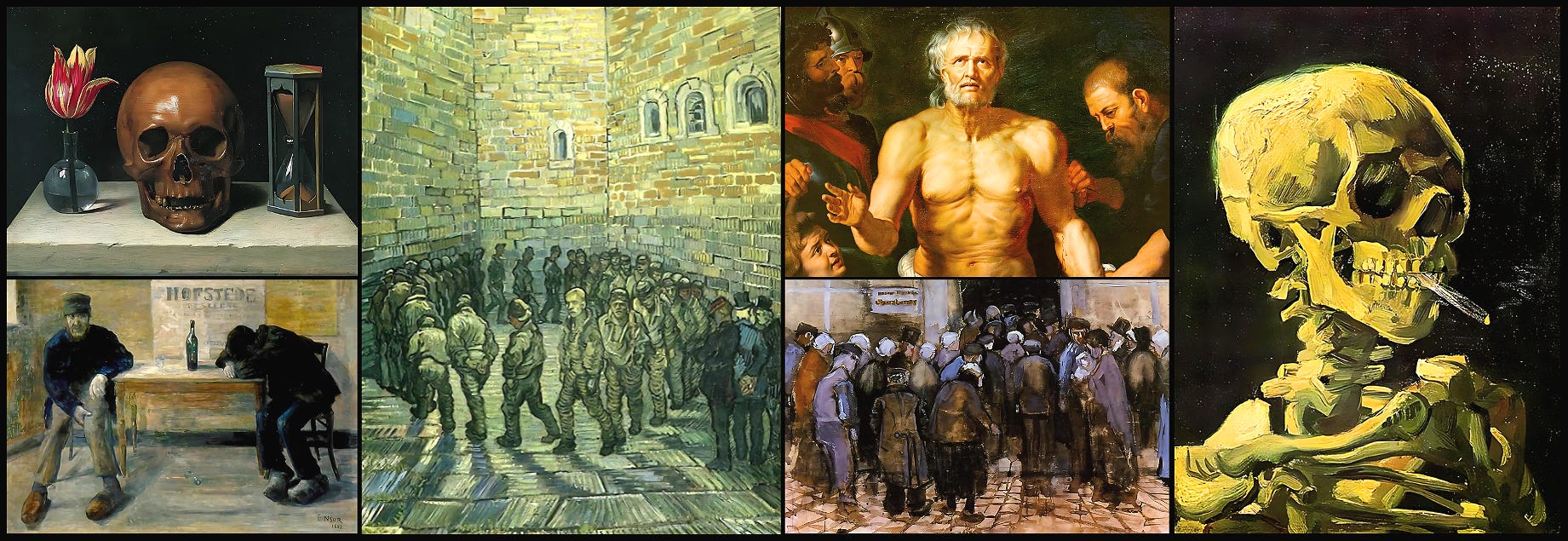
Seneca on the perils of drunkenness
Welcome back to Dying Every Day (Stoicism in a Year). We’ve made it to Day 80, where we’re turning to Seneca for lessons on the perils of drunkenness.
In a letter to his friend Lucilius, Seneca advised,
Zeno, that greatest of men, the revered founder of our brave and holy school of philosophy, wishes to discourage us from drunkenness. Listen, then, to his arguments proving that the good man will not get drunk: ‘No one entrusts a secret to a drunken man; but one will entrust a secret to a good man; therefore, the good man will not get drunk.’
Seneca continued,
How much better it is to arraign drunkenness frankly and to expose its vices! For even the middling good man avoids them, not to mention the perfect sage, who is satisfied with slaking his thirst; the sage, even if now and then he is led on by good cheer which, for a friend’s sake, is carried somewhat too far, yet always stops short of drunkenness. [...]
+Adapted from On Drunkenness
The art of having enough (an idea discussed back on Day 11) applies to various aspects of life. For the Stoics, it’s important to practice moderation and one of the four cardinal virtues (Temperance). Similarly, the idea of “nothing to excess” is one of three Delphic maxims inscribed at the Temple of Apollo.
Embodying these types of ideas can get a little tricky. It requires a degree of self-awareness and wisdom to discern appropriately. To the question, “How much alcohol is too much?” We can reasonably assume a wide array of answers. How about the question, “What is drunkenness?”
The key is to clarify what matters and what doesn’t. Seneca uses “drunkenness” in this example, but the lesson applies to many areas of life.
Reflection Prompt
Consider reflecting (or journaling) on what “nothing to excess” looks like in daily life. You could ask yourself, “How does moderation connect with the good life?” and/or “A question Marcus Aurelius posed to himself: ‘Ask yourself at every moment, Is this necessary?’”
Listen on Apple Podcasts, Spotify, or YouTube
—
Thank you for listening; I hope you found something useful.
Until next time, be wise and be well,
J.W.
P.S. I greatly appreciate your time, attention, and support!