

💀 Dying Every Day
Dying Every Day (Stoicism in a Year) is a daily podcast by the Perennial Leader Project. Each episode turns a selected passage from Stoic philosophy into a guided meditation designed to help you (and me) learn how to live the ‘good’ life.
Listen on Apple Podcasts, Spotify, or YouTube
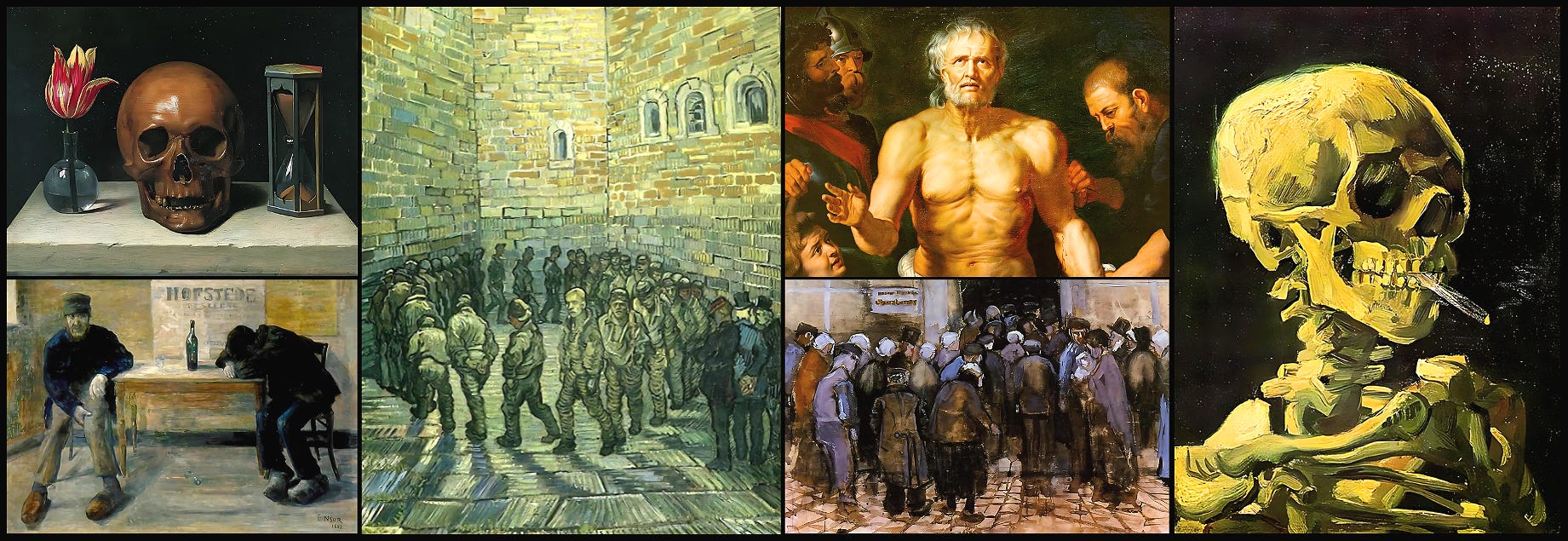
Seneca on the Nature of Virtue
Welcome back to Dying Every Day (Stoicism in a Year). We’ve made it to Day 59, where we’re turning to Seneca for a few thoughts on the nature of virtue.
In a letter to Lucilius, Seneca wrote,
Virtue is not changed by the matter with which it deals; if the matter is hard and stubborn, it does not make the virtue worse; if pleasant and joyous, it does not make it better. Therefore, virtue necessarily remains equal. For, in each case, what is done is done with equal uprightness, with equal wisdom, and with equal honor. Hence the states of goodness involved are equal, and it is impossible for a man to transcend these states of goodness by conducting himself better, either the one man in his joy, or the other amid his suffering. And two goods, neither of which can possibly be better, are equal.
+Adapted from On Various Aspects of Virtue
We explored the cardinal virtues of courage, temperance, wisdom, and justice a couple of weeks ago. (If you missed any of those episodes, I encourage you to go back and listen.) An idea I mentioned in one of those episodes was the unity of virtue, which basically means that although the cardinal virtues have distinct characteristics, you cannot have one without the others.
Seneca raises another counterintuitive idea in today’s passage by explaining that all virtuous acts are equal.
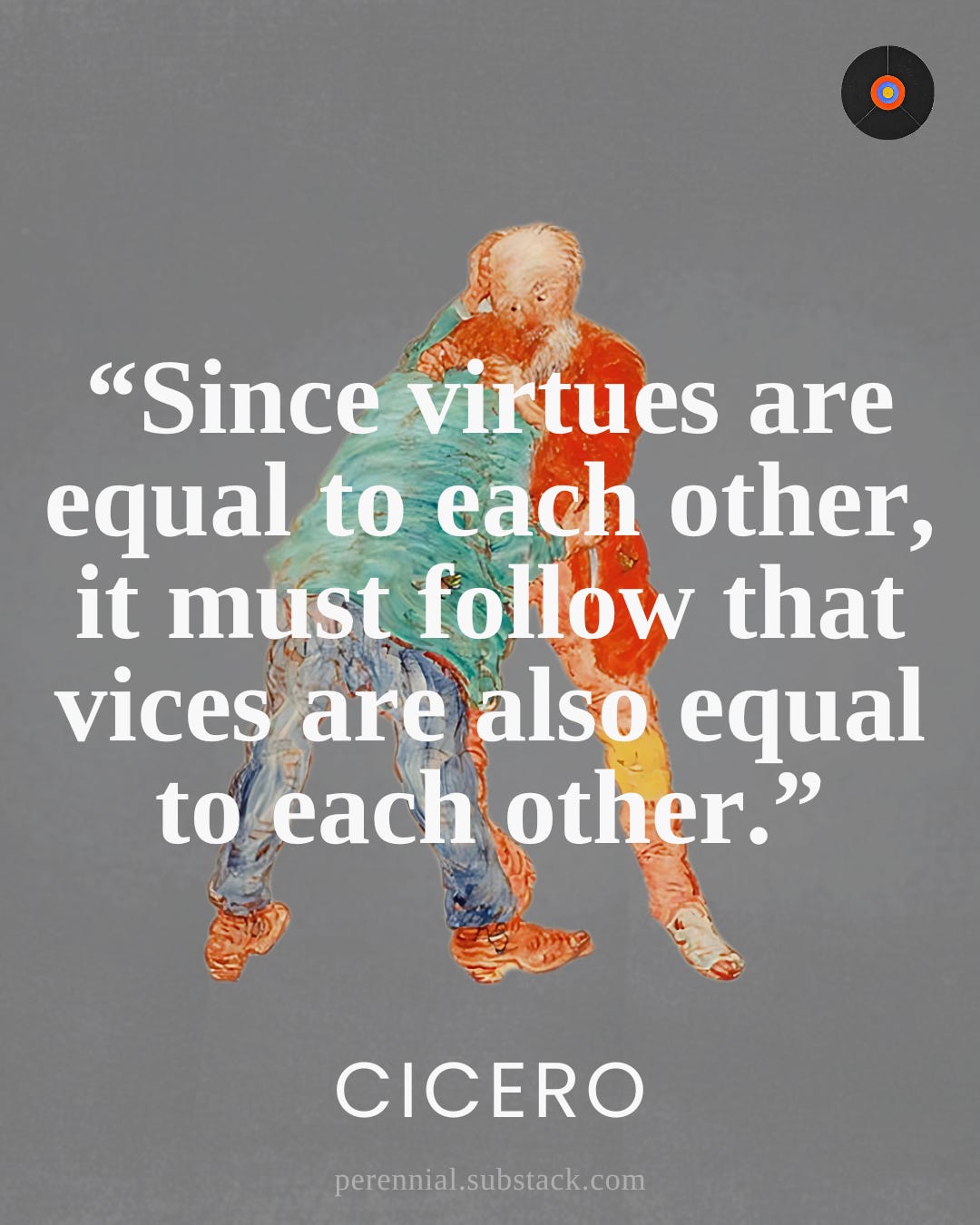
Stoic philosophy contains quite a few paradoxical ideas. The Roman orator and statesman Cicero wrote about six in Stoic Paradoxes. Seneca’s words connect with Paradox III of Cicero’s work, which says, “Misdeeds are equal, and good deeds are equal.”
Cicero explains,
Since virtues are equal to each other, it must follow that vices are also equal to each other. And virtues are indeed equal: it can easily be seen that no one can be better than a good man, nor more temperate than a temperate man, nor more upright than an upright man. … Unified virtue is in accord with reason and perpetual constancy: nothing here can be added to it to make the virtue greater, and nothing subtracted such that the name of virtue is lost.
Reflection Prompt
As a daily exercise, consider reflecting (or journaling) on why the notion of virtues being equal matters. You might ask yourself, How might this idea influence my thinking on the nature of virtue and vice?
Listen on Apple Podcasts, Spotify, or YouTube
—
Thank you for reading/listening; I hope you found something useful.
Until next time, be wise and be well,
J.W.
P.S. I greatly appreciate your time, attention, and support!
So,at times in general one is either good or bad. 😉
Is the reason one person appears more virtuous than another, their ability to properly balance and expand these four virtues each moment?