

💀 Dying Every Day
Dying Every Day (Stoicism in a Year) is a podcast by the Perennial Leader Project. Each episode turns a selected passage from Stoic philosophy into a guided meditation designed to help you (and me) learn how to live.
Listen on Apple Podcasts, Spotify, or YouTube
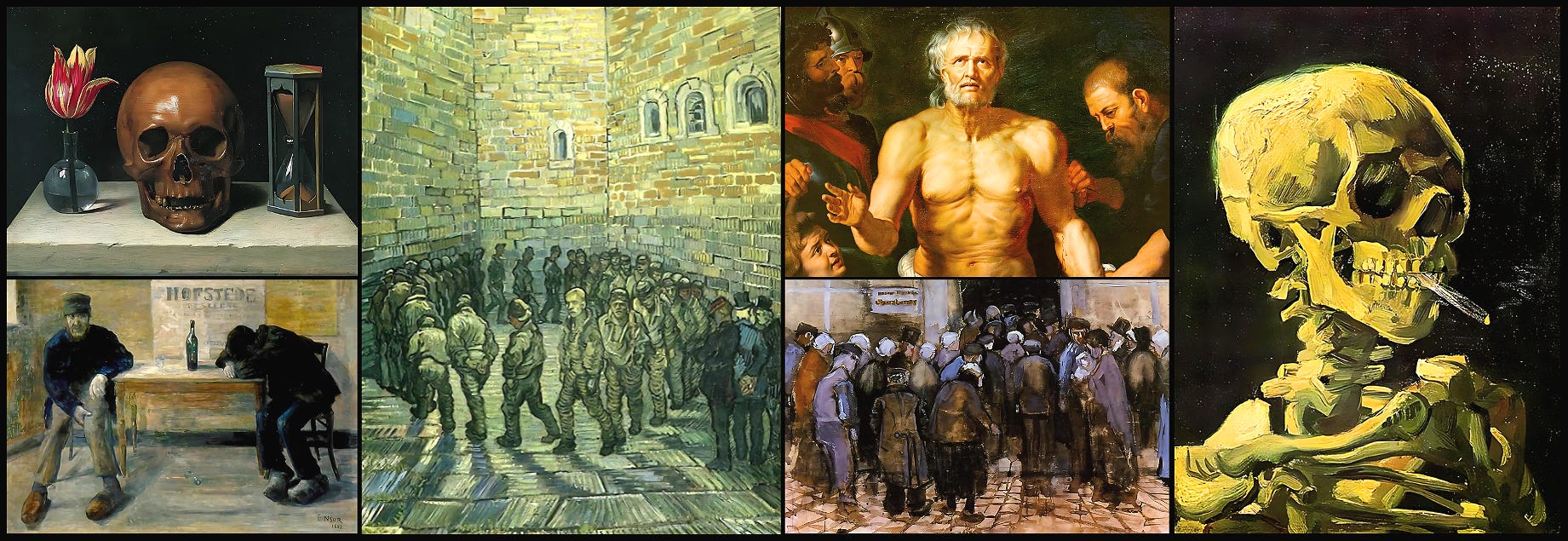
Seneca on guarding the mind
Welcome back to Dying Every Day (Stoicism in a Year). This is Day 120.
Step into a crowded marketplace—or scroll through your social media feed. The noise, opinions, and shifting moods of the masses swirl around you. How long before your focus begins to slip? How long before you find yourself echoing ideas or adopting attitudes you didn’t walk in with?
Seneca knew this feeling well. He wrote to Lucilius,
Do you ask what you should avoid more than anything else? A crowd. It is not yet safe for you to trust yourself to one. I’ll freely admit my own weakness in this regard. Never do I return home with the character I had when I left; always there is something I had settled before that is now stirred up again, something I had gotten rid of that has returned.
In ancient Rome, crowds gathered in the forum, at political assemblies, and in the amphitheater. These places were moments of intense persuasion, entertainment, and sometimes moral chaos. For Seneca, the danger was not just physical. Our moral state is not fixed. Like a flame in the wind, it can be strengthened or snuffed out depending on where we position ourselves.
The “crowd” is more than just a group of people. It is any environment where noise drowns out reason, where distraction overpowers reflection, and where the currency is applause, anger, or fear rather than wisdom. In such spaces, the erosion of character is rarely dramatic. It happens in small concessions: a laugh at the wrong joke, a nod to a false claim, a surrender of patience to frustration.
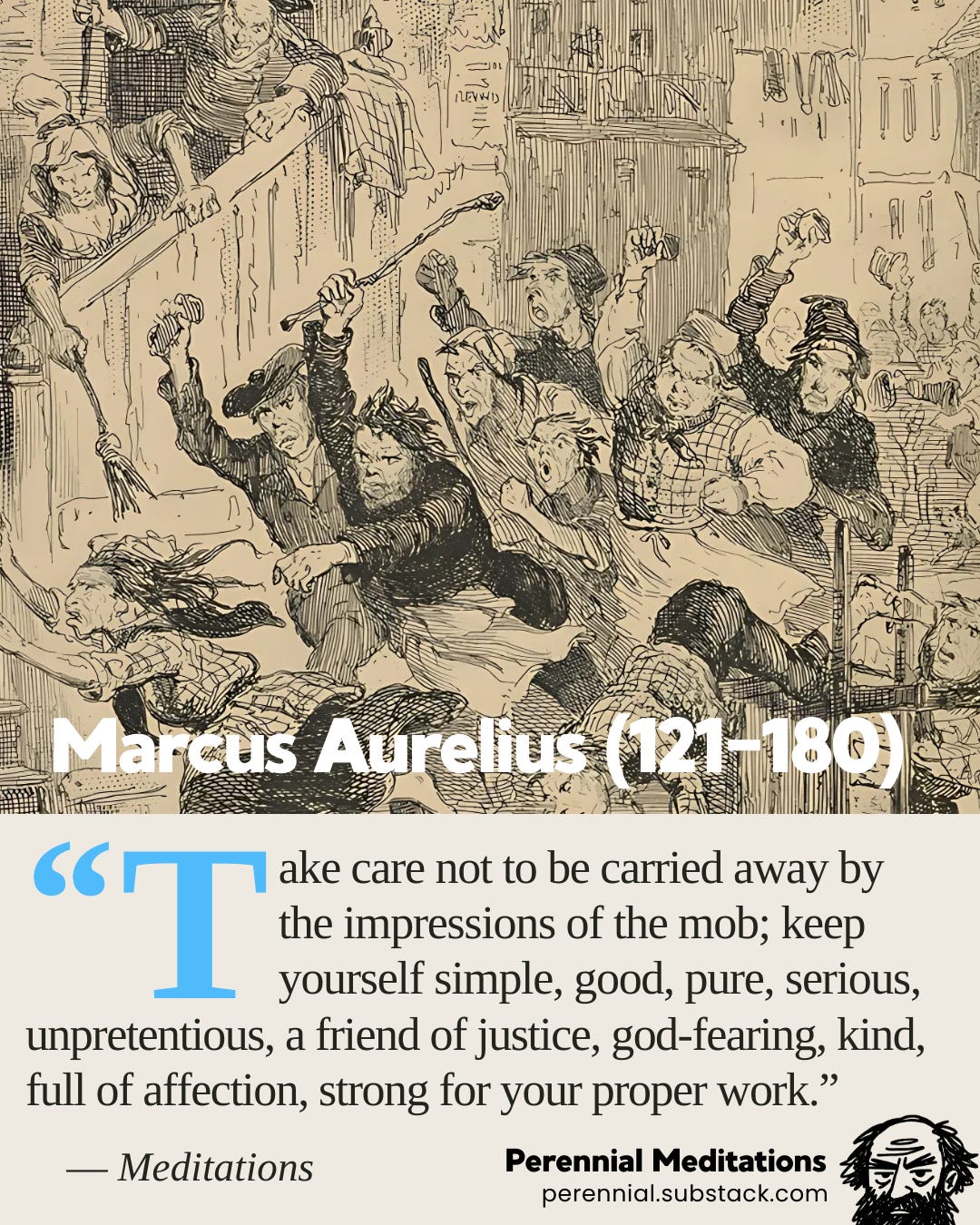
Marcus Aurelius echoed this caution:
Take care not to be carried away by the impressions of the mob; keep yourself simple, good, pure, serious, unpretentious, a friend of justice, god-fearing, kind, full of affection, strong for your proper work.
Both Seneca and Marcus recognized that the true danger isn't being “corrupted” in a single dramatic instance but gradually losing your character without noticing.
Notice Seneca’s honesty and self-awareness: “I’ll freely admit my own weakness in this regard.” Even a philosopher who advised emperors knew that exposure to the wrong influences could unsettle his moral clarity. The wise do not claim immunity; they arrange their lives to guard what is still fragile.
This is not an argument for permanent withdrawal. The Stoic aim is to strengthen the mind until it can enter the crowd without losing itself. As Epictetus advised, avoid dangerous situations until your reasoning is secure. Avoidance, in this sense, is not cowardice—it is preparation.
Today’s “crowds” may be online feeds filled with outrage or news cycles designed to provoke an emotional response. The core principle remains the same: put your own stability first. Build habits of self-awareness, regularly reconnect with what matters, and nurture your ability to think for yourself.
Reflection Prompt
Consider reflecting or journaling on what it means to guard your mind. You could ask yourself, “What ‘crowds’ in my life most tempt me to compromise my better judgment?” Or consider, “How can I strengthen my principles so they remain steady in any environment?”
Listen on Apple Podcasts, Spotify, or YouTube
—
Thank you for reading/listening; I hope you found something useful.
Until next time, be wise and be well.
J.W.
P.S. Catch up on recent (and past) meditations in the archive!
Thanks! I needed this today.
Great article. For me, this is like the chicken and the egg. You don't want to miss living, but you have to develop the discipline to live among the world and retain your values when interacting.