

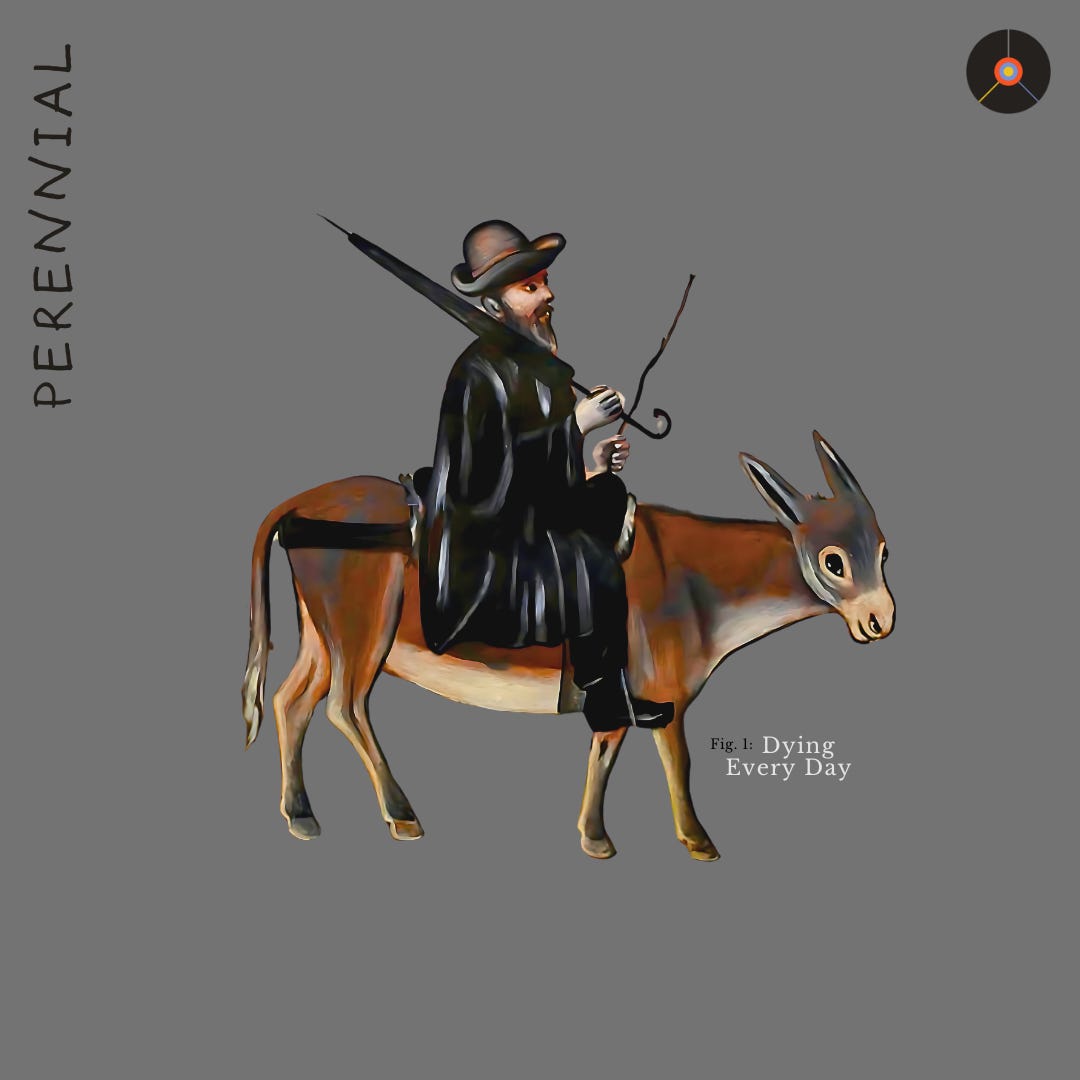
💀 Dying Every Day
The Dying Every Day series delivers guided Stoic meditations on the art of living. Each meditation provides a quote, a selected passage, and a journaling prompt to consider. These meditations are designed to help you (and me) reflect on what it means to live a ‘good’ life.
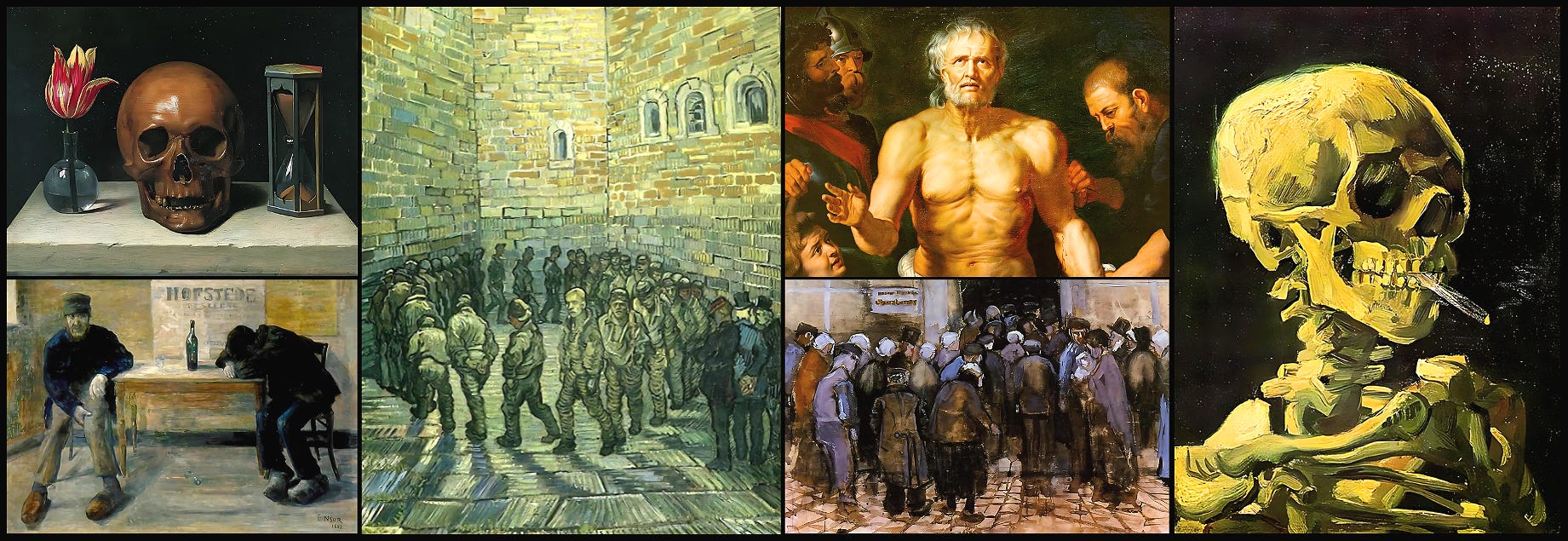
‘Let us postpone nothing. Let us balance life’s account every day.’
Every day and every hour reveal to us what a nothing we are and remind us with some fresh evidence that we have forgotten our weakness; then, as we plan for eternity, they compel us to look over our shoulders at Death. …
But how foolish it is to set out one’s life when one is not even the owner of the morrow! O, what madness it is to plot out far-reaching hopes! To say: ‘I will buy and build, loan and call in money, win titles of honor, and then, old and full of years, I will surrender myself to a life of ease.’
Believe me when I say everything is doubtful, even for prosperous people. No one has any right to draw for himself upon the future. The very thing we grasp slips through our hands, and chance cuts into the hour we are crowding so full.
Yet what is more foolish than to wonder if something that may happen every day has happened on any one day? There is indeed a limit fixed for us, where the remorseless law of Fate has fixed it, but none of us knows how near he is to this limit. Therefore, let us order our minds as if we had come to the end.
Let us postpone nothing. Let us balance life’s account every day.
+Adapted from On the Futility of Planning Ahead (Letter 101)
Reflection Exercise: ‘Enjoying the present’
It’s easy to get swept away into the future—it seems to happen to everyone. But if philosophical (and spiritual) traditions agree on one thing, it is the wisdom of living in the present moment.
The philosopher and classicist Pierre Hadot put it this way in Philosophy as a Way of Life (a previous book from Reading & the Good Life).
Despite the profound differences between Epicurean and Stoic doctrine, we find an extraordinary structural analogy between the experiences of time as it was lived in both schools. This analogy will perhaps allow us to glimpse a certain common experience of the present underlying their doctrinal differences.
We can define this analogy as follows: Epicurean and Stoicism privilege the present to the detriment of the past and, above all, the future. They posit an axiom that ‘happiness can only be found in the present’, that one instant of happiness is equivalent to an eternity of happiness. That happiness can and must be found immediately, here and now.
The call to live in the ‘present moment’ is timeless advice. It reminds us to focus our attention on what truly matters—the here and now. The art of living requires us to “begin at once to live,” as Seneca urged Lucilius, “and count each day as a separate life.”
Journaling Prompt
Consider reflecting (or journaling) on these question(s): ‘What meaningful tasks are you postposing?’ ‘How can you remember that happiness (and life) is found in one place—the present moment?’
Follow Us: Instagram | Youtube
—
Thank you for reading; I hope you found something useful.
Until next time, be wise and be well,
J.W.
P.S. New here? Catch up on previous volumes in the archive!
Love it