

🖼️ Monday Muse
The “Monday Muse” is a weekly collection of reminders, insights, and maxims on the art of living. The term “muse” has two meanings: (1) a state of deep thought; and (2) a source of inspiration. May the following (in a small way) be a source of contemplation and wisdom to live your highest good.
📌 Perennial Reminder(s)
There is something within man that is wiser than himself.
— Plotinus, Enneads
Plotinus, the Neoplatonist philosopher, held that every person has a higher part of the soul—“wiser than ourselves”—that remains unaffected by fear or confusion. This aspect is not driven by logic or ego but is characterized by stillness. It does not react but radiates.
For Plotinus, this higher self is our most genuine connection to the divine.
The Stoics expressed a similar idea. Epictetus referred to it as our ruling faculty and emphasized that, when disciplined and clear, it remains unconquered by external influences.
The Roman emperor Marcus Aurelius wrote to himself,
Dig inside yourself. Inside there is a spring of goodness ready to gush at any moment, if you keep digging.
When uncertain, we tend to look outside ourselves—toward experts, algorithms, books, or friends. The next time you’re unsure or torn, pause for a moment. Close your eyes, take a deep breath, and shift your focus inward. What emerges might not be a clear answer, but it can often point you in the right direction.
You don't need to believe every voice in your head, but it's important to remember that inner wisdom exists within us all.
📜 Perennial Maxim(s)
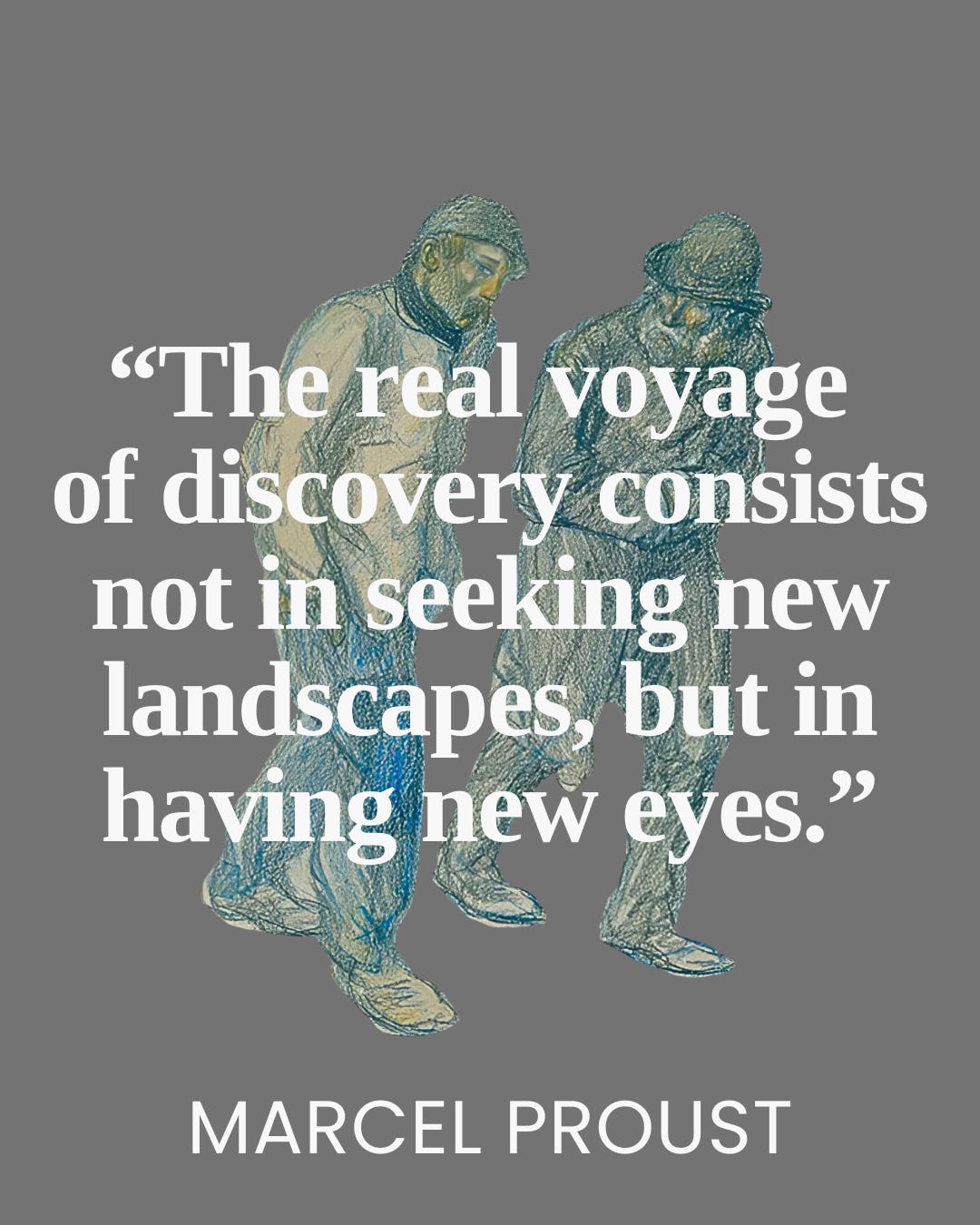
We often believe that meaning, beauty, and insight are found elsewhere—in exotic locations, new experiences, or profound changes. But the French novelist Marcel Proust (1871—1922) suggests that reality already holds endless depth and wonder—if only we can see it:
Follow: Instagram | Youtube | Notes
💡 Perennial Insight(s)
We must reserve a little back-shop, all our own, entirely free, in which to establish our true liberty and principal retreat.
— Michel de Montaigne, Essays
The world is noisy—not just with sound, but with demands, opinions, and constant interruptions. Over time, it's easy to feel fragmented and lose your sense of self.
Montaigne, a French philosopher and statesman from the 16th century, recognized this long before the digital era. While serving in public office, he encouraged individuals to develop a “back-shop” of the soul—an inner space to detach from worldly chaos.
This space, he said, should be protected—not out of selfishness, but because without it, we risk losing ourselves. If you never return to your own mind, how will you know what you truly think? If you never retreat from the crowd, how will you hear the quiet truths that rise in solitude?
This space isn’t about isolation. It’s about refuge.
However, this “room” doesn’t create itself. It requires deliberate selection, furnishing, and regular return. It can be as straightforward as spending ten minutes in silent sitting, taking a long walk without your phone, or dedicating time to write for yourself, not for anyone else.
Make a room within. Protect it. And let that be the place from which your life flows outward.
🎧 Latest Podcast(s)


—
Thank you for reading; I hope you found something useful.
Until next time, be wise and be well.
J.W. Bertolotti
P.S. Catch up on recent (and past) meditations in the archive!
Truly wonderful essay! And it speaks to a truth that we usually find in the religious traditions. It also deals with the issue of who are “we?“ Who am I really? And of course follows nicely, your essay on Heraclitus and his thoughts about change. How we are always changing therefore the “we“ of who we are is always changing. Thank you so much!