

🖼️ Monday Muse
The Monday Muse is a weekly collection of reminders, insights, and maxims on the art of living. The term “muse” has two meanings: (1) a state of deep thought; and (2) a source of inspiration. May the following (in a small way) be a source of contemplation, insight, and wisdom to live your highest good.
📌 Perennial Reminder(s)
The British philosopher and writer A.C. Grayling on philosophy as ‘health of the soul’:
All the schools of thought after Socrates agree with him that the good and worthwhile life is one that is consciously chosen on the basis of reason. Like him, therefore, the teachers and adherents of these schools accept the assumptions that we are free to choose, that we can change ourselves, and that there are things worth doing and being in life. …
What especially impressed Socrates’ followers was that his view of happiness, ‘the health of the soul’, was – as this phrase itself implies – radically internalist, a perspective which led some, not least Epicurus, to treat philosophy as a practical therapy for the soul. In their writings, Plato and Xenophon both emphasized Socrates’ ability to master the appetites that are a source of disturbance for most other people – appetites for food, comfort, and sex – because they are chief among the drivers of bad conduct. […]
Source: Philosophy and Life
📜 Perennial Maxim(s)
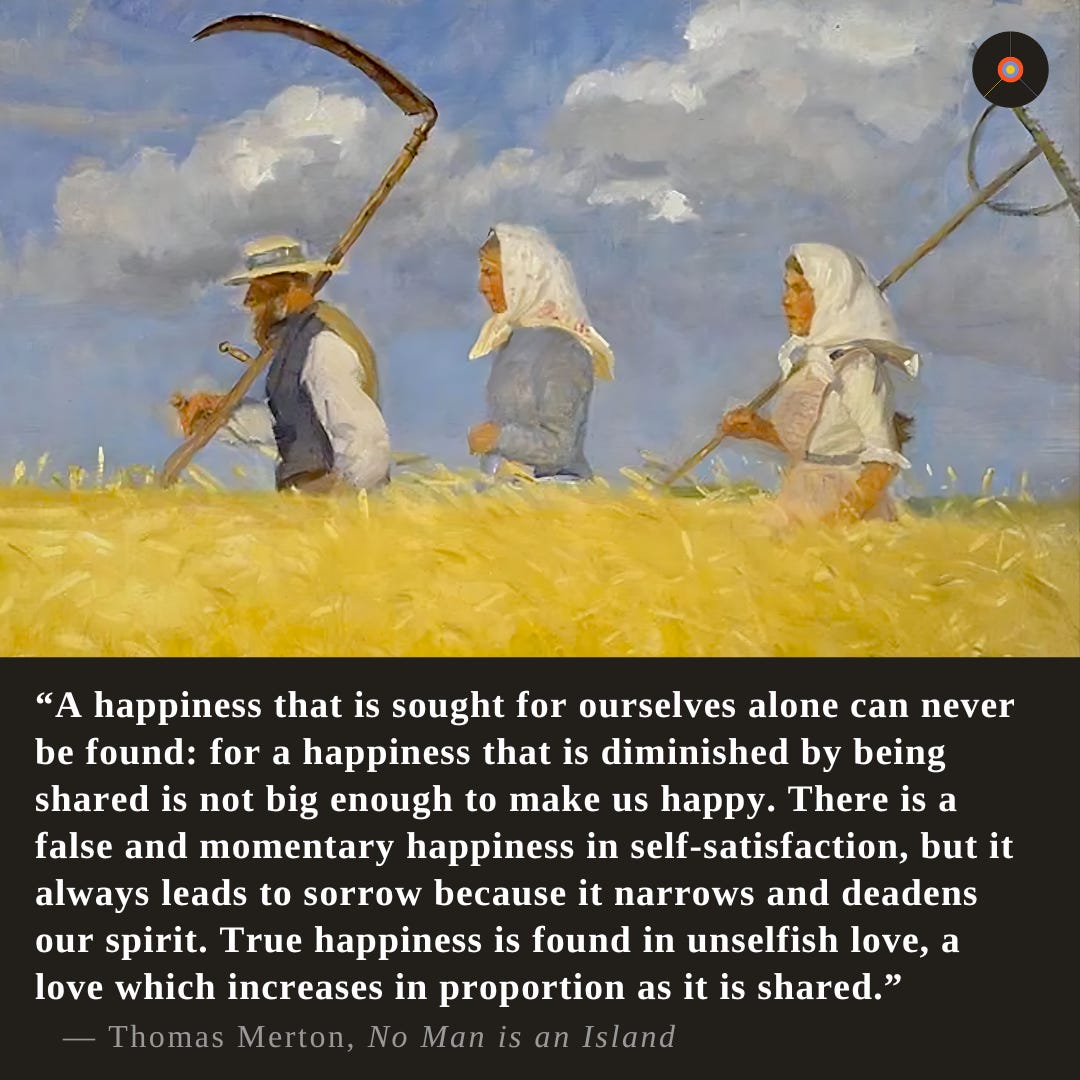
The American Trappist monk Thomas Merton (1915—1968) on true happiness:
Follow us: Instagram | Youtube
💡 Perennial Insight(s)
The French philosopher Gabriel Marcel (1889—1973) on the perils of pride:
The metaphysical problem of pride—hubris—which was perceived by the Greeks and which has been one of the essential themes of Christian theology, seems to me to have been almost completely ignored by modern philosophers other than theologians. It has become a domain reserved for the moralist. Yet from my own standpoint it is an essential—if not the vital—question. It is sufficient to recall Spinoza’s definition of superbia in his Ethics to see how far he was from grasping the problem: ‘Pride is an exaggeratedly good opinion of ourselves which arises from self-love.’
In reality, this is a definition of vanity. As for pride, it consists in drawing one’s strength solely from oneself. The proud man is cut off from a certain form of communion with his fellow men, which pride, acting as a principle of destruction, tends to break down. Indeed, this destructiveness can be equally well directed against the self; pride is in no way incompatible with self-hate; this is what Spinoza does not seem to have perceived. […]
Source: The Philosophy of Existence
—
Thank you for reading; I hope you found something useful.
Until next time, be wise and be well,
J.W. Bertolotti
P.S. If you’re interested in becoming a member but cannot afford it, feel free to request a complimentary membership or use this discount link.