

💀 Dying Every Day
Dying Every Day (Stoicism in a Year) is a podcast by the Perennial Leader Project. Each episode turns a selected passage from Stoic philosophy into a guided meditation designed to help you (and me) learn how to live.
Listen on Apple Podcasts, Spotify, or YouTube
Musonius Rufus on virtue and practice
Welcome back to Dying Every Day (Stoicism in a Year). This is Day 108.
Musonius Rufus—teacher of Epictetus and one of the clearest moral voices in the Stoic tradition—believed philosophy should not remain in books or lecture halls. It was a way of life. He often taught that the point of philosophy was not to appear wise but to become good. And that, he insisted, takes effort.
In this short passage, Musonius connects virtue and practice:
No man becomes good by accident. Virtue is the result of long practice, continual self-examination, and persistent effort. Just as one becomes skilled at music or medicine through training, so too does one become just or courageous. One must act as a good man would act, not only when it is easy or convenient, but when it is hard, painful, or thankless. In the end, the labor of virtue is lighter than the burden of vice.
We often admire virtues like integrity, courage, patience, and wisdom, assuming they are innate traits. However, Musonius teaches us that goodness is not accidental. People do not stumble into virtue; they attain it through deliberate training.
The analogy with music or medicine is straightforward. No one anticipates mastering the violin or performing surgery proficiently without extensive study and practice. Similarly, we shouldn't expect to remain calm under pressure, be generous in conflicts, or stay honest when tempted, without some form of ethical training.
Musonius warns that this is a risky misconception.
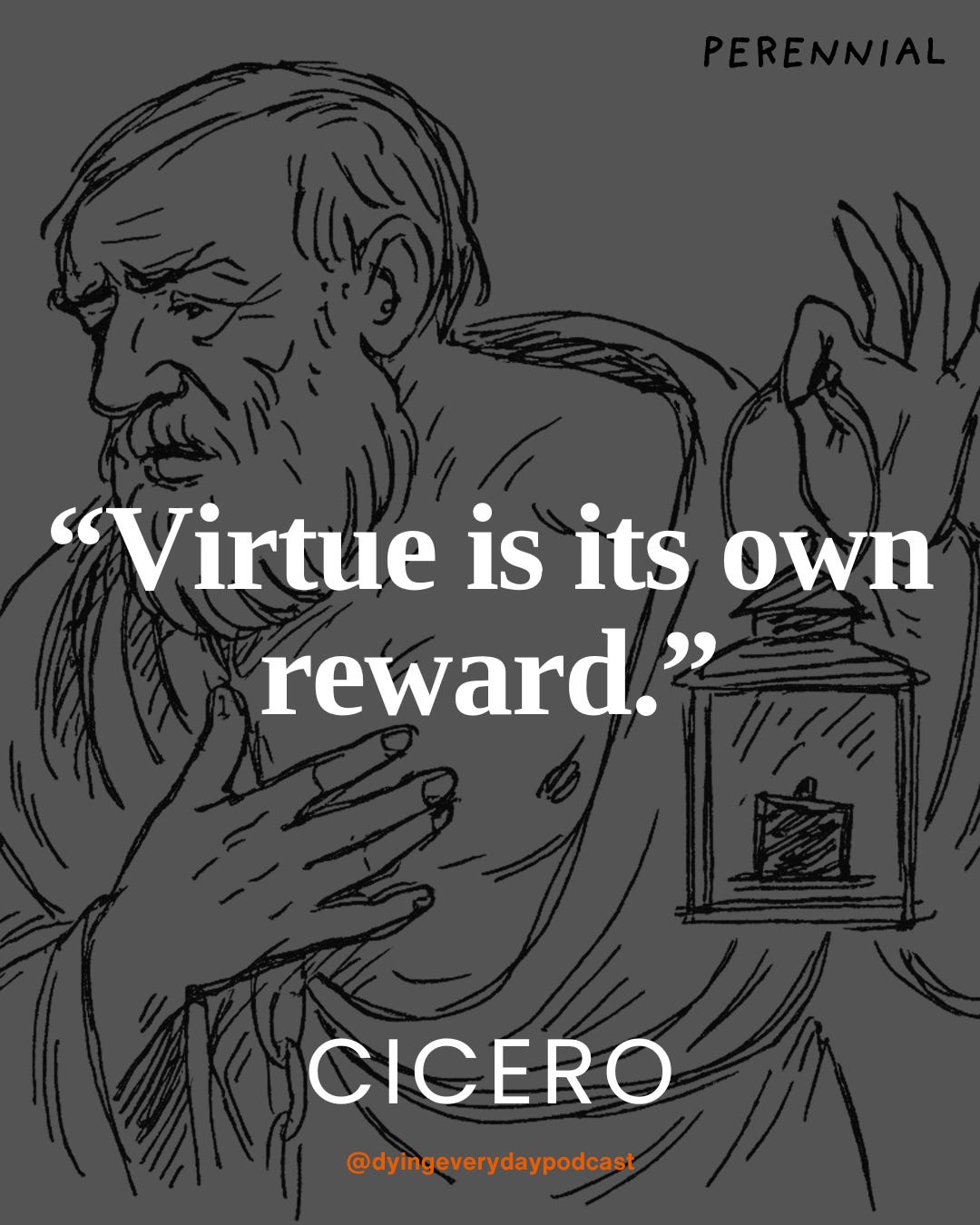
Virtue is not something we merely “believe in.” It is something we do—especially when it’s uncomfortable. “One must act as a good man would act,” he says, even when it’s “painful or thankless.” That’s the real test. It’s easy to be kind when people are watching, generous when you feel secure, or brave when there’s applause. But, as Cicero put it, “virtue is its own reward.”
And yet, the Stoics did not praise struggle for its own sake. Musonius presents a paradox: “The labor of virtue is lighter than the burden of vice.” While vice may seem to offer ease, it incurs hidden costs such as guilt, addiction, regret, and anxiety. The fleeting relief from effort ultimately becomes a lasting burden.
Virtue, though demanding, lightens over time. It clears the conscience. It strengthens the will. It makes us more dependable, more resilient, more free. Over the long arc of life, the virtuous path turns out to be the easier one.
Musonius practiced what he preached. He was exiled multiple times and lived simply, often choosing hardship over comfort. But he was never bitter—because he had trained himself in the discipline of right action.
That’s what Stoicism offers: not perfection, but preparation. We don’t wait to feel virtuous. We practice virtue, again and again.
Reflection Prompt
Consider reflecting or journaling on how you think about the virtue of practice. You could ask yourself, “What would my life look like if I treated ‘virtue’ as a craft worthy of mastering?” And/or “What small action today could be my training ground for virtue?”
Listen on Apple Podcasts, Spotify, or YouTube
—
Thank you for reading/listening; I hope you found something useful.
Until next time, be wise and be well.
J.W.
P.S. Feel free to catch up on the previous episodes of “Dying Every Day” below:
Thank you!
Excellent!