

💀 Dying Every Day
Dying Every Day (Stoicism in a Year) is a podcast by the Perennial Leader Project. Each episode turns a selected passage from Stoic philosophy into a guided meditation designed to help you (and me) learn how to live.
Listen on Apple Podcasts, Spotify, or YouTube
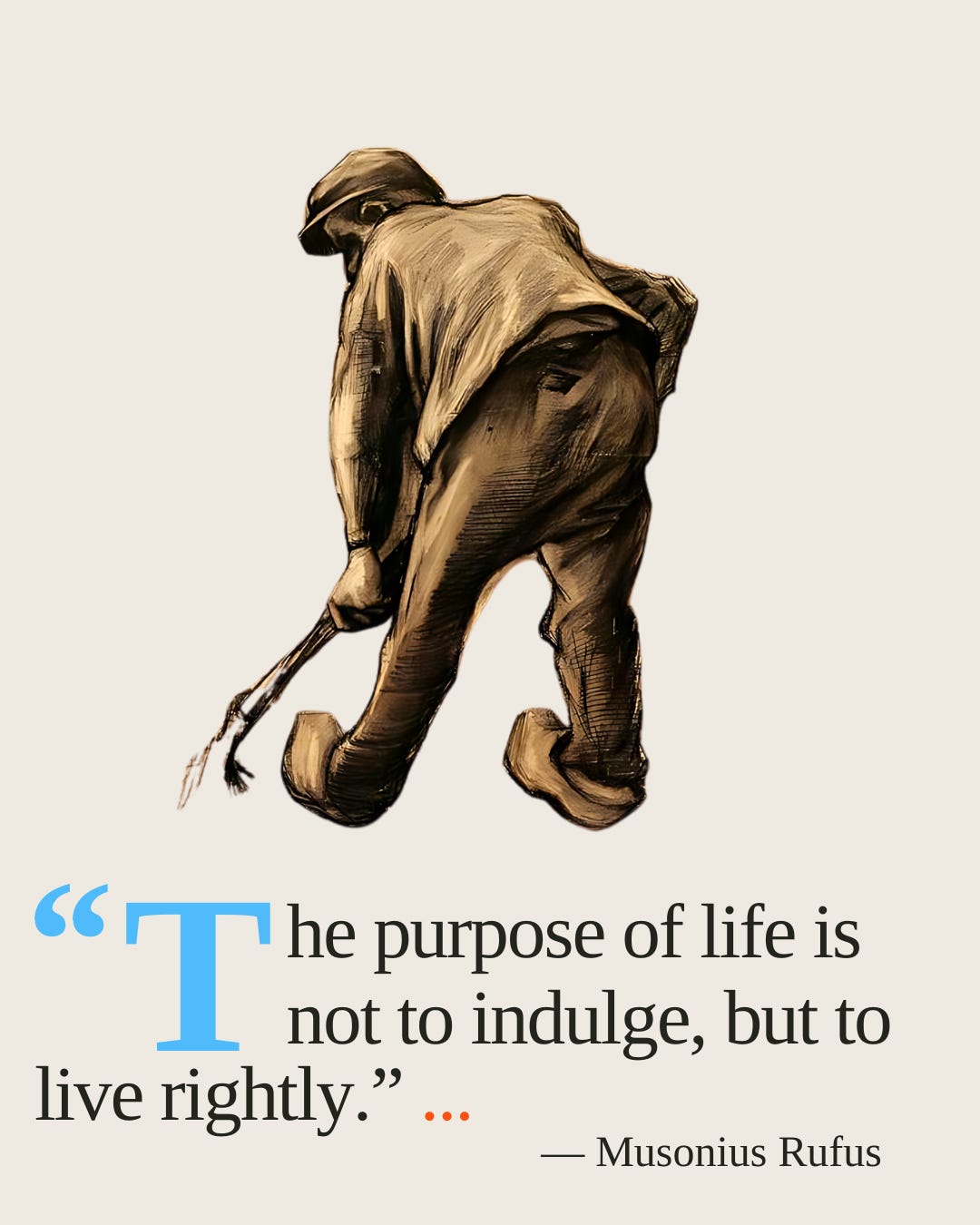
Musonius Rufus on the purpose of life
Welcome back to Dying Every Day (Stoicism in a Year). This is Day 121.
Imagine sitting down to a simple meal of bread and water—and finding in it not deprivation, but freedom. Musonius Rufus, the “Roman Socrates,” tells us that every meal is more than nourishment. It is a test of character.
He writes:
It is not fitting that a rational creature should live for eating or sensual pleasure. The purpose of life is not to indulge, but to live rightly. Food should be taken for health and strength, not for delight. Pleasure pursued for its own sake makes us weak.
In a society known for its extravagant banquets and lavish feasts, these words must have sounded radical. Musonius insisted that a rational being—gifted with reason—should not live as though food or pleasure were life’s highest goods.
He adds:
But self-control, practiced daily, makes us stronger, freer, more fully human. Let every meal be an opportunity to practice virtue, not a moment of indulgence.
Living for pleasure means being bound by desire. In contrast, living with discipline leads to freedom. When we chase pleasure for its own sake, we become reliant on factors beyond our control.
Self-control, by contrast, strengthens the will. It makes us less fragile and more resilient.
Pierre Hadot, a well-known interpreter of Stoicism, explained in Philosophy as a Way of Life how these teachings fit into the broader practice of philosophy:
For the Stoic, every action, however trivial it might appear, is an opportunity to practice virtue. Eating, walking, conversing—these are not neutral events but occasions to put reason in command.
Hadot continues,
The discipline of desire requires us to want nothing that does not depend on us; the discipline of action requires us to do each thing as though it were a step toward justice. Thus, philosophy is not learned in words but lived in deeds, repeated at every instant of daily life.
The philosopher’s table isn’t about denial but about discipline. Each meal offers an opportunity to practice moderation. Every glass of water provides a moment to cultivate gratitude. A meal can serve as a training ground where we learn self-control, one choice at a time.
Such simplicity does not mean that joy is absent. In fact, Musonius would argue the opposite. The simpler the meal, the deeper the appreciation. The less we expect from pleasure, the more easily we discover it. Simplicity, not extravagance, is what frees us to savor without dependence.
The lesson is clear: every aspect of life is connected to philosophy. Every moment presents you with two paths: to feed your cravings or practice your philosophy. Which will you choose?
Reflection Prompt
Consider reflecting or journaling on the purpose of your life. You could ask yourself, “What would it mean to practice my philosophy in every aspect of life?” Or consider, “How can I make meals (and other routine activities) an opportunity to practice the virtue of temperance?”
Listen on Apple Podcasts, Spotify, or YouTube
—
Thank you for reading/listening; I hope you found something useful.
Until next time, be wise and be well.
J.W.
P.S. Catch up on recent (and past) meditations in the archive!
Excellent piece.
Those are powerful entry points. Reflection like this strips life of autopilot and makes even the smallest acts sacred. To ask, “What would it mean to practice my philosophy in every aspect of life?” is to move beyond theory and into embodiment—no longer just believing, but becoming.
And temperance isn’t about denial—it’s about presence. To eat slowly, with gratitude, is to practice balance. To walk, to breathe, to speak with awareness—that’s philosophy in motion. The purpose of life may not be something you “find” out there, but something you live in each moment, deliberately.
Freedom Law #5: Remember Who You Are. That is the Revolution.