

💀 Dying Every Day
Dying Every Day (Stoicism in a Year) is a podcast by the Perennial Leader Project. Each episode turns a selected passage from Stoic philosophy into a guided meditation designed to help you (and me) learn how to live.
Listen on Apple Podcasts, Spotify, or YouTube
Marcus Aurelius on controlling your thoughts
Welcome back to Dying Every Day (Stoicism in a Year). Today is Day 72, and we’re learning to control our thoughts and train our minds.
In his Meditations, Marcus Aurelius wrote to himself,
Your ability to control your thoughts—treat it with respect. It’s all that protects your mind from false perceptions—false to your nature, and that of all rational beings. It’s what makes thoughtfulness possible, and affection for other people, and submission to the divine.
+Adapted from Meditations, 3.9
Marcus Aurelius points out in today’s passage that controlling (or you could say discerning) our thoughts is how we avoid false perceptions. Training our minds (and attention) is how we practice our philosophy.
Think about a few of the Stoic exercises we’ve discussed throughout the year, from memento mori, the dichotomy of control, and the view from above. These practices require us to obtain a certain level of attention or mindfulness.
A focus on training the mind (or thinking well) is one of the parallels between Buddhism and Stoicism. In the Dhammapada, the Buddha put it this way,
We are what we think. All that we are arises with our thoughts. With our thoughts we make the world. Speak or act with an impure mind and trouble will follow you. As the wheel follows the ox that draws the cart.
We are what we think. All that we are arises with our thoughts. With our thoughts we make the world. [...]
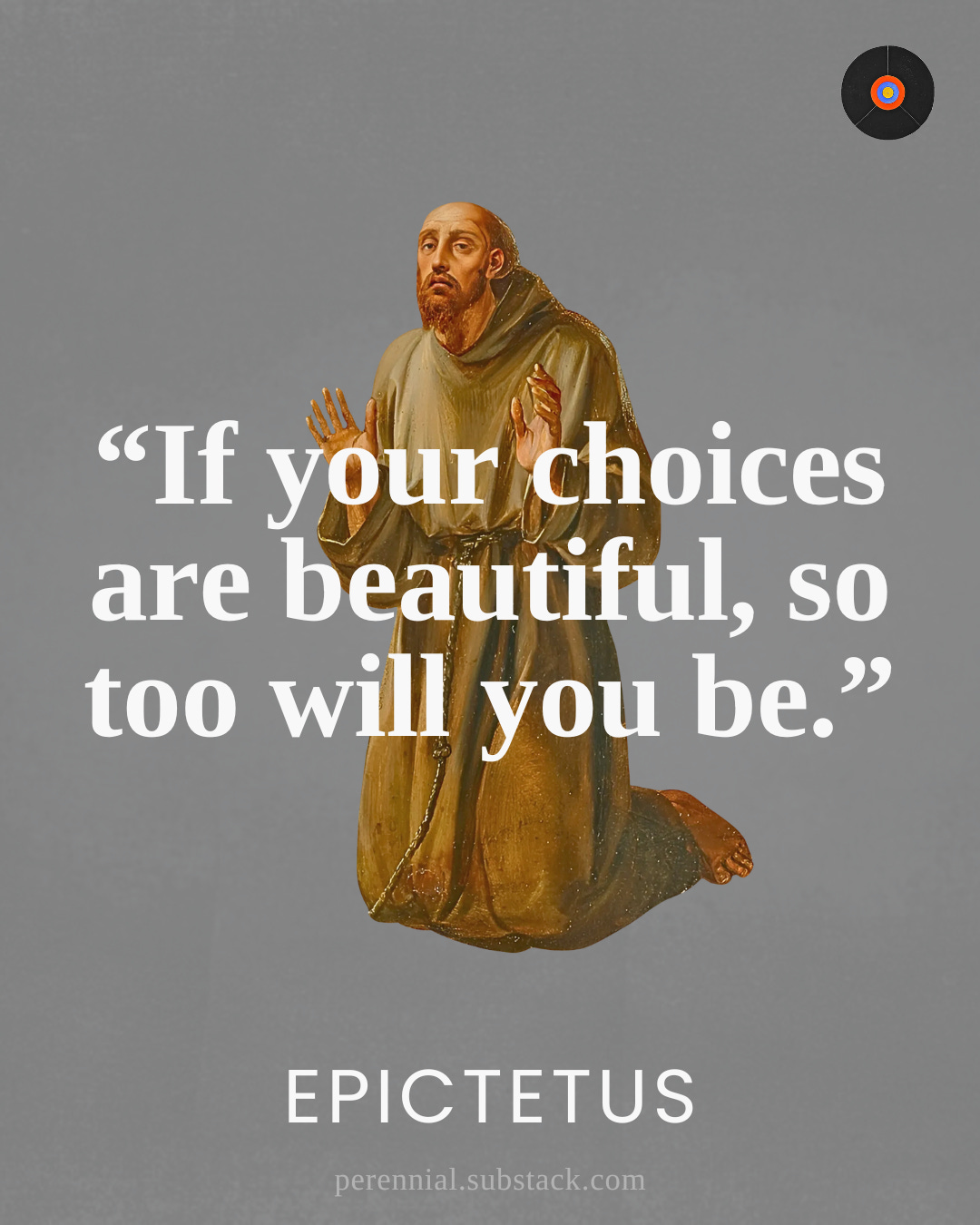
The key insight is that working with our minds (or discerning wisely) makes our philosophy of life possible. It allows us to choose what matters over what doesn’t. To quote Epictetus, “If your choices are beautiful, so too will you be.”
Reflection Prompt
Consider reflecting (or journaling) on what it means to train the mind. You could ask yourself, “What type of world are my thoughts creating?” and/or “Are my thoughts (or choices) aligned with my philosophy of life?”
Listen on Apple Podcasts, Spotify, or YouTube
—
Thank you for reading/listening; I hope you found something useful.
Until next time, be wise and be well,
J.W.
P.S. I greatly appreciate your time, attention, and support!
Thank you!