

🖼️ Monday Muse
The “Monday Muse” is a weekly collection of reminders, insights, and maxims on the art of living. The term “muse” has two meanings: (1) a state of deep thought; and (2) a source of inspiration. May the following (in a small way) be a source of contemplation and wisdom to live your highest good.
📌 Perennial Reminder(s)
“The unexamined life is not worth living.”
— Socrates, via Plato’s Apology
Socrates spent his days in the streets of Athens asking unsettling questions. Rather than give lectures, he turned to his fellow citizens and asked:
“What do you mean by justice?”
“What is courage?”
“How should we live?”
His point was not to embarrass them, but to show how easily we drift through life with untested assumptions.
We have more information than any generation before us, yet often very little self-knowledge. We can scroll for hours without ever asking, “What am I really seeking?”
Socrates insists that to be human is to turn toward these questions, even if the answers are unfinished. The danger is not ignorance itself, but the illusion of knowledge—the sense that because we are busy, we must be awake.
Daily Action
Tonight, take a page and divide it into three headings: “What happened today,” “How I felt,” and “What this shows me about what I value.” Spend five minutes filling it in. Treat it as a small act of examining your life, not to judge it but to know it.
Learn more: How to Lead Yourself Like Socrates
📜 Perennial Maxim(s)
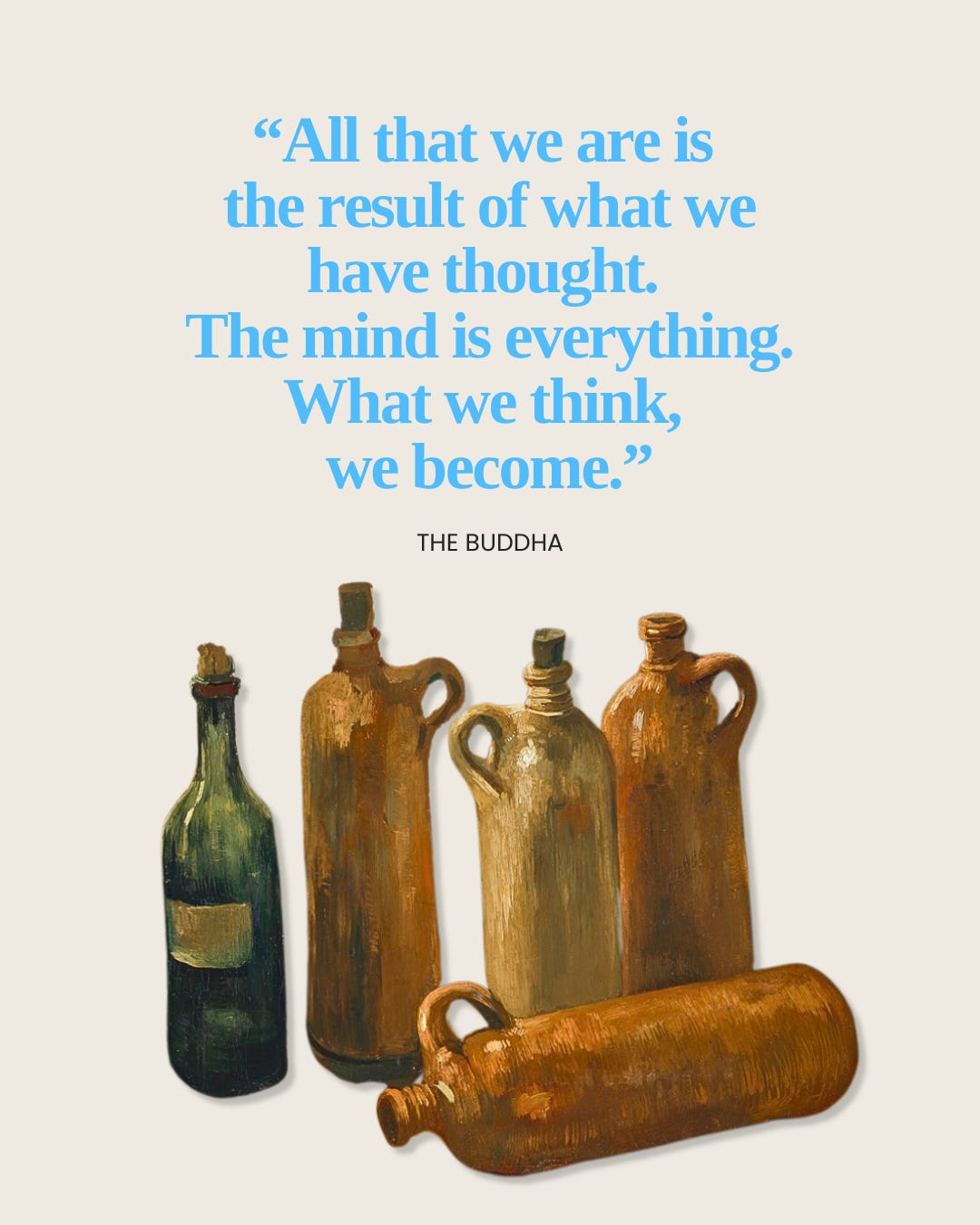
The Buddha (c. 6th or 5th century BCE) on the art of thinking:
Learn more: The Buddha on Tending the Mind
💡 Perennial Insight(s)
“We become just by doing just acts, temperate by doing temperate acts, brave by doing brave acts.”
— Aristotle, Nicomachean
The Greek philosopher Aristotle thought of character less as a fixed label and more as a pattern. You become just, he says, by doing just actions; brave, by doing brave actions. We don’t wake up one morning as “virtuous” by accident. We are quietly shaped, day after day, by what we choose to practice.
This idea can be eye-opening.
Many of our habits were not intentionally chosen—they developed out of convenience, imitation, or fatigue. Reach for your phone again. Snap in irritation again. Avoid the hard task again. Each repetition reinforces a habit.
But Aristotle’s point is not to judge; it’s to show where hope exists. If character is built through repetition, then small changes in what we repeat can, over time, transform who we are.
Daily Action
Choose one small habit you’d like to develop—a kinder tone, starting tasks earlier, or a nightly wind-down. Create a simple if-then statement: “When it’s [specific moment], I will [specific action].” Practice it once today, as if you’re laying the first brick of a new character.
Learn more: The Hard Truth About Virtue
—
Thank you for reading; I hope you found something useful.
Until next time, be wise and be well.
J.W. Bertolotti
P.S. Catch up on recent (and past) meditations in the archive!