

Perennial Wisdom
Perennial Wisdom is a podcast for seekers and curious minds. Each episode explores philosophical and spiritual traditions for universal truths and enduring ideas to help you (and me) never stop learning how to live.
Listen on Apple Podcasts, Spotify, or YouTube
Kierkegaard on the courage to choose
In this episode of Perennial Wisdom, we sit down with Søren Kierkegaard, the 19th-century Danish philosopher often considered the father of existentialism. Specifically, we explore insights from his book Either/Or, which addresses one of life’s toughest questions: How do we live when every choice feels like a loss?
Kierkegaard believed that to live at all is to make a choice. And every choice—whether we act or remain still—shapes who we become.
Listen on Apple Podcasts, Spotify, or YouTube
Episode Transcript
The following is a transcript from “Kierkegaard on the Courage to Choose” on the Perennial Wisdom podcast (Ep. 251).
—
Close your eyes for a moment.
Imagine yourself standing before two roads—one leading to pleasure and freedom, the other to duty and devotion.
You pause, aware that whichever option you pick, the other will be lost forever.
Søren Kierkegaard, the 19th-century Danish philosopher, often considered the father of existentialism, begins his classic Either/Or here, with a human being suspended between possibility and responsibility.
We aim to keep all options available, but as time goes on, it becomes increasingly difficult for us to bear the wait.
Do it or do not do it—you will regret both, says Kierkegaard.
— Either/Or
He isn’t mocking us; he's depicting modern life—long before terms like “decision fatigue” and “the paradox of choice” were introduced.
We live in a world of seemingly infinite options—endless career choices, relationships, and distractions. The modern self, like Kierkegaard’s “aesthete,” wants to feel everything, do everything, be everything.
But this hunger for experience can become its own kind of despair.
Boredom is the root of all evil, Kierkegaard insists, the despairing refusal to be oneself. — Either/Or
The aesthete doesn’t live in the moment—he hides in it. He seeks pleasure not to feel alive, but to forget that he doesn’t know who he is. And the more we run from that question, the more anxious we become.
Modern psychology agrees: research on the paradox of choice shows that having too many options makes us restless and unsatisfied.
Freedom without direction becomes its own prison. True freedom, at least according to Kierkegaard, begins when we dare to choose.
1. The Weight of Responsibility
At some point, possibility becomes unbearable. The self can’t float forever. It must take form.
This is the shift from the aesthetic life to the ethical life.
In the second half of Either/Or, Kierkegaard introduces “Judge William,” a married man who writes to the restless youth. He says, “Stop chasing experiences. Start living as a whole person.”
Kierkegaard puts it this way,
To choose oneself is to choose the ethical.
— Either/Or
To choose is to bind oneself to marriage, to work, to something that gives structure to freedom.
As the existential psychologist Rollo May wrote:
Freedom is not the absence of constraints but the presence of purpose.
— The Discovery of Being
May noted,
Kierkegaard defines freedom as possibility. … He sees man as the creature who is continually beckoned by possibility, who conceives of possibility, visualizes it, and by creative activity carries it into actuality.
Interestingly, recent research backs this up. Psychologists such as Angela Duckworth and Viktor Frankl have demonstrated that meaning arises not from constant change, but from an ongoing commitment to love and vocation.
But sustained commitment is hard. Every choice involves renunciation. Every “yes” contains a thousand “no’s.”
And so the ethical life introduces its own kind of anxiety. You become aware of your limits—aware that you can fail.
But this, Kierkegaard insists, is not tragedy.
The unhappy man is always absent from himself, never present to himself.
— Either/Or
Responsibility calls us back to presence. To be here and now. To say yes to life—even when it’s imperfect.
Because meaning, Kierkegaard reminds us, is not found—it is chosen.
2. The Leap of Faith
But there is a third stage—the hardest of all.
Beyond pleasure and duty lies what Kierkegaard calls the religious stage—
where we face the ultimate uncertainty of existence.
He writes,
Faith is precisely the contradiction between the infinite passion of inwardness and the objective uncertainty.
Faith, for Kierkegaard, is not dogma. It’s the courage to live without guarantees. It’s the willingness to act even when we’re uncertain we’re right.
This is what he refers to as the leap of faith.
And this leap is not blind—it’s existential. It’s the same leap a lover takes when saying “I do,” or an artist makes when facing the blank page. It’s the leap you make when you choose love over fear—again and again.
The German philosopher Friedrich Nietzsche, who shared Kierkegaard’s passion for authenticity, offered this challenge:
You must be ready to burn yourself in your own flame; how could you rise anew if you have not first become ashes?
— Thus Spoke Zarathustra
To have faith, Kierkegaard says, is to live with paradox—to accept that truth cannot be proven, yet to devote yourself to it anyway.
It’s what modern therapy refers to as existential courage—the ability to remain open in the face of uncertainty.
In The Concept of Dread, Kierkegaard put it like this,
To dare is to lose one’s footing momentarily. Not to dare is to lose oneself.
3. The Courage to Choose
So what does Kierkegaard’s Either/Or mean for us today?
It means this:
You cannot have everything.
You cannot know everything.
But you can still say yes.
Freedom without responsibility becomes despair. Responsibility without grace becomes guilt. But when freedom and faith come together, they become authenticity.
In a Journal entry, Kierkegaard famously observed,
Life can only be understood backwards; but it must be lived forwards.
The courage to choose isn’t about being right—it’s about being real. It’s the courage to live before you understand.
And in that space—in the trembling moment between fear and faith—life unfolds.
Reflection Exercise
Take a deep breath.
And consider these questions:
What choice am I postponing because I fear regret?
Where have I mistaken freedom for avoidance?
What small act of commitment could give my life more direction?
In his book The Irrational Man, the American philosopher William Barrett explained these ideas in practical terms.
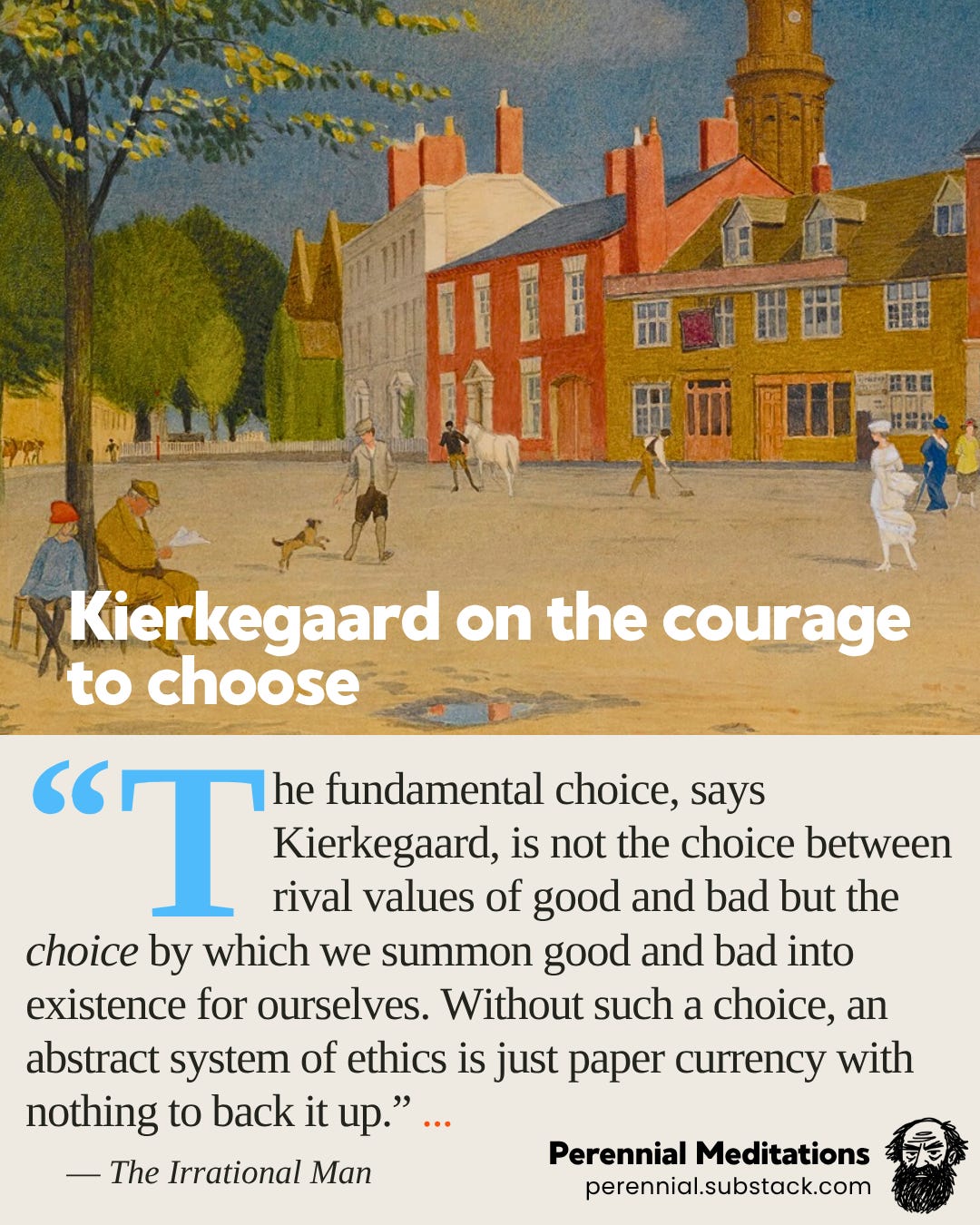
The fundamental choice, says Kierkegaard, is not the choice between rival values of good and bad, but the choice by which we summon good and bad into existence for ourselves. Without such a choice, an abstract system of ethics is merely paper currency with nothing to back it up.
It’s important to remember that, even though someone might write down their values, real life often goes on as if ethics don’t matter. According to Barrett, a formal ethical theory would be pointless without the crucial act of ethical existence, where we let values guide our lives.
Final Thoughts
Kierkegaard reminds us that we do not become ourselves by escaping choice—but by entering it. Each act of decision is an act of creation.
And each moment of anxiety is the invitation to life.
To live is to choose.
To choose is to risk.
And to risk is to be alive.
As Kierkegaard wisely pointed out,
The door to happiness opens inward.
Until next time—keep seeking, keep daring to choose, and keep becoming (each and every day) who you already are.
—
Thank you for reading/listening; I hope you found something useful.
Until next time, be wise and be well.
J.W.
P.S. If you enjoyed it, consider leaving a rating on Apple Podcasts or Spotify.
Thanks for writing this, it clarifies a lot. What if the choise itself is the only freedom?