


Reading & the Good Life
Join the conversation! Every Friday at Noon EST, Perennial Meditations readers are welcome to gather for Reading & the Good Life (Register here), a casual space for connection, contemplation, and conversations on the art of living.

What is the philosophy of happiness?
There are roughly two philosophical literatures on “happiness,” each corresponding to a different sense of the term. One uses ‘happiness’ as a value term, roughly synonymous with well-being or flourishing. The other body of work uses the word as a purely descriptive psychological term, akin to ‘depression’ or ‘tranquility’. An essential project in the philosophy of happiness is simply clarifying what various writers are talking about: the important meanings of the term and how they connect.
While the “well-being” sense of happiness receives significant attention in the contemporary literature on well-being, the psychological notion is reviving as a major focus of philosophical inquiry, following recent developments in the science of happiness. …
The meanings of ‘happiness’
What is happiness? This question has no straightforward answer, because the meaning of the question itself is unclear. What exactly is being asked? Perhaps you want to know what the word ‘happiness’ means. In that case, your inquiry is linguistic. Chances are, you had something more interesting in mind: perhaps you want to know about the thing, happiness, itself. Is it pleasure, a life of prosperity, something else? Yet we can’t answer that question until we know what we mean by the word.
Philosophers who write about “happiness” typically take their subject matter to be either of two things, each corresponding to a different sense of the term:
A state of mind
A life that goes well for the person leading it
In the first case, our concern is simply a psychological matter. Just as inquiry about pleasure or depression fundamentally concerns questions of psychology, inquiry about happiness in this sense—call it the (long-term) “psychological sense”—is fundamentally the study of particular mental states. What is this state of mind we call happiness? Typical answers to this question include life satisfaction, pleasure, or a positive emotional condition. […]
Source: Stanford Encyclopedia of Philosophy
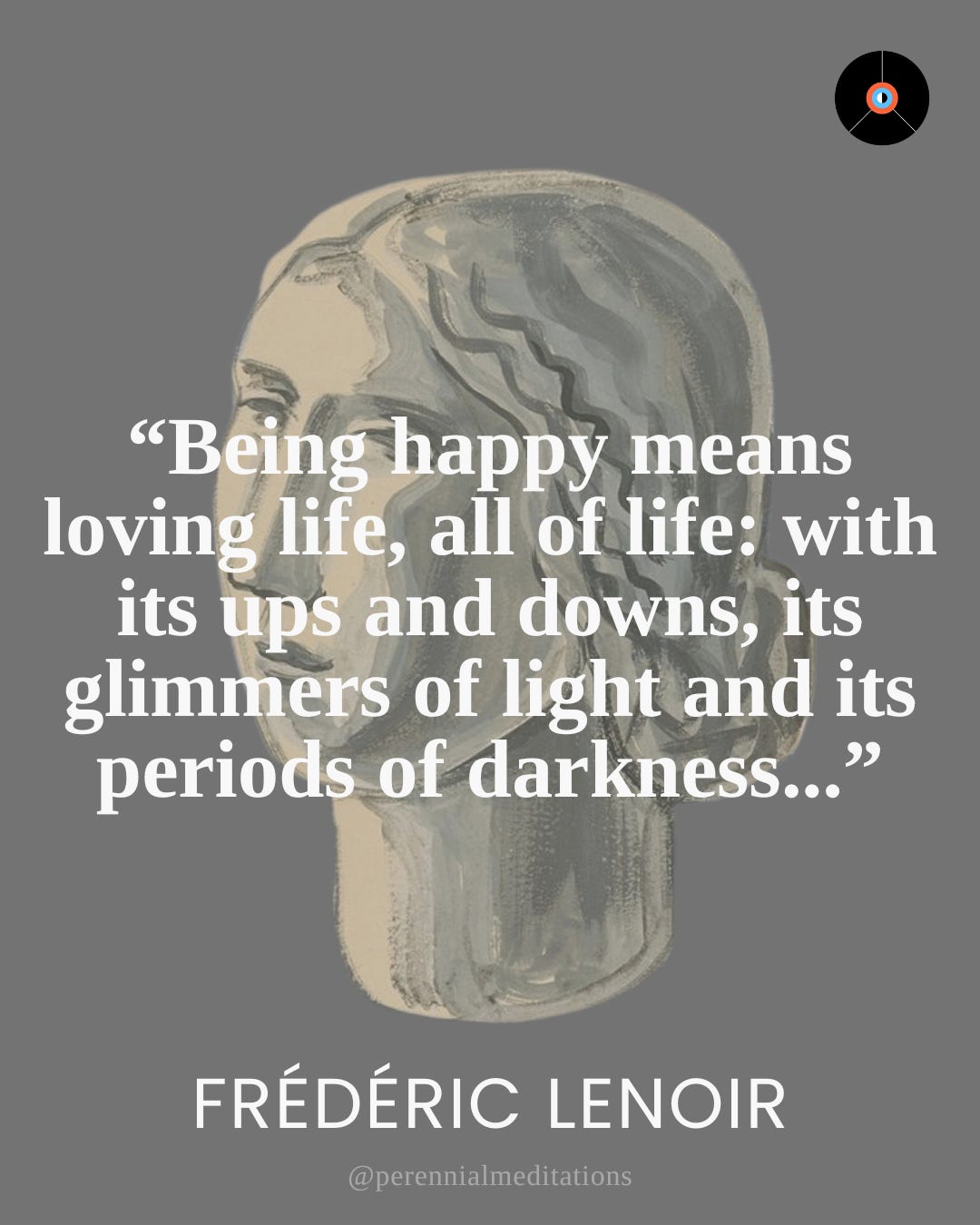
Dear Readers,
This Friday, we continue our exploration of the philosophy of happiness through Frederic Lenoir’s book Happiness: A Philosopher’s Guide. If you’re available at Noon EST, feel free to join us (Register here).
As you read the passages below, consider reflecting on the following questions:
(1) How can I embody these lessons in daily life?
(2) What might stand in the way of implementing these ideas?
(3) How can the following insights help me live the “good” life?
