

Reading & the Good Life
Join the conversation! Every Friday at Noon EST, Perennial Meditations readers are welcome to gather for Reading & the Good Life (Register here), a casual space for connection, contemplation, and conversations on the art of living!
Who is Aristotle?
Aristotle (384–322 B.C.E.) is among the most significant philosophers ever. Judged solely in terms of his philosophical influence, only Plato is his peer: Aristotle’s works shaped centuries of philosophy from Late Antiquity through the Renaissance and, even today, continue to be studied with keen, non-antiquarian interest. A prodigious researcher and writer, Aristotle left a significant body of work, perhaps numbering as many as two hundred treatises, from which approximately thirty-one survive. His extant writings span a wide range of disciplines, from logic, metaphysics, and philosophy of mind through ethics, political theory, aesthetics, and rhetoric, and into such primarily non-philosophical fields as empirical biology, where he excelled at detailed plant and animal observation and description. In all these areas, Aristotle’s theories have provided illumination, met with resistance, sparked debate, and generally stimulated the sustained interest of an abiding readership. …
Aristotle’s philosophy defies easy encapsulation because of its wide range and its remoteness in time. The long history of interpretation and appropriation of Aristotelian texts and themes—spanning over two millennia and comprising philosophers working within various religious and secular traditions—has rendered even basic points of interpretation controversial. […]
Source: Stanford Encyclopedia of Philosophy
Dear Readers,
This week, we continue searching for lessons on the good life from Mortimer Adler’s classic book Aristotle for Everybody. We’ll discuss three selected passages at our upcoming Friday meetup (Register here). As you read these passages below, consider reflecting on the following questions:
(1) How can you begin to embody these lessons in daily life?
(2) What might stand in the way of implementing these ideas?
(3) How can the following insights help you to live the good life?
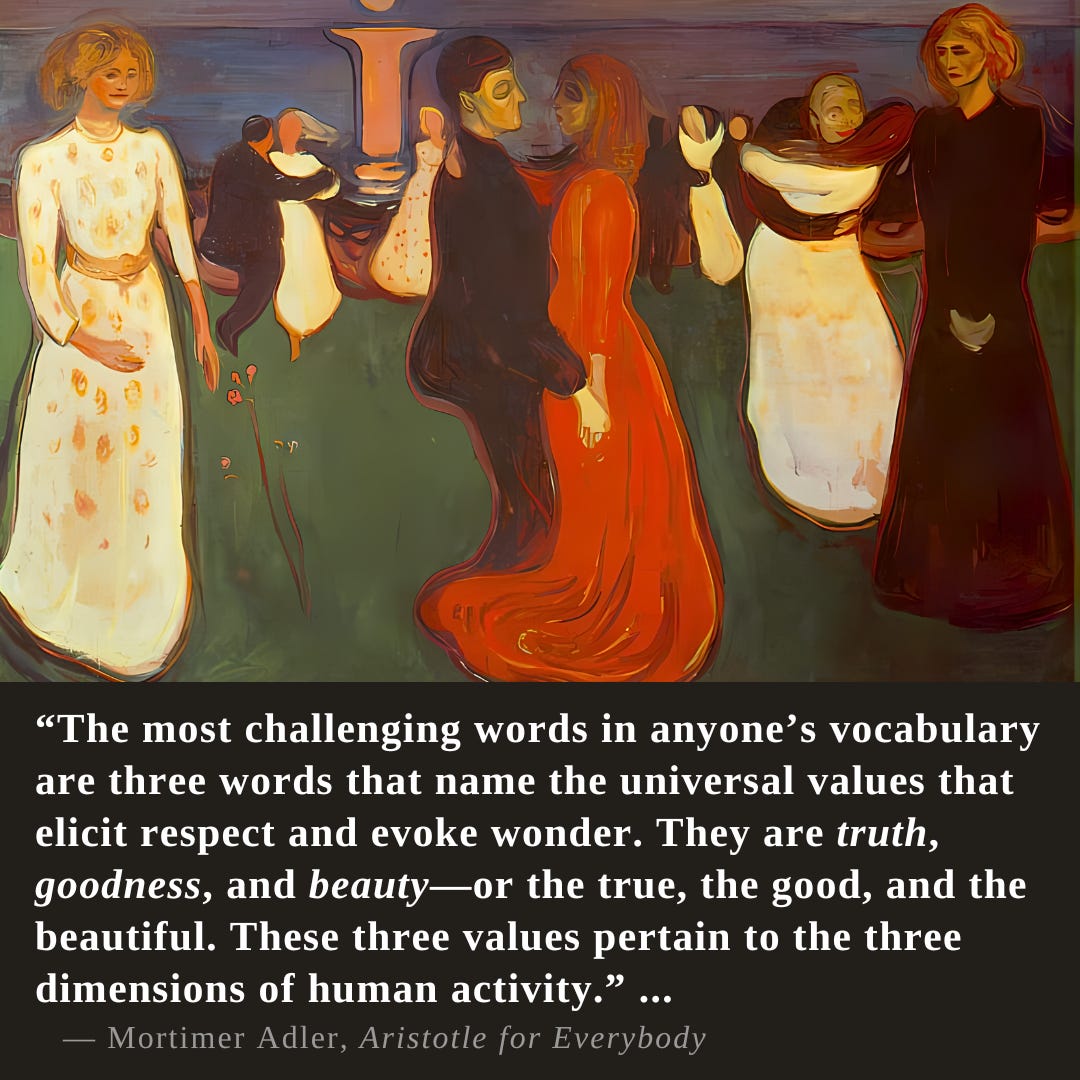
In the first of these three dimensions, making, we have man the artist or artisan—the producer of all sorts of things: shoes, ships, and houses, books, music, and paintings. It is not just when human beings produce statues or paintings that we should call them artists. That is much too restricted a use of the word art. …
In the second of these dimensions, doing, we have man the moral and social being—someone who can do right or wrong, someone who, by what he or she does or does not do, either achieves happiness or fails to achieve it, someone who finds it necessary to associate with other human beings in order to do what, as a human being, he or she feels impelled to do.
In the third dimension, knowing, we have man as learner, acquiring knowledge of all sorts—not only about nature, not only about the society of which human beings are a part, not only about human nature, but also about knowledge itself. […]
— Mortimer Adler, Aristotle for Everybody (Ch. 3)
