

Reading & the Good Life
Join the conversation! Every Friday at Noon EST (Join here), Perennial Meditations readers are welcome to gather for Reading & the Good Life, a space for connection, contemplation, and conversations on the art of living! This week concludes our exploration of the writing and wisdom of William James (through John Kaag’s book — Sick Souls, Healthy Minds).
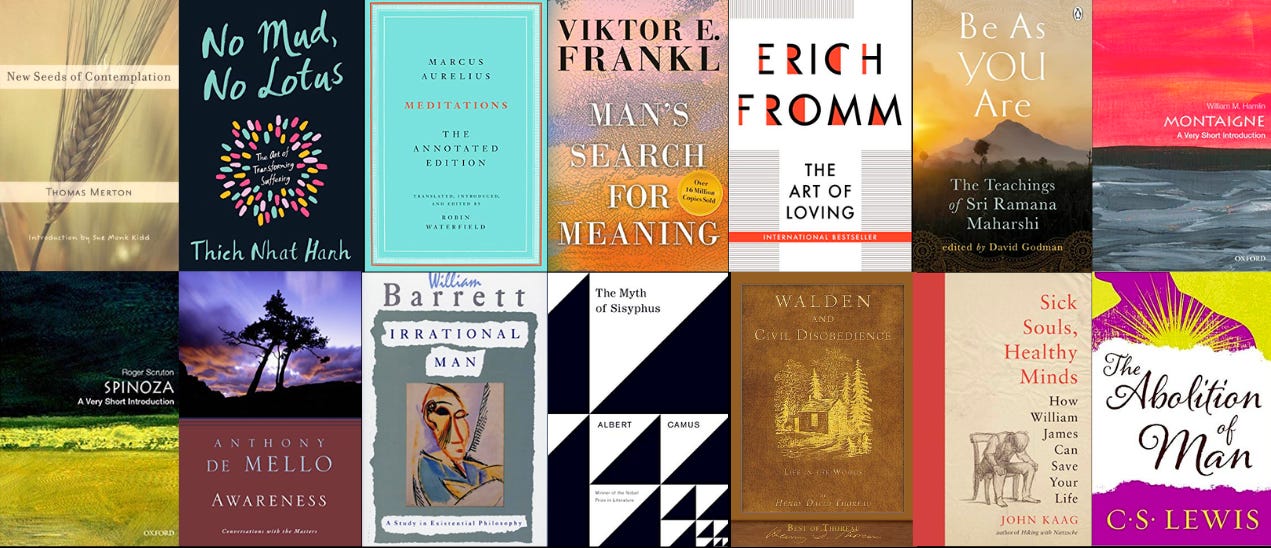
***We’re reading The Abolition of Man by C.S. Lewis next month. You can learn more about this work from my conversation with Michael Ward (the author of After Humanity: A Guide to C.S. Lewis’s Abolition of Man). Check out our bookshelf below for previous and future reading!
Who is William James?
William James was an original thinker in and between physiology, psychology, and philosophy. His twelve-hundred-page masterwork, The Principles of Psychology (1890), is a rich blend of physiology, psychology, philosophy, and personal reflection. It contains seeds of pragmatism and phenomenology and influenced generations of thinkers in Europe and America, including Edmund Husserl, Bertrand Russell, John Dewey, and Ludwig Wittgenstein. […]
Learn more: https://plato.stanford.edu/entries/james/
What is Pragmatism?
Pragmatism is a philosophical tradition that broadly understands knowing the world as inseparable from agency within it. … Pragmatism originated in the United States around 1870 and now presents a growing third alternative to both analytic and ‘Continental’ philosophical traditions worldwide. Its first generation was initiated by the so-called ‘classical pragmatists’ Charles Sanders Peirce (1839–1914), who first defined and defended the view, and his close friend and colleague William James (1842–1910), who further developed and ably popularized it. […]
Learn more: https://plato.stanford.edu/entries/pragmatism/
How to Wonder — Like William James
For many people, life’s worth is never questioned, explains Kaag. It never becomes a topic of conversation or debate. Life is simply lived until it is not. Why are some of us so insatiably curious about life’s questions? “Pragmatism might save your life,” observes Kaag, “but never once and for all.” In 1895, James explained to a crowd of young men from the Cambridge YMCA that it is up to us to make “what we will” of life. It is up to us to make life worth living.
In Sick Souls, Healthy Minds, Kaag explains,
For now, I believe that James’s ‘maybe’—the open question of life’s worth—is right, or at least right for me, because it maps my existential situation as one who is not always entirely sold on life’s value. It is also right, I think, because his ‘maybe’ is roughly fitted to the open question of the cosmos.
James believed that the world is filled with hypotheses, with the “maybes” that make life, in all its many forms, possible and make our lives worthwhile.
