

Perennial Wisdom
Join the search! Perennial Wisdom (formerly In Search of Wisdom) is a podcast for seekers and curious minds. Each episode explores philosophical and spiritual traditions for practical wisdom for modern living.
Listen on Apple Podcasts, Spotify, or YouTube
How to Live (and Die) Like an Epicurean
In this episode of Perennial Wisdom, we explore the ancient philosophy of pleasure (Epicureanism) to find three lessons for modern living. Expect to learn what the ancient Greek philosopher Epicurus thought about having enough, friendship, and the art of dying well.
Key Takeaways
The art of having enough
The art of friendship
The art of dying well
Support the Project
If you’d like to become a member, I’ve created three options: (1) Become a member at $5 a month or $39 for the year; (2) If you need assistance, you can use this 50% discount link; and (3) If you can’t afford it — please accept a complimentary membership.
Episode Transcript
The following is a transcript from “How to Live (and Die) Like an Epicurean” from the Perennial Wisdom podcast.
—
What comes to mind when you hear the word pleasure? How about the notion that “pleasure” is the highest good?
This is what the ancient Greek philosopher Epicurus taught more than two millennia ago. As he put it, “pleasure is the starting point and the goal of living blessedly.” He believed that pleasure is the source of happiness and the only truly good thing. However, Epicurus’s definition of pleasure might differ from ours. He called “pleasure” the absence of pain, anxiety, and fear.
In this video, we explore the philosophy of pleasure (known as Epicureanism) by extracting three ancient lessons for modern living from Epicurus.
1. The Art Having Enough
Have you ever thought that you have more than you need? Maybe you’ve looked around your home and wondered how you accumulated so much stuff.
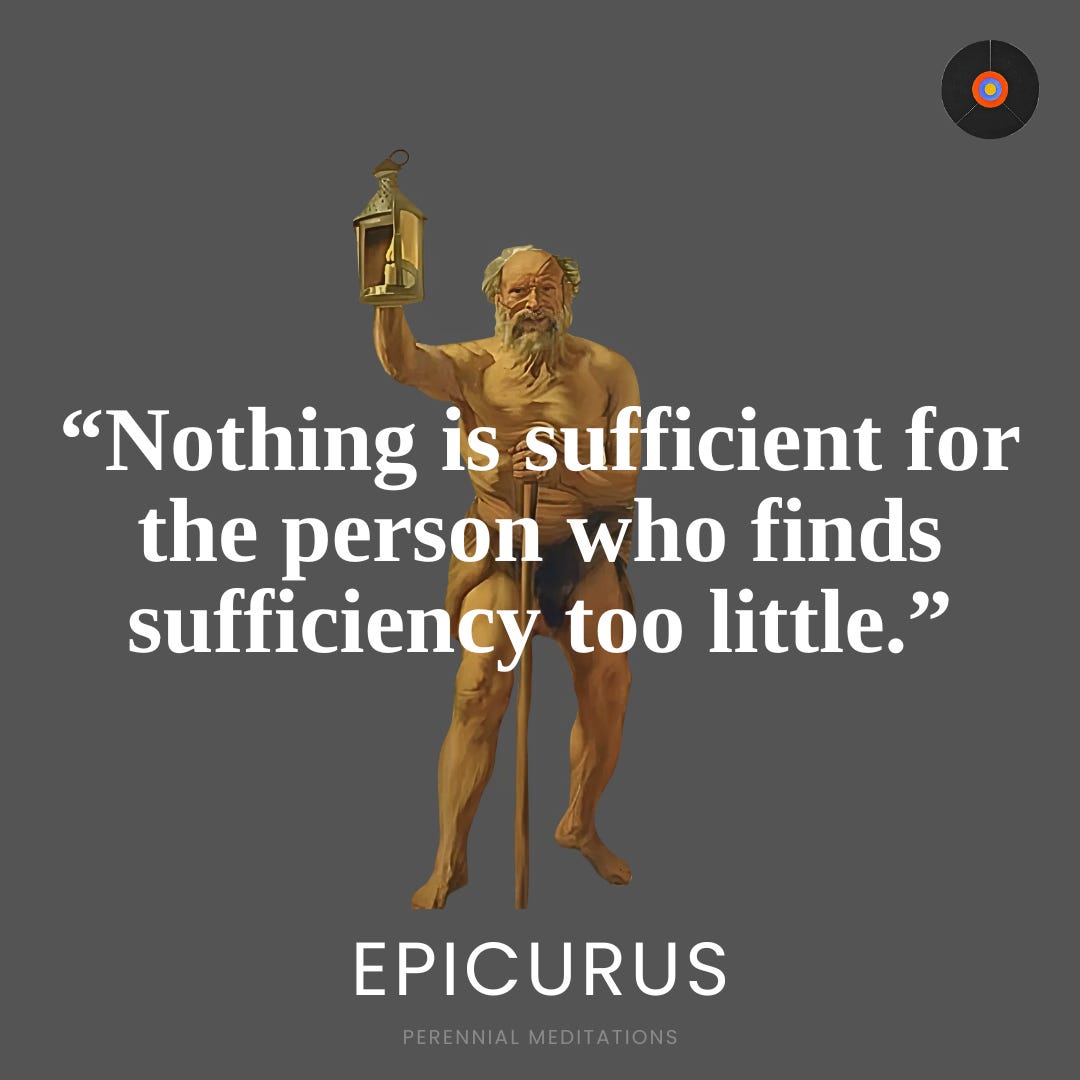
For Epicurus, we need very little to be happy, and most of us actually have everything we need.
My conversation with John Sellars, author of The Pocket Epicurean, revealed that,
Epicurus’s approach to the question was to strip things back down to basics. What do we actually need? What is essential for our physical survival? Food, water, shelter from the elements; that’s about it. These are nature’s demands. Epicurus called the desire for these sorts of things ‘natural and necessary’.
You might be thinking to yourself, this doesn’t sound like a philosophy of pleasure. What if you want something beyond the mere basics? Epicurus would say that’s all fine and perfectly reasonable.
