

Perennial Wisdom
Perennial Wisdom is a podcast for seekers and curious minds. Each episode explores philosophical and spiritual traditions for universal truths and enduring ideas to help you (and me) never stop learning how to live.
Listen on Apple Podcasts, Spotify, or YouTube
Heraclitus on the wisdom of change
Today, on this Sunday edition of Perennial Wisdom, we are turning to the pre-Socratic philosopher Heraclitus, who famously said,
No man ever steps in the same river twice, for it is not the same river and he is not the same man. — Fragments
Heraclitus believed that everything and everyone is in a constant state of change. While this idea might seem unsettling, he presents it not as a threat but as a vital key. To live well, we must live with change, not against it.
When Heraclitus wandered through the ancient streets of Ionia in the 6th century BCE, he was known not for power or prestige, but for speaking in paradoxes. His fragments are short and cryptic, yet they reveal wisdom.
He saw what many refused to see: that stability is an illusion, and becoming is the ground of all being. “Everything flows; nothing stands still,” he stressed.
Thought Experiment
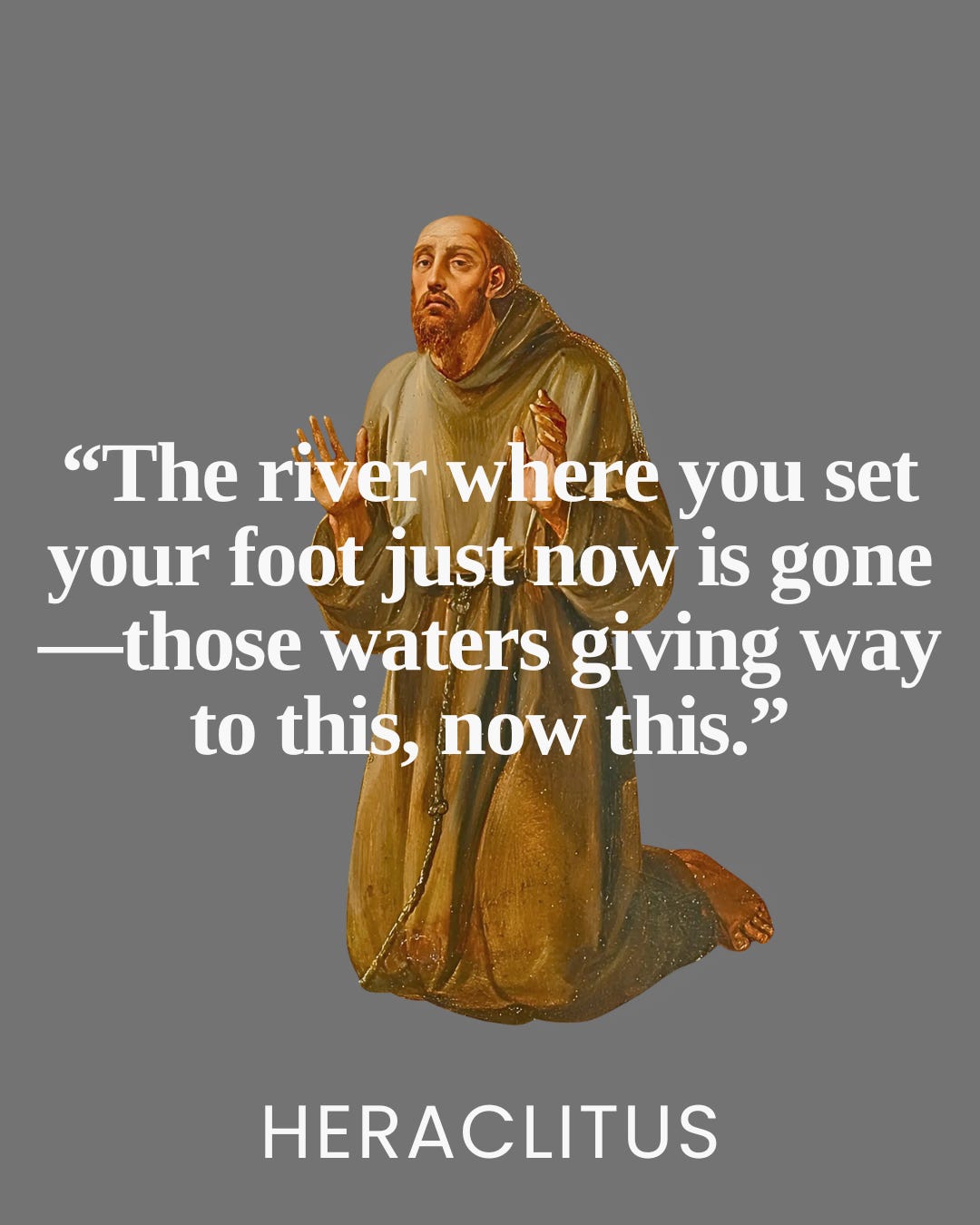
Imagine for a moment that you’re on the edge of a river: cold, clear water rushing past rocks smoothed by time. You step into it—ankle deep, then knee deep. The water is in constant flux. Heraclitus says, “The river where you set your foot just now is gone—those waters giving way to this, now this.”
The river is a metaphor. But it’s also reality.
Your thoughts change. Your body ages. Your relationships deepen, fray, and mend. “By cosmic rule… all things change,” he observed.
But Heraclitus did not teach chaos or nihilism. He taught harmony through opposites, unity through tension. The world, he said, is held together not despite conflict, but through it.
Heraclitus encourages us to accept the wisdom of change—not to fear or control it, but to see it as the fundamental nature of everything.
Can you notice the tension in your own life?
The tension that exists between the past and the future.
The tension that exists between who you are and who you are becoming.
According to Heraclitus, what causes us to suffer is not change, but our resistance to it. We desire to live in a stable world, instead of one that is constantly in flux.
But Heraclitus speaks with compassion to that grasping: “It is in changing that we find repose.”
The Roman emperor Marcus Aurelius (a figure influenced by the writings of Heraclitus) speaks often of the wisdom of change.
In his Meditations, he asks himself,
Frightened of change? But what can exist without it? What’s closer to nature’s heart? Can you take a hot bath and leave the firewood as it was? Eat food without transforming it? Can any vital process take place without something being changed?
Can’t you see? It’s just the same with you—and just as vital to nature.
It’s important to remember that to change is not to fail. To evolve is not to betray or lose yourself. You are constantly becoming.
It can be useful to regularly reflect on questions like, “Where am I resisting change?” or “Where am I clinging to a version of myself that no longer exists?”
Curiously, what looks like loss may actually be liberation. What seems like falling could be a new beginning.
Heraclitus didn't provide a comprehensive system or a philosophy of life. Instead, he left us with fragments—like embers glowing in the darkness. Each fragment encourages us to trust the insights that change offers.
He recommended, “Applicants for wisdom, do what I have done: inquire within.” He held that self-knowledge is crucial and that embracing change allows us to better understand ourselves, others, and the world around us.
Listen on Apple Podcasts, Spotify, or YouTube
—
Thank you for reading/listening; I hope you found something useful.
Until next time, be wise and be well.
J.W.
P.S. If you enjoyed it, consider leaving a rating on Apple Podcasts or Spotify.
Fabulous essay! This is absolutely the best explanation of Heraclitus and his ideas about change I have ever read! Beautifully explained and explicated. So meaningful, regardless of our stage of life or age.Thank you so much!
Exactly what Gandolfo Corradino said!
Thank you.