


💀 Dying Every Day
Dying Every Day (Stoicism in a Year) is a podcast by the Perennial Leader Project. Each episode turns a selected passage from Stoic philosophy into a guided meditation designed to help you (and me) learn how to live.
Listen on Apple Podcasts, Spotify, or YouTube
Epictetus on what is truly ours
Welcome back to Dying Every Day (Stoicism in a Year). This is Day 122.
What do you really own? Not your body, which ages and weakens. Not your wealth either, which fortune can give and take. Not your reputation, which belongs to the crowd.
Epictetus insists we possess only one thing that is truly ours: our will and reason. In his straightforward style, he says,
You are not flesh or blood but will and reason. Say to yourself: I am a rational being. I must act accordingly.
We are not defined by others' perceptions or what time erodes. We are shaped by our choices, our judgments, and our ability to live in accordance with reason.
Epictetus continues,
If another reviles you, remember: you are not harmed unless you make yourself so.
Regarding loss, he adds,
If you lose something, remember: it was not yours by nature. All things are borrowed from fate, to be returned without complaint when called for.
For Epictetus, possessions, even relationships, are like loans. They were never owned outright; they were entrusted for a time. To give them back is not theft, but the natural order.
He concludes,
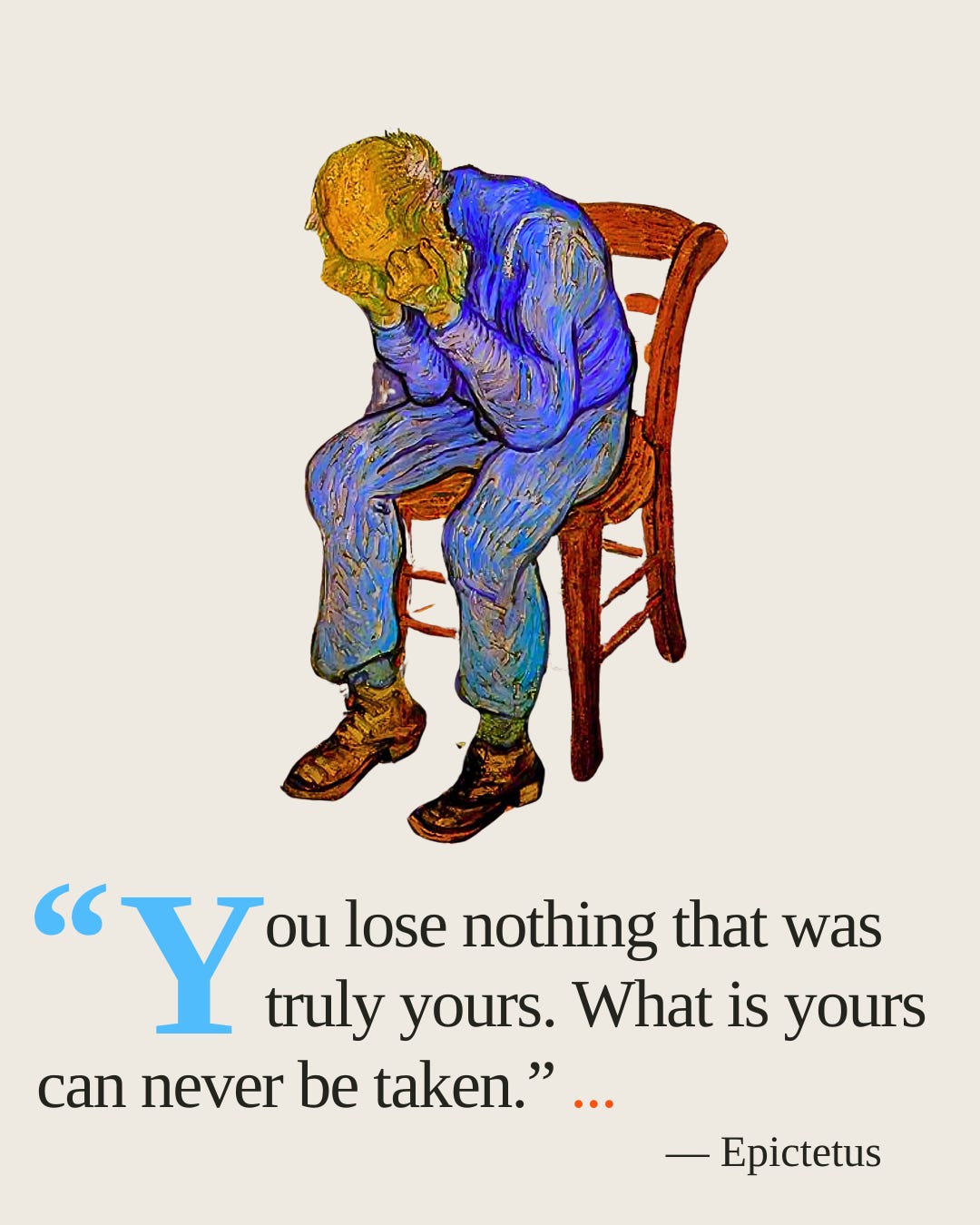
You lose nothing that was truly yours. What is yours can never be taken.
This passage might seem extreme, but it is meant to free us. If all things are borrowed, then gratitude replaces entitlement. If nothing external can define us, then serenity is possible even under challenging circumstances.
We are wise to remember that Epictetus is not speaking hypothetically. His insights here are from experience. He spent much of his life as a slave in ancient Rome. When he asks, “What is truly yours?” we should imagine that he contemplated this very question for much of his life.
Interestingly, this vision echoes Plato’s in the Republic:
We are not concerned with the body but with the soul itself, in order that it may be as good as possible… when each part of the soul does its own work and does not meddle with that of another, then the whole soul will be just and at peace.
Plato, like Epictetus, saw that true harmony does not lie in possessions or honors but in the rightly ordered soul. Justice, peace, and strength come when reason governs—not when desire or fear holds sway.
Taken together, their message is radical and empowering: no one can take away what is truly essential. Fortune may take your wealth, time may wear down your body, others may slander your name—but your rational will remains unbreakable.
It’s important to remind ourselves regularly that flesh will fail. Fortune will fade. But our reason endures. It is the only thing that can never be taken.
Reflection Prompt
Consider reflecting or journaling on what you really own. You could ask yourself, “What have you clung to as ‘yours’ that is in fact only borrowed from fate?” Or consider, “How might your choices change if you lived as though only your will and reason belonged to you?”
Listen on Apple Podcasts, Spotify, or YouTube
—
Thank you for reading/listening; I hope you found something useful.
Until next time, be wise and be well.
J.W.
P.S. Catch up on recent (and past) meditations in the archive!
Do we own our soul?
What happens when someone may reach an age that we lose our ability to reason?