

💀 Dying Every Day
Dying Every Day (Stoicism in a Year) is a podcast by the Perennial Leader Project. Each episode turns a selected passage from Stoic philosophy into a guided meditation designed to help you (and me) learn how to live.
Listen on Apple Podcasts, Spotify, or YouTube
Epictetus on the power of restraint
Welcome back to Dying Every Day (Stoicism in a Year). This is Day 114.
How often do we chase something, only to feel frustrated when it slips away? Or fear something, only to find it was unavoidable? Epictetus begins here—with our restless desires and irrational fears—and shows us how to reclaim our peace.
In the Enchiridion (or Handbook), he explains,
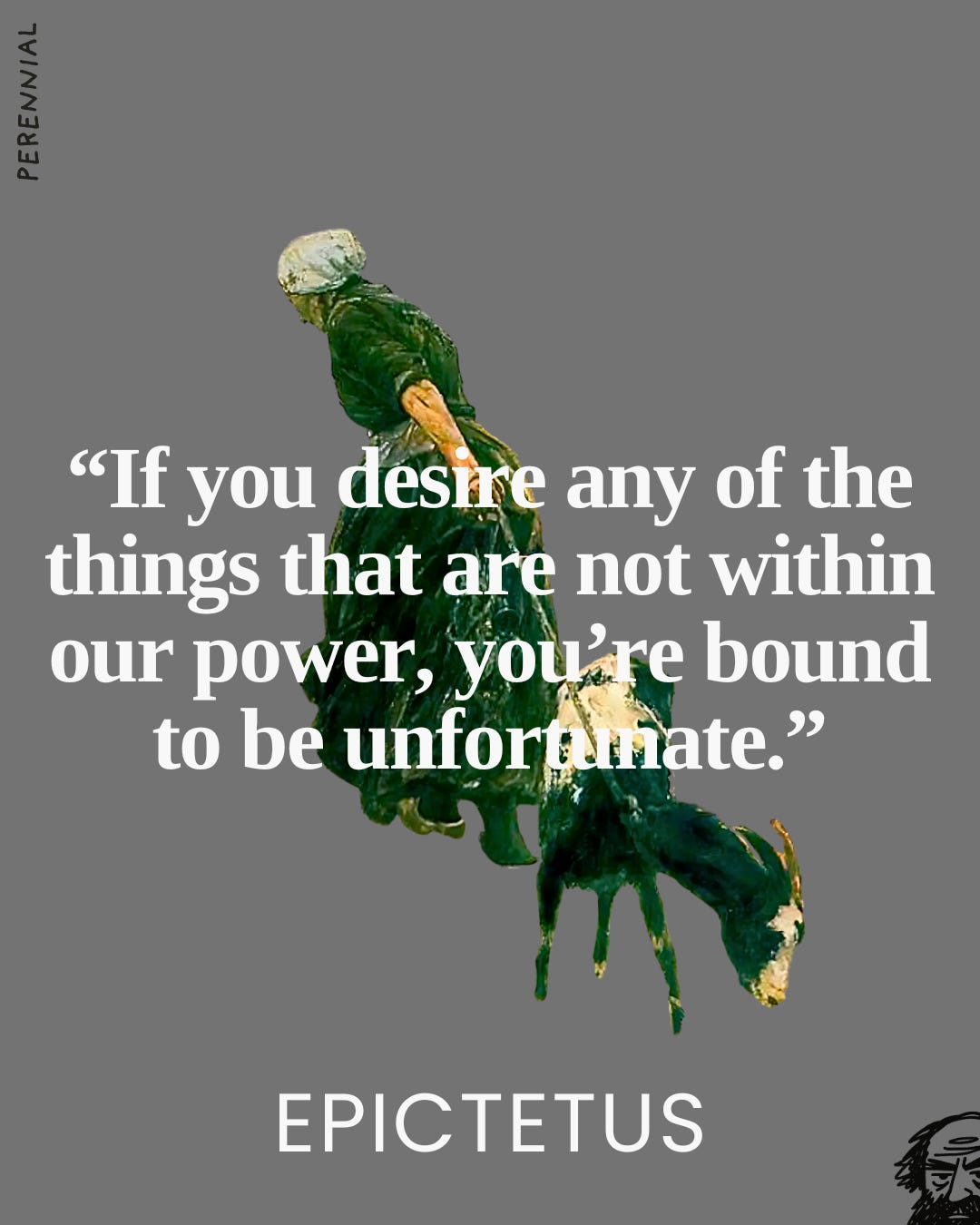
Remember that desire promises the attaining of what you desire, and aversion the avoiding of what you want to avoid, and that he who falls into desire is unfortunate, while he who falls into what he wants to avoid suffers misfortune. If you seek to avoid, then, only what is contrary to nature among those things that are within your own power, you’ll never fall into anything that you want to avoid; but if you attempt to avoid illness, or death, or poverty, you’ll suffer misfortune.
Desire lures us with promises of satisfaction. Aversion frightens us with the threat of pain. But both—when misdirected—enslave us. The person who yearns for wealth, beauty, or fame often finds themselves constantly disappointed.
Likewise, the person who fears death, sickness, or poverty is always uneasy, always fleeing what they cannot escape. And that’s the trap.
But here’s the way out: aim your desires and aversions only at what lies truly within your power—your own choices, your own character. You can’t control poverty or illness. But cowardice? Injustice? Those are yours to master.
Epictetus continues:
Remove your aversion, then, from everything that is not within our power, and transfer it to what is contrary to nature among those things that are within our power.
In other words, stop recoiling from external hardships. Reserve your aversion for inner failures: pettiness, dishonesty, weakness of will. That is what truly diminishes you—nothing else.
Consider someone who is obsessed with their image on social media, craving likes and fearing criticism. Their peace rises and falls with the whims of strangers—things beyond their control.
Epictetus would say: stop. Withdraw that power. Place it where it belongs—inside you. Even your actions, he adds, should be undertaken “lightly, with reservations, and without straining”—not with desperation, but with calm resolve.
Desire and fear can be tamed. If you direct them inward—toward your own moral choices—you become free. If you scatter them outward—toward what you cannot command—you remain a slave.
Everything we truly need to live well has been within our reach all along. The rest? Let it go.
Reflection Prompt
Consider reflecting on or contemplating the power of restraint. You might ask yourself, “Where are my desires pulling me toward things beyond my control?” or “What would it mean to turn my aversions toward my faults rather than external misfortunes?”
Listen on Apple Podcasts, Spotify, or YouTube
—
Thank you for reading/listening; I hope you found something useful.
Until next time, be wise and be well.
J.W.
P.S. Catch up on the previous episodes of “Dying Every Day” below:

