

💀 Dying Every Day
Dying Every Day (Stoicism in a Year) is a podcast by the Perennial Leader Project. Each episode turns a selected passage from Stoic philosophy into a guided meditation designed to help you (and me) learn how to live.
Listen on Apple Podcasts, Spotify, or YouTube
Epictetus on the freedom to see differently
Welcome back to Dying Every Day (Stoicism in a Year). This is Day 127.
The plane is delayed again. A friend cancels at the last minute. The test results come in, and your heart sinks. Life continues as always—unpredictable and indifferent. In that moment, the mind rushes to label, judge, and resist.
But the Stoic teacher Epictetus offers a radical alternative:
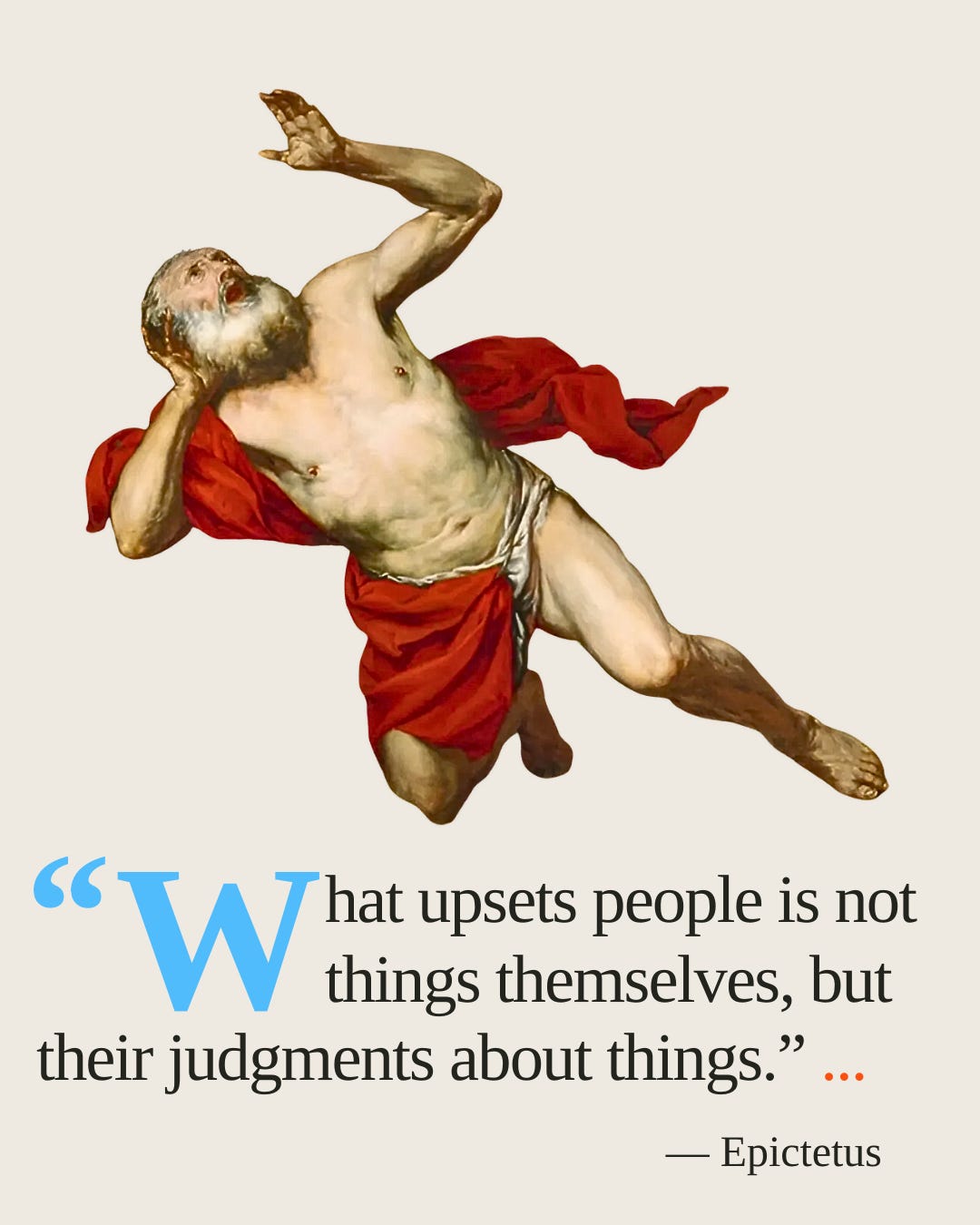
When something happens, the only thing in your power is your attitude toward it; you can either accept it or resent it. What upsets people is not things themselves, but their judgments about things. For example, death is nothing dreadful. If it were, Socrates would have thought so. Instead, what frightens us is the view we take of death, and that is something we can change.
Epictetus understood that our inner freedom depends not on what happens to us, but on how we interpret what happens. Between the event and our response lies a narrow space—small enough to miss, yet large enough to contain peace. In that space, we decide whether to face life with resentment or acceptance, fear or understanding.
Albert Ellis, the founder of Rational Emotive Behavior Therapy, revived this ancient truth in modern words. “People and things do not upset us,” he wrote, “rather, we upset ourselves by believing that they can upset us.” His insight echoes Epictetus: emotions come from the beliefs we assign to events, not the events themselves. If we question those beliefs, we can change our experience.
Similarly, Marcus Aurelius wrote, “If you are distressed by anything external, the pain is not due to the thing itself, but to your estimate of it.” We live as though peace depends on events, but it does not. It depends on perception.
Acceptance, then, is not passivity. To accept reality as it is—to cease fighting what cannot be changed—is to reclaim the energy we waste on resentment.
Viktor Frankl, who survived the Holocaust, described this as “the last of the human freedoms—to choose one’s attitude in any given set of circumstances.” Even when all external freedoms are taken away, the ability to choose our response remains intact.
Epictetus taught this same freedom to his students. The external world, he said, will always be uncertain. But our judgments—our inner world—can become steady, clear, and serene. When we learn to see things differently, even pain becomes a teacher, and even loss turns into a mirror.
So when something unwanted happens today—a delay, a rejection, a loss—pause. Feel the initial sting, then notice the story you begin to tell yourself about it. “This shouldn’t happen.” “I can’t handle this.” “It’s unfair.”
Ask yourself: are these facts, or judgments? The moment you see the difference, a quiet door opens inside you—the door of choice.
Behind that door lies your freedom.
Reflection Prompt
Consider reflecting or journaling on the discipline of perception. Think of something that has recently frustrated or saddened you. Then ask yourself, “What judgment did I attach to it?” Or consider, “How often do I confuse external control (changing the world) with internal control (changing my perspective)?”
Listen on Apple Podcasts, Spotify, or YouTube
—
Thank you for reading/listening; I hope you found something useful.
Until next time, be wise and be well.
J.W.
P.S. Catch up on recent (and past) meditations in the archive!
Bear those things that are not in my control, forbear those things that I can control, accept my fate, things are just as they should be.
An excellent presentation of this key piece of knowledge from stoicism