

💀 Dying Every Day
Dying Every Day (Stoicism in a Year) is a podcast by the Perennial Leader Project. Each episode turns a selected passage from Stoic philosophy into a guided meditation designed to help you (and me) learn how to live.
Listen on Apple Podcasts, Spotify, or YouTube
Epictetus on the cause of anxiety
Welcome back to Dying Every Day (Stoicism in a Year). Today is Day 71, and we’re exploring the meaning and cause of anxiety.
The Stoic teacher, Epictetus, taught his students,
When I see someone in a state of anxiety, I say, ‘What is it that he wants?’ For unless he wanted something that was not within his power, how could he still be anxious? That is why a musician feels no anxiety when singing on his own, but becomes anxious when he enters the theatre, even if he has a fine voice and plays his instrument well. For he wants not only to sing well, but also to win the approval of his audience, and that is something that lies beyond his control. +Adapted from Discourses, 2.13
Yes, anxiety is part of being human. But it’s also worth reflecting on the cause of our anxiety. For example, does our anxiety connect with a desire for something beyond our control? If so, Epictetus reminds us that the solution is to cease worrying about things beyond our control (a practice we discussed on Day 1).
Similarly, the Danish theologian and philosopher Soren Kierkegaard believed that anxiety is our greatest teacher.
In his book The Concept of Dread, Kierkegaard wrote,
I would say that learning to know anxiety is an adventure which every man has to affront if he would not go to perdition either by not having known anxiety or by sinking under it. He therefore who has learned rightly to be anxious has learned the most important thing.
As we discussed on Day 6 in a meditation titled “Reasons Not to Worry,” it’s important to remember that it’s natural for us to be anxious at times. We should remind ourselves often that philosophical exercises exist because they are practices designed to help us learn to live.
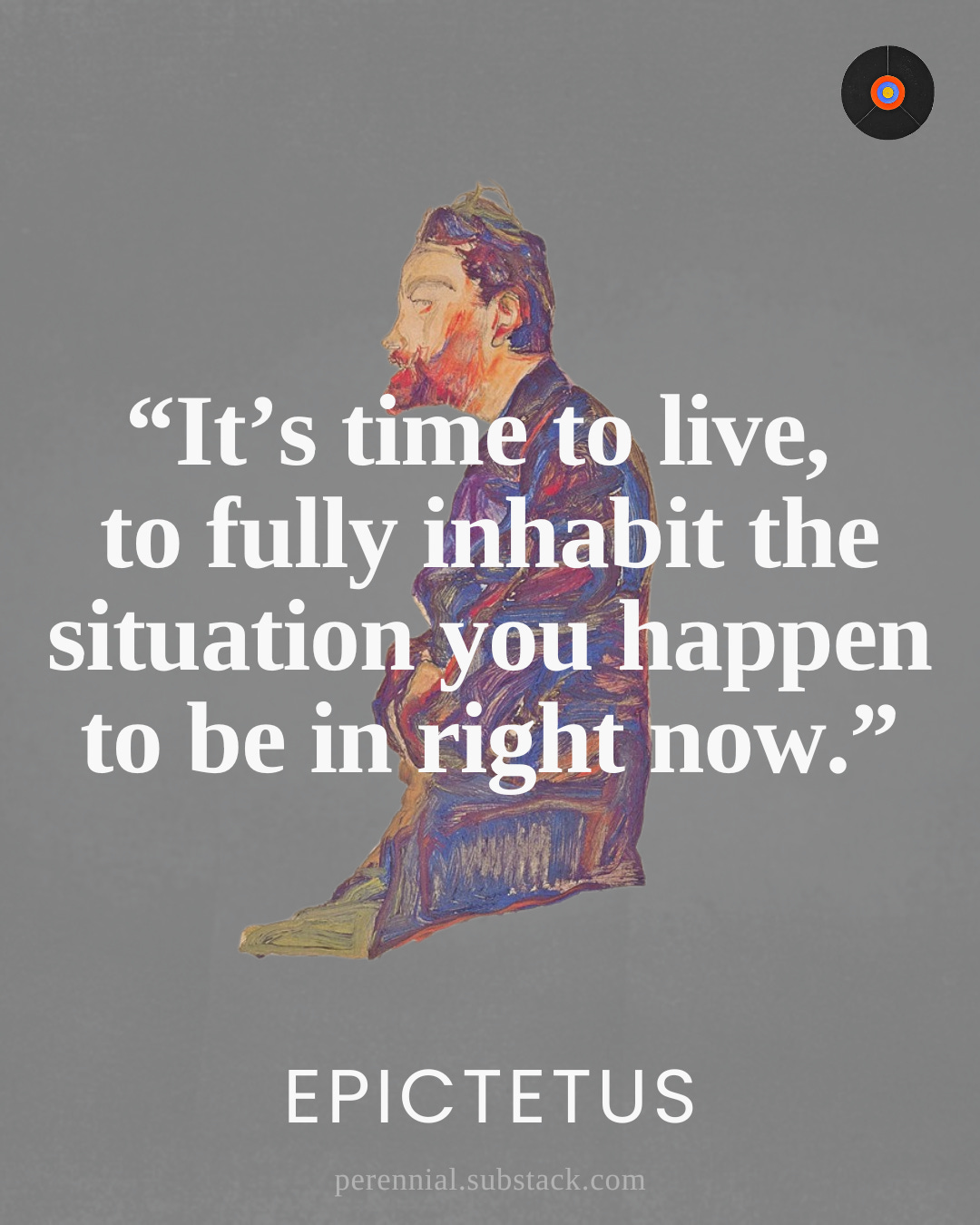
For example, anxiety generally relates to the future. Stoic philosophy urges us to live in the present. As Epictetus advised his students, “Stop giving yourself needless trouble. It’s time to live, to fully inhabit the situation you happen to be in right now.”
Reflection Prompt
Consider reflecting (or journaling) on how you think about (or define) anxiety. Then, ask yourself, “What can anxiety teach me about myself, others, and the world around me?”
Listen on Apple Podcasts, Spotify, or YouTube
—
Thank you for reading/listening; I hope you found something useful.
Until next time, be wise and be well,
J.W.
P.S. I greatly appreciate your time, attention, and support!
It is amazing how often one needs to remember the skills needed to cope with anxiety. Yesterday's April Fool's election brought many citizens' anxiety to a high level, including myself. Fortunately elections aren't daily events. Fool's Day might be appropriate because we let our emotions get control.
I am thankful for your daily reminders on how to practice Stoic philosophy.
It helps me remember that every day can be my Fool's day, if I let anxiety control me versus letting go of the uncontrollable.