

💀 Dying Every Day
Dying Every Day (Stoicism in a Year) is a podcast by the Perennial Leader Project. Each episode turns a selected passage from Stoic philosophy into a guided meditation designed to help you (and me) learn how to live.
Listen on Apple Podcasts, Spotify, or YouTube
Epictetus on calming the mind
Welcome to Dying Every Day (Stoicism in a Year). Today is Day 78, and we’re exploring how to calm the mind.
The Stoic teacher Epictetus stressed to his students,
If you want to be self-respecting and trustworthy, who can prevent you? If you want to be subject to no hindrance and constraint, who can constrain you to desire things that you don’t think that one should desire, or to avoid things that you don’t think that one should avoid? … Since desire and aversion are within your own power, then, what else do you need to worry about?
+Adapted from Discourses, 2.2
Working with our desires and aversions is a consistent theme in Stoic philosophy. But it’s important to remember, as Epictetus explained, that the point is to desire the “right” things.
For example, as practicing Stoics, we should desire to be virtuous and have an aversion to vice. The key is to order or orient our desires and aversions with the highest good (virtue).
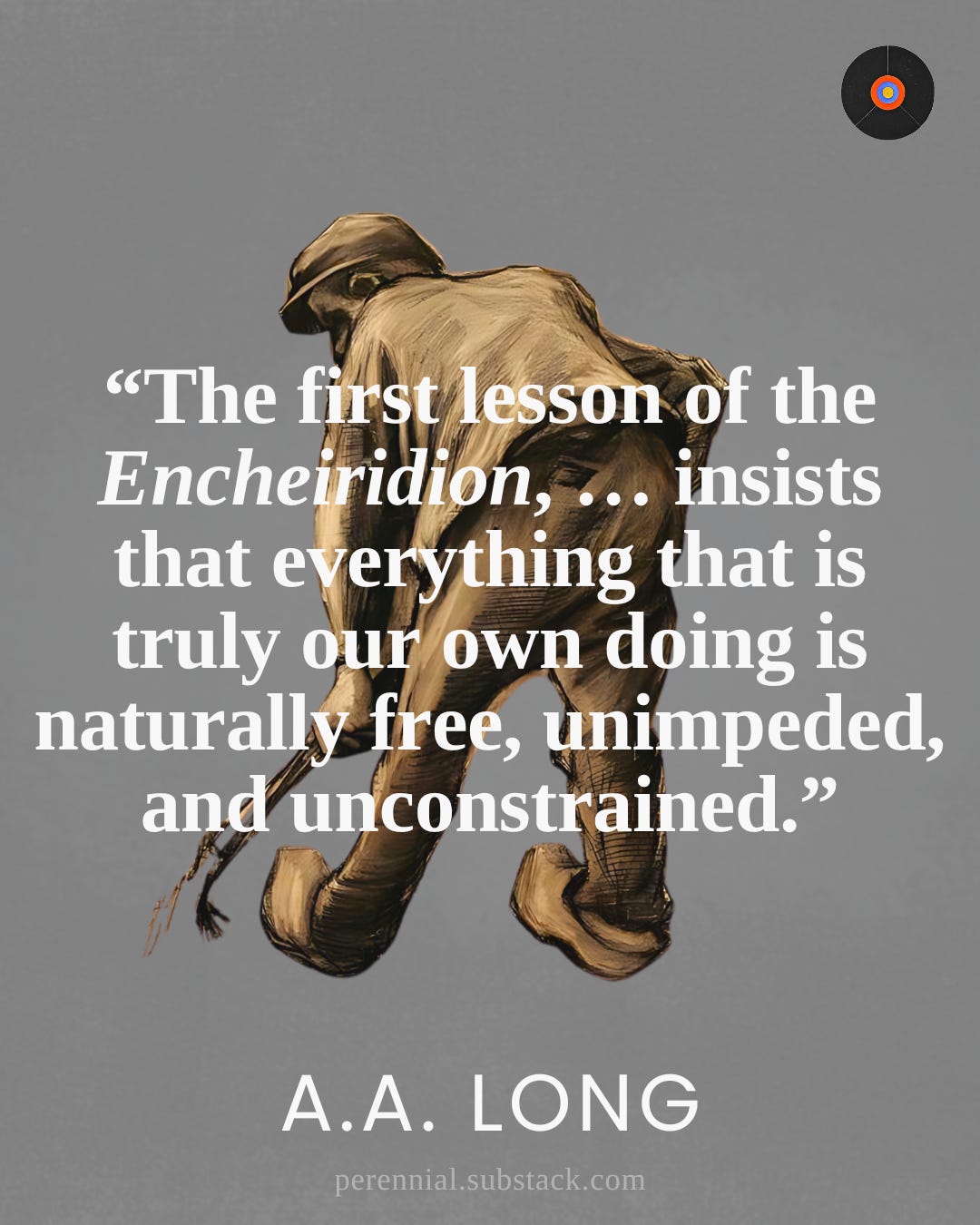
In his book How to Be Free, the philosopher A.A. Long explains,
The first lesson of the Encheiridion, …insists that everything that is truly our own doing is naturally free, unimpeded, and unconstrained. Freedom, according to this notion, is neither legal status nor opportunity to move around at liberty. It is the mental orientation of persons who are impervious to frustration or disappointment because their wants and decisions depend on themselves and involve nothing that they cannot deliver to themselves.
“How does this calm the mind?” you might ask. Training (or ordering) our desires and aversions is connected to leading one’s life (or practicing one’s philosophy). Although tranquility is not the goal (or highest good) in Stoicism, there is freedom in aligning one’s desires and aversions with virtue (or “the only good”, according to the Stoics).
To the question, “Who is your master?” Epictetus responded, “Whoever has authority over anything you’re anxious to gain or avoid.”
Reflection Prompt
Consider reflecting (or journaling) on the notion that you have everything you need to live the good life. You could contemplate the question posed by Epictetus: “Since desire and aversion are within your own power, then, what else do you need to worry about?”
Listen on Apple Podcasts, Spotify, or YouTube
—
Thank you for listening; I hope you found something useful.
Until next time, be wise and be well,
J.W.
P.S. I greatly appreciate your time, attention, and support!
The statements
statements
“Whoever has authority over anything you’re anxious to gain or avoid.” and
"The goal is not tranquility"
are interesting. To me this means, that the knowledge you are doing your best to live a virtuous life is the bridge between being anxious and tranquility. But being Human we can only strive to truly cross that bridge.