

💀 Dying Every Day
Dying Every Day (Stoicism in a Year) is a podcast by the Perennial Leader Project. Each episode turns a selected passage from Stoic philosophy into a guided meditation designed to help you (and me) learn how to live.
Listen on Apple Podcasts, Spotify, or YouTube
Epictetus on Being a Philosopher
Welcome back to Dying Every Day (Stoicism in a Year). We’ve made it to Day 62, where we’re turning to Epictetus to learn the difference between a layman and a philosopher.
Epictetus stressed to his students,
The first difference between a layman and a philosopher is this, that the one says, ‘Ah, how I suffer because of my child, because of my brother, ah, how I suffer because of my father,’ whereas the other, if he can ever be compelled to say, ‘Ah, how I suffer,’ adds after a moment’s thought, ‘because of myself’.
Epictetus continues,
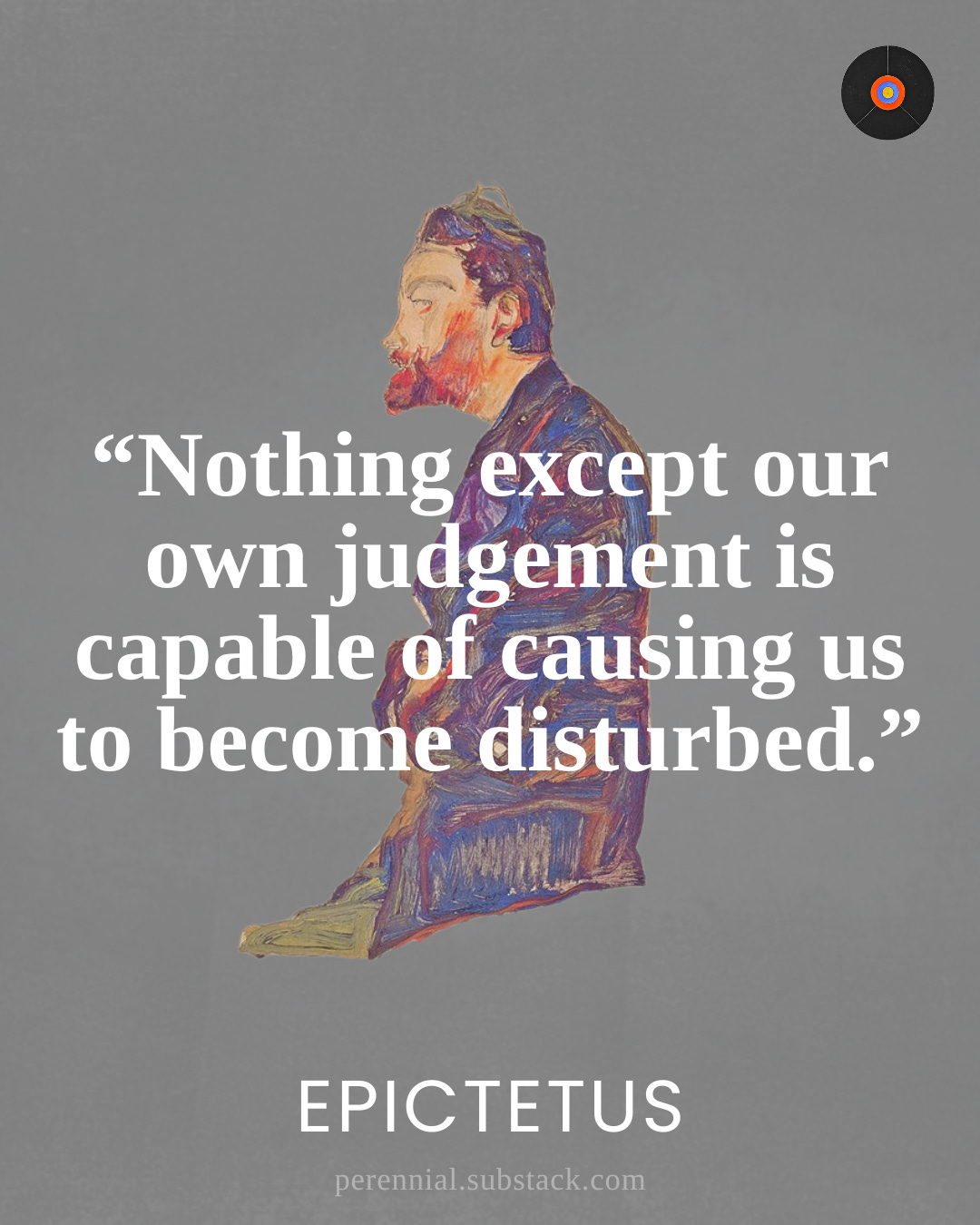
For choice cannot be hindered or harmed by anything that lies outside the sphere of choice, but only by choice itself. So if we too incline towards this latter course, and whenever we go astray, blame ourselves for it and remember that nothing except our own judgement is capable of causing us to become disturbed or confused. +Adapted from Discourses
This is a challenging insight to embody.
For Epictetus, who has a rather direct style, the roots of suffering come down to our choices and judgments. A consistent theme in Stoic philosophy is that we don’t react to events; we respond to our judgments about them, and the judgments are up to us.
In his book The Practicing Stoic, Ward Farnsworth put it this way,
For many students of Stoic philosophy, this first principle starts as counterintuitive, gradually becomes convincing, and finally seems obviously true – and then the cycle may be repeated, because the mind constantly gives us an opposite impression that appears convincing in its own right.
Reflection Prompt
Consider reflecting (or journaling) on a recent challenge in your life. Attempt to find something that you have an aversion to or causes you to suffer. Then, you might examine your choices (or judgments) about said event or circumstance. You could ask yourself, “How does my judgment connect or relate to my experience of suffering?”
Listen on Apple Podcasts, Spotify, or YouTube
—
Thank you for reading/listening; I hope you found something useful.
Until next time, be wise and be well,
J.W.
P.S. I greatly appreciate your time, attention, and support!
Most of my anxiety is related to current state of affairs with our nation's current leadership.
Am I judging the situation with respect to the risks to democracy and our collective social responsibility as cosmopolitan citizens and as a nation correctly? And am I taking the right actions to challenge it and turn it to a more just flourishing leadership?
I believe these same concerns are on the minds of many of my fellow (global) human beings because at the most basic ethical level we are violating the golden rule, in my opinion.