

Perennial Wisdom
Perennial Wisdom is a podcast for seekers and curious minds. Each episode explores philosophical and spiritual traditions for universal truths and enduring ideas to help you (and me) never stop learning how to live.
Listen on Apple Podcasts, Spotify, or YouTube
Dostoevsky on Freedom, Suffering, and Love
In this episode of Perennial Wisdom, we explore the moral and psychological depth of Fyodor Dostoevsky, one of the greatest novelists and spiritual thinkers in history. From his near-execution in 1849 to his rebirth in the prisons of Siberia, Dostoevsky’s life became a living parable of human suffering, redemption, and love.
Drawing from Crime and Punishment, The Brothers Karamazov, and The Idiot, we uncover three perennial lessons for the modern world:
Freedom without responsibility leads to despair.
Suffering is the path to self-knowledge.
Love is the final answer to the problem of evil.
Listen on Apple Podcasts, Spotify, or YouTube
Episode Transcript
The following is a transcript from “Dostoevsky on Freedom, Suffering, and Love” on the Perennial Wisdom podcast (Ep. 250).
—
On a freezing December morning in 1849, Fyodor Dostoevsky stood before a firing squad in St. Petersburg. The drums rolled. The rifles were raised. At the final moment, a messenger arrived from the palace: a pardon. The sentence was commuted to hard labor in Siberia.
Dostoevsky would later say that those five minutes before his expected death changed him forever. They stripped away illusion, leaving only what mattered.
In the icy prisons, surrounded by murderers and thieves, he began to see what he called “the mystery of man.” When he emerged years later, his writing would probe the human condition with a psychological and spiritual intensity unlike anything before—or since.
Today, Dostoevsky speaks to us across centuries not as a moralist, but as a witness. His novels—Crime and Punishment, The Brothers Karamazov, The Idiot, Notes from Underground—remain mirrors for our fragmented age.
1. Freedom and Responsibility
“If God is dead, everything is permitted.” — The Brothers Karamazov
In Dostoevsky’s world, this line from Ivan is not merely a philosophical statement; it’s a warning about the dangers of radical freedom. For Ivan, the death of God makes everything meaningless, and in the absence of divine morality, he believes that nothing is forbidden.
Dostoevsky understood that freedom without responsibility leads to moral chaos. This crisis of freedom is precisely what he explored in Notes from Underground, where the Underground Man mocks the idea that reason can lead to moral action:
What do I care for the laws of nature and arithmetic, if for some reason I don’t like them?
Such liberty is the voice of nihilism, a freedom that’s ungrounded and unanchored by values. It’s a freedom that suffocates us.
For Dostoevsky, freedom must be tethered to duty and moral principles. Freedom without conscience, without higher aims, leads only to despair and moral decay.
Modern thinkers like the British philosopher Isaiah Berlin have also warned against the dangers of negative liberty—the type of freedom where we reject all constraints but fail to create meaningful lives. Instead of bringing us peace, this move isolates us.
Dostoevsky noted,
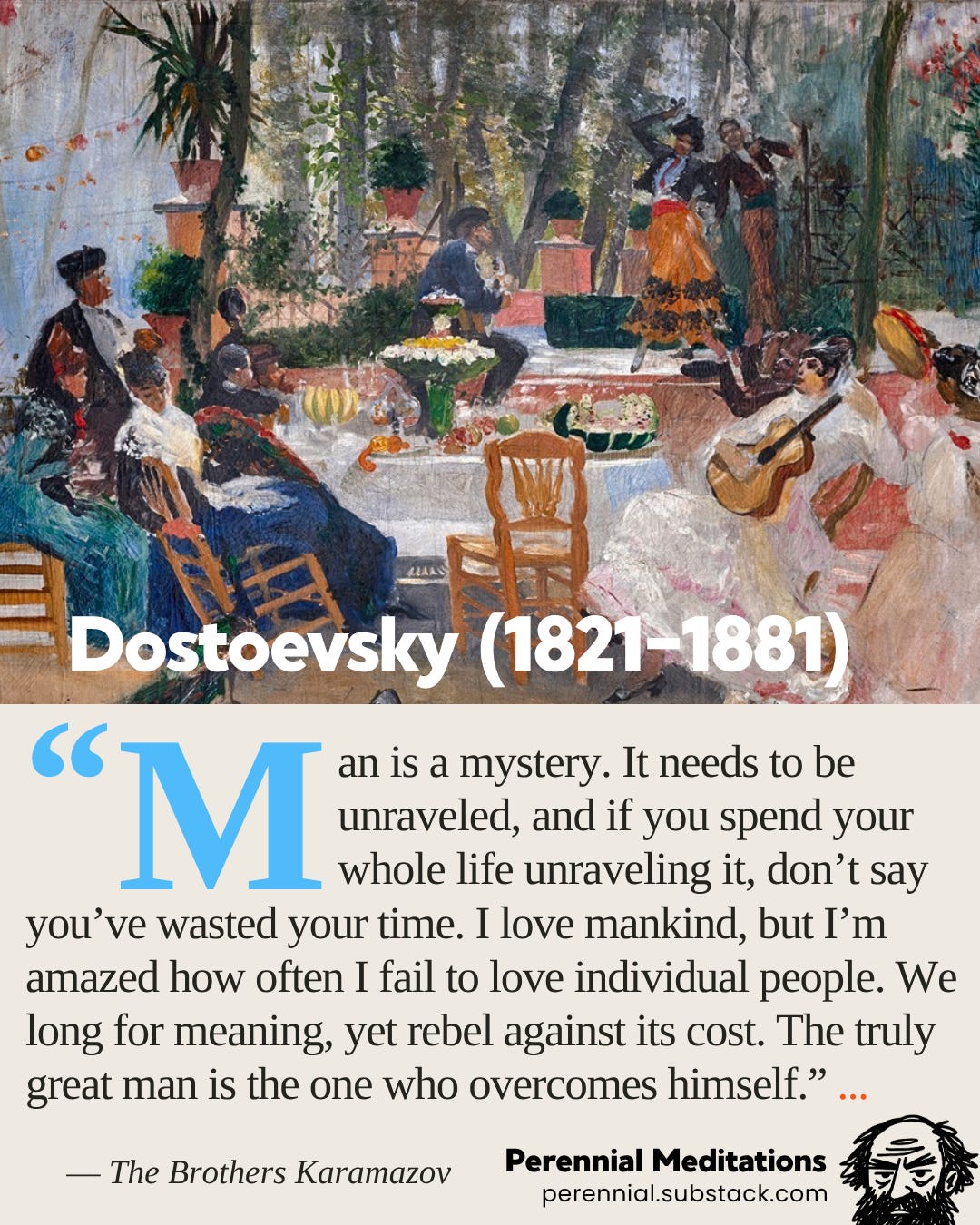
The mystery of human existence lies not in staying alive, but in finding something to live for.
To Dostoevsky, true freedom is not about breaking every rule. It’s about choosing to act in ways that honor responsibility, love, and the moral law.
2. Suffering and Self-Knowledge
Pain and suffering are always inevitable for a large intelligence and a deep heart. — Crime and Punishment
Suffering is an inevitable part of life. Dostoevsky not only wrote about it but also experienced it firsthand. Exiled to Siberia and facing death, he knew what it was like to feel abandoned by God—he understood suffering in a way few others could.
In Crime and Punishment, we meet a young student who commits a murder, convinced that he is an extraordinary man who is above moral law. But after the crime, his intellect can no longer protect him from the unbearable weight of guilt. He descends into delirium.
Dostoevsky shows us that suffering is not the end—it is the beginning of redemption. It is through suffering that he faces his inner darkness and begins the path of repentance and self-knowledge.
Dostoevsky writes,
Go at once, stand at the crossroads, bow down, and say aloud, ‘I have killed.’ Then God will send you life again.
Suffering, in Dostoevsky’s world, is a necessary part of the human experience. It is the crucible in which the soul is tested and purified.
Likewise, Carl Jung, the Swiss psychologist, famously said, “There is no coming to consciousness without pain.”
Dostoevsky understood this better than anyone: suffering without meaning destroys us. But suffering with meaning leads us to a deeper self—to compassion, redemption, and hope.
For Dostoevsky, suffering, when approached with courage and humility, reveals our true selves.
3. Love and the Problem of Evil
Love in action is a harsh and dreadful thing compared to love in dreams.
— The Brothers Karamazov
Dostoevsky’s characters wrestle with the problem of evil at every turn. Ivan famously asks how a benevolent God could allow so much suffering, particularly the suffering of innocent children. The suffering of children—Ivan’s rebellion—is not just a theological argument; it is the deepest moral and spiritual wound Dostoevsky could imagine.
Dostoevsky does not try to explain away evil. He faces it head-on, acknowledging its terror. Yet, Dostoevsky offers no rational explanation for evil—only love as a remedy.
In the Grand Inquisitor parable, Ivan’s indictment of the world is met with silence and compassion by Alyosha, his brother. Alyosha, a devout monk, represents the opposite of Ivan’s cynicism. He believes in the power of love to redeem humanity, even in the face of the worst evils. Alyosha doesn’t provide intellectual answers. Instead, he lives out a vision of unconditional love.
He says,
Each of us is responsible for everyone and for everything.
— The Brothers Karamazov
Dostoevsky teaches us that evil is not overcome by reasoning or philosophy, but by the will to love—and to suffer for that love. Love, for him, is the ultimate force that redeems the world.
Interestingly, Prince Myshkin in The Idiot represents this. He is simple, pure, and loving, even though society mocks and misunderstands him. He chooses love, even when it seems like the only foolish thing to do.
Love, in Dostoevsky’s view, is not just a feeling. It is a decision—a practice of seeing the divine in every person, no matter how broken.
The existential psychologist Erich Fromm, in his book The Art of Loving, captured this notion when he wrote:
Love is not primarily a relationship to a specific person; it is an attitude, an orientation of character which determines the relatedness of a person to the world as a whole, not toward one ‘object’ of love. If a person loves only one other person and is indifferent to the rest of his fellow men, his love is not love but a symbiotic attachment, or an enlarged egotism. Yet, most people believe that love is constituted by the object, not by the faculty.
Dostoevsky would agree. Love, in his work, is an active choice to recognize goodness even amidst evil, to heal wounds that reason cannot reach.
Final Thoughts
The darker the night, the brighter the stars; The deeper the grief, the closer is God. — Crime and Punishment
Dostoevsky’s novels are not easy to read. They require us to look into the abyss—and see our own souls reflected back. He invites us to ask the perennial question: “What kind of human being will I become?”
Will I choose to run from the responsibility of our freedom?
Will I avoid suffering, or let it transform me?
And when faced with evil, will I choose to love, even when it hurts?
In a world obsessed with success, comfort, and certainty, Dostoevsky shows us that freedom without responsibility is a prison. Suffering without meaning is despair. And love, true love, is the answer to the problem of evil.
—
Thank you for reading/listening; I hope you found something useful.
Until next time, be wise and be well.
J.W.
P.S. If you enjoyed it, consider leaving a rating on Apple Podcasts or Spotify.
The long suffering and death of a child. If God is dead, all things are possible. These plague Ivan’s mind and, finally, drives him mad just at the point at which he could save his brother at his trial. The novel ends with the youngest brother, Aloysha, at the funeral of a young boy, who we meet in a chapter entitled “Lacerations.” I did not understand how the child’s funeral could be the ending of the book, but your essay helped see how the structure of the book is the answer to Ivan’s burning questions. The love, reconciliations, and the memory of Ilyushecha are an answer: “How good life is when one does something good and just!” That is better than madness.
Hey Art, Thanks for sharing; glad to hear you found something useful in the essay.