

Reading & the Good Life
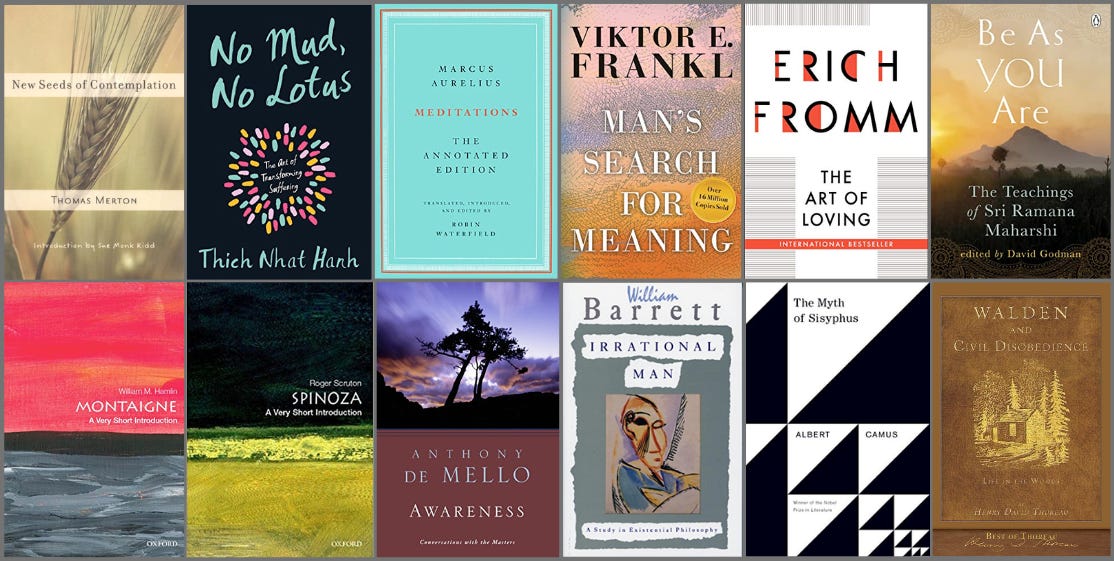
Join the conversation! Every Friday at Noon EST (Join here), Perennial Meditations readers are welcome to gather for Reading & the Good Life. A space for connection, contemplation, and conversations on the art of living! This week concludes our exploration of existential philosophy with Irrational Man by William Barrett, initially published in 1958.
Check out our bookshelf below for previous and future reading.
A Study in Existential Philosophy
As discussed in How to Think Like an Existentialist, How to Be Yourself — Like Nietzsche, How to Think — Like Kierkegaard, and Being in the World — According to Heidegger, Existentialism is challenging to define. Existentialist thinkers explored a broad range of issues from meaning, purpose, anxiety and authenticity, freedom, absurdity, and the value of human existence. Among the earliest figures associated with Existentialism include: Søren Kierkegaard, Friedrich Nietzsche, and the novelist Fyodor Dostoevsky. In the 20th century, prominent existentialist thinkers included Jean-Paul Sartre, Albert Camus, Martin Heidegger, and Simone de Beauvoir.
Condemned to Be Free — Jean-Paul Sartre
Jean-Paul Sartre (1905—1980) was a French philosopher, novelist, and a key figure in the philosophy of existentialism. Like many of his generation, Sartre lived through a series of significant cultural and historical events that his existential philosophy responded to and attempted to shape. His notable works include: Existentialism is a Humanism, Being and Nothingness, Nausea, and others.
Barrett describes Sartre’s philosophy this way in Irrational Man,
The essential freedom, the ultimate and final freedom that cannot be taken from a man, is to say No. This is the basic premise in Sartre’s view of human freedom: freedom is in its very essence negative, though this negativity is also creative.
