

💀 Dying Every Day
Dying Every Day (Stoicism in a Year) is a podcast by the Perennial Leader Project. Each episode turns a selected passage from Stoic philosophy into a guided meditation designed to help you (and me) learn how to live.
Listen on Apple Podcasts, Spotify, or YouTube
Cicero on the common good
Welcome back to Dying Every Day (Stoicism in a Year). This is Day 116.
What is virtue worth if it never leaves your heart or your mind? If it never shows itself in the world, what good is it? Cicero reminds us: virtue only truly exists when it moves outward—when it serves others.
Cicero writes:
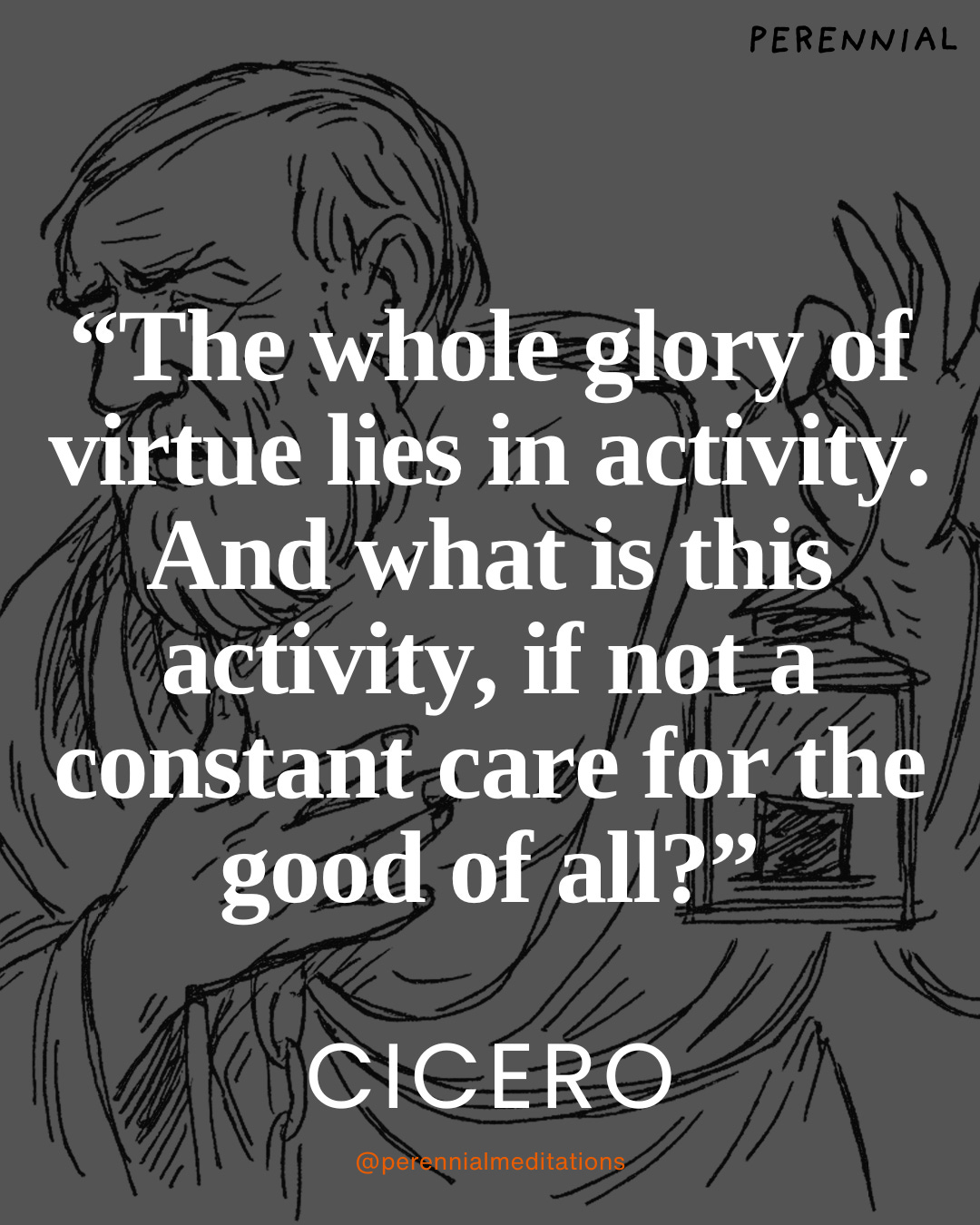
The whole glory of virtue lies in activity. And what is this activity, if not a constant care for the good of all? For just as it is characteristic of a pilot to preserve his ship in a storm, and of a physician to heal the sick, so too it is the office of a wise man to safeguard the interests of his fellow men. And anyone who withdraws himself from the common good, and seeks only his own gain, has abandoned his post in human society, for which he was born and to which he owes everything.
+Adapted from On the Good Life
We tend to think of virtue as a private trait—something we quietly hold within. However, Cicero and the Stoics dispute this notion. Virtue only truly exists through action, and such action is always intended for the benefit of others.
Cicero states that a pilot's skill shows itself during a storm, a doctor's expertise is evident with the sick, and a wise person's virtue is reflected in their concern for humanity.
You don’t need to captain a ship or heal a patient to make a difference. Holding a door, comforting a friend, or speaking out for what’s right—these actions also honor your role in society.
Cicero’s image of “abandoning one’s post” is worth lingering on. To live only for yourself is not neutrality—it’s desertion. You walk away from the role entrusted to you, leaving behind the people and the world.
The Roman emperor Marcus Aurelius put it simply:
What brings no benefit to the hive brings no benefit to the bee.
When you neglect the whole, you harm yourself too—because your own well-being is bound to the well-being of others.
And yet, in our modern world, it is easy to withdraw. To focus only on personal comfort, private gain, or our own small circle. But Cicero reminds us: this is not what we were born for.
The wise person remains at their post—sometimes quietly, sometimes at great cost—maintaining their watch over the common good. Not perfectly. Not without fatigue. But persistently, knowing that the glory of virtue lies not in being admired, but in being useful.
In the end, virtue is not what you carry within, but what you leave behind—in the common good you’ve helped sustain.
Reflection Prompt
Consider reflecting or journaling on the common good. You could ask yourself, “Where in your life have you retreated from your post, caring only for yourself?” Or consider, “What is one small way you can serve the common good today, however quietly?”
Listen on Apple Podcasts, Spotify, or YouTube
—
Thank you for reading/listening; I hope you found something useful.
Until next time, be wise and be well.
J.W.
P.S. Catch up on the previous episodes of “Dying Every Day” below:

