

🖼️ Monday Muse
The Monday Muse is a weekly collection of reminders, insights, and maxims on the art of living. The term “muse” has two meanings: (1) a state of deep thought; and (2) a source of inspiration. May the following (in a small way) be a source of contemplation, insight, and wisdom to live your highest good.
📌 Perennial Reminder(s)
The American Jungian analyst and writer James Hollis on becoming who we are:
Gaining a sense of worth and recovering personal authority thus becomes the single most important task of the second half of life. From our personal authority, or lack thereof, our choices rise, our consequences multiply, and our lives course onward in their uncertain ways.
Too often we identify who we are by what happened to us. …
Often, the desired outcome of therapy is the discovery that we are not what happened to us but what we chose to become. This transformation of consciousness makes a huge difference in our sense of permission to live the life we wish and to take the risks necessary to fulfill our potential. …
As a Jungian analyst, I’ve often tried to put a wedge between what happened to a person and who they think they are—their old reductive and restrictive stories. It seems impossible at times to believe, but it is true that what happened to us was what happened ‘out there.’ What happened ‘out there’ is not who we are. […]
Source: A Life of Meaning
📜 Perennial Maxim(s)
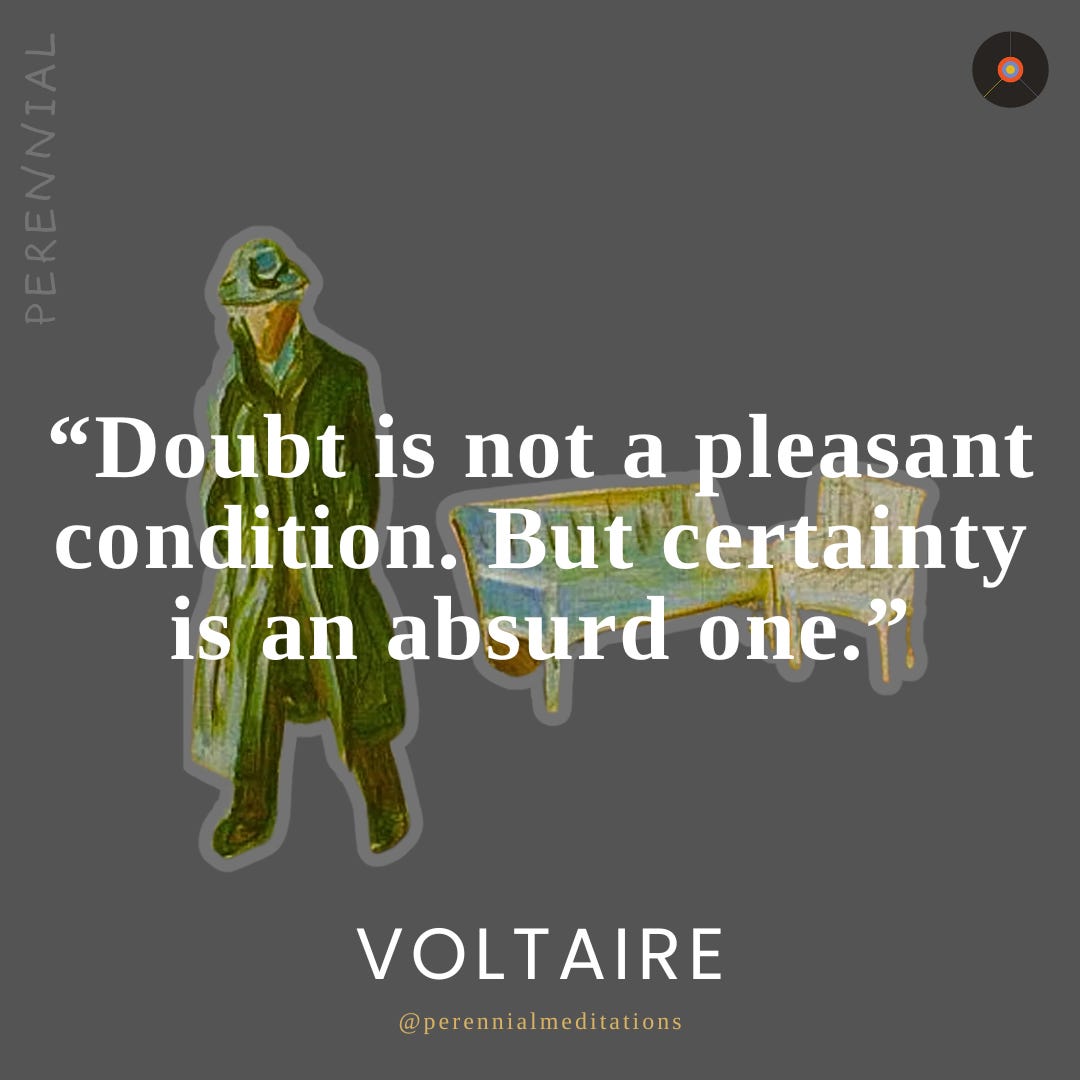
The French writer Voltaire (1694—1778) on doubt and uncertainty:
Follow Us: Instagram | Youtube
💡 Perennial Insight(s)
The French philosopher Michel de Montaigne (1533–1592) on life’s continual task:
Death is one of the attributes you were created with; death is a part of you; you are running away from yourself; this being which you enjoy is equally divided between death and life. …
All that you live, you have stolen from life; you live at her expense. Your life’s continual task is to build your death. You are in death while you are in life: when you are no more in life, you are after death. …
The usefulness of living lies not in duration but in what you make of it. Some have lived long and lived little. See to it while you are still here. Whether you have lived enough depends not on a count of years but on your will. […]
Source: Essays (To philosophize is to learn how to die)
—
Thank you for reading; I hope you found something useful.
Until next time, be wise and be well,
J.W. Bertolotti
P.S. If you’re interested in becoming a member but cannot afford it, feel free to request a complimentary membership or use this discount link.