


💀 Dying Every Day
Dying Every Day is a podcast by the Perennial Leader Project. Each episode turns a selected passage from Stoic philosophy into a guided meditation designed to help you (and me) learn how to live.
Listen on Apple Podcasts, Spotify, or YouTube
A Stoic Guide to Money and Happiness
Welcome back to Dying Every Day. This is Day 132.
Fortune often changes without warning. An opportunity appears, a season of ease begins, or a long-awaited success finally arrives. Just as easily, circumstances shift: a job ends, plans fall apart, or what once felt secure becomes uncertain.
These changes are part of life, not personal verdicts about our worth.
The Roman emperor Marcus Aurelius never advised rejecting prosperity. Instead, he taught us to relate to it wisely. He writes:
“Receive wealth or prosperity without arrogance; be ready to let it go without sorrow.”
To receive without arrogance is to recognize that success is never achieved by effort alone. Luck, timing, health, relationships, and the contributions of others play a role in every gain.
Gratitude is the appropriate response, not self-importance.
The second instruction is more challenging: be ready to let it go without sorrow. This does not mean pretending loss is pleasant. It means refusing to tie your peace to things that were never fully under your control.
The Stoic approach is not emotional denial; it is emotional honesty without dependence. You acknowledge what you had, you feel the disappointment when it changes, and you keep your footing.
Epictetus sharpened this point when he said that when something is taken from us, we should not say, “I have lost it,” but “I have returned it.” Everything given to us—status, comfort, resources, relationships—was always subject to change.
Recognizing the truth helps soften the shock when circumstances shift.
Marcus continues:
“If it comes, use it rightly; if it leaves, do not chase it.”
Wealth is not inherently good or bad. Its moral value depends entirely on how it is used. Seneca stressed that “wealth is the servant of the wise, the master of fools,” meaning that prosperity can support virtue when held correctly or undermine it when clung to.
Using prosperity rightly might mean being generous, fair, or disciplined with what you have. It might mean using resources to support others, invest in growth, or pursue meaningful work. And if prosperity fades, refusing to chase it allows you to return your attention to the only area where strength is always available: your ability to choose your attitude and your actions.

The philosopher Boethius learned this lesson with painful clarity. Once a trusted Roman official, he fell suddenly from influence and found himself imprisoned and disgraced.
In that cell, he wrote The Consolation of Philosophy, reflecting on the instability of fortune. Philosophy asks him why he mourns the loss of things he always knew were temporary.
Boethius put it this way:
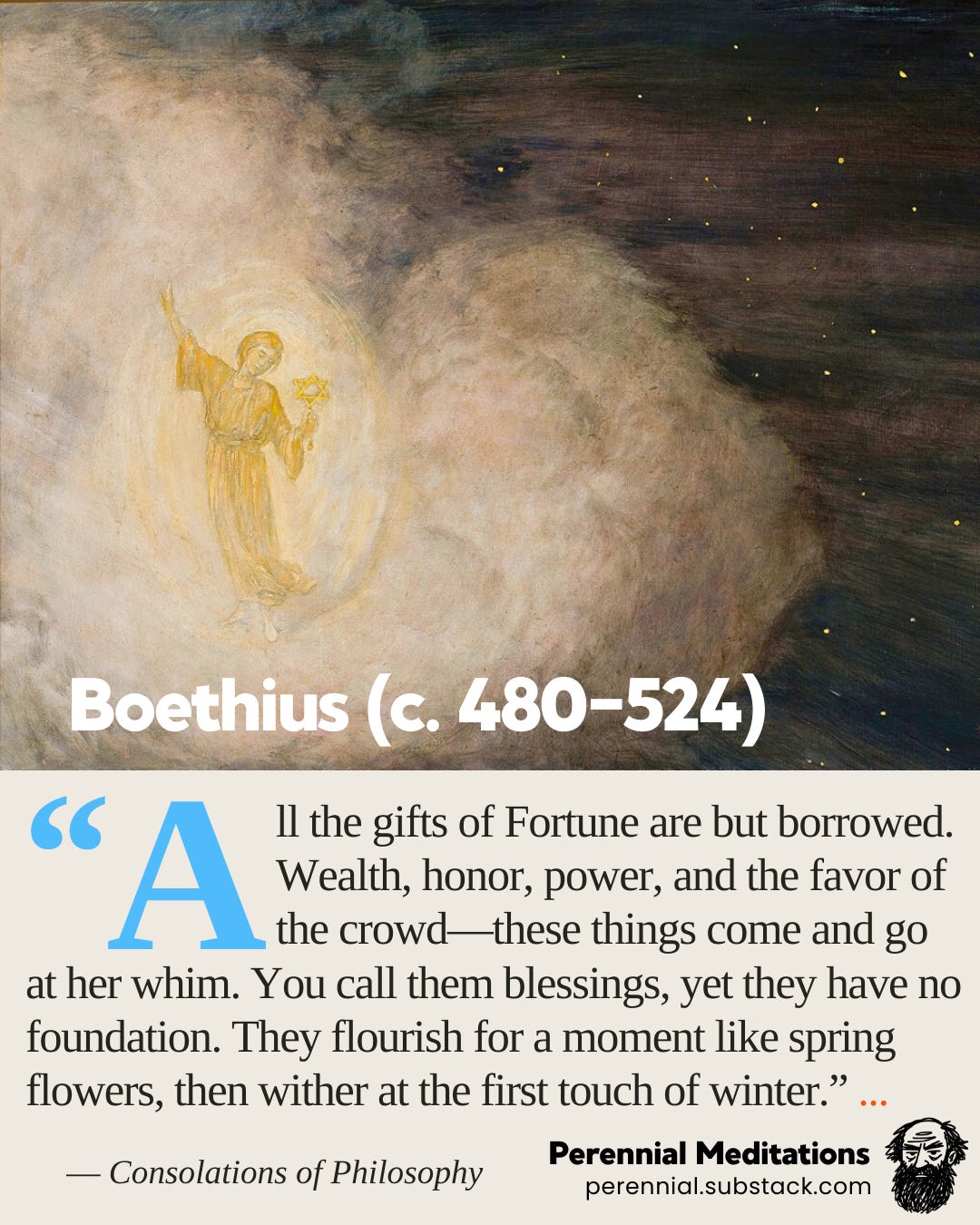
All the gifts of Fortune are but borrowed. Wealth, honor, power, and the favor of the crowd—these things come and go at her whim. You call them blessings, yet they have no foundation. They flourish for a moment like spring flowers, then wither at the first touch of winter.
He added:
No one can be made truly happy by possessions that can be snatched away.
The good that Fortune gives is not your own, and what is not truly yours cannot make you rich. Seek therefore the sovereign good, which neither Fortune bestows nor takes away. It lies within you, rooted in reason and virtue, and by cultivating it, you shall stand unshaken in every change.
Over time, Boethius comes to see that his freedom, dignity, and clarity must come from within. What remained to him—his reasoning, his conscience, his principles—was more important than what had been taken.
Marcus makes the same point: what truly matters is what remains in your control—your judgment, your integrity, your choices. These are the elements of character that no external event can steal. Prosperity may expand your options, and its loss may restrict them, but neither defines you unless you let it.
The central lesson is simple and demanding: prosperity is welcome when it comes, but it should not govern the state of your inner life.
Success does not justify arrogance.
Loss does not require despair.
Your worth is measured not by what fortune provides or takes away, but by how you respond. Receive what comes. Release what leaves. And remain steady in what is yours to shape.
Reflection Prompt
Think of one thing you have gained recently—an opportunity, a bit of good fortune, or something that made life easier. Then identify one thing you have lost, or that has changed unexpectedly.
For each one, ask, “What part of the outcome was truly up to me, and what part depended on circumstances?”
Notice how you responded to the gain and the loss.
Did success inflate you?
Did the loss unsettle you more than it should have?
Be honest but gentle with yourself.
Name one quality (or virtue) you want to practice—and ask, “How can I act from this virtue regardless of what comes or goes?”
Listen on Apple Podcasts, Spotify, or YouTube
—
Thank you for reading/listening; I hope you found something useful.
Until next time, be wise and be well.
J.W.
P.S. Catch up on recent (and past) meditations in the archive!
I built an AI journaling coach that asks Socratic questions and helps you build systems. Completely free. Copy the prompt and use it tonight. https://open.substack.com/pub/theinnerself46/p/clarity-is-a-competitive-advantage?r=2kbdxu&utm_campaign=post&utm_medium=web&showWelcomeOnShare=true
Great post! It was a great reminder that everything is temporary. Enjoy the successes, learn from the failures, and find joy in both! Happy Holidays!