

💀 Dying Every Day
Dying Every Day is a podcast by the Perennial Leader Project. Each episode turns a selected passage from Stoic philosophy into a guided meditation designed to help you (and me) learn how to live.
Listen on Apple Podcasts, Spotify, or YouTube
A Stoic Guide to Happiness—The Art of Having Enough
Welcome back to Dying Every Day. This is Day 129.
In every age, people chase abundance and ultimately feel empty. The table is full, yet hunger remains. The house grows larger, but the heart feels smaller. Seneca saw this disease of endless desire clearly—what we call wealth often enslaves us more than poverty ever could.
He once asked his friend Lucilius, “What is the proper limit to a person’s wealth?” His answer was disarmingly simple:
First, having what is essential; second, having what is enough.
If we live according to nature, he said, we will never be poor. But if we live according to opinion—measuring our worth by the shifting approval of others—we will never be rich.
Nature’s desires are few: a little food, some shelter, warmth, friendship, and meaningful work. These are the ingredients of a full life. However, opinion has no limit. It whispers that satisfaction is just out of reach: one more purchase, one more promotion, one more proof of success.
And so, we feed an appetite that can never be satisfied.
Seneca understood that craving is the true poverty of the soul. “It is not the man who has too little,” he said, “but the man who craves more, who is poor.” We imagine that adding more will bring contentment, but abundance without boundary breeds anxiety. Every new desire multiplies dependence; every act of gratitude multiplies freedom.
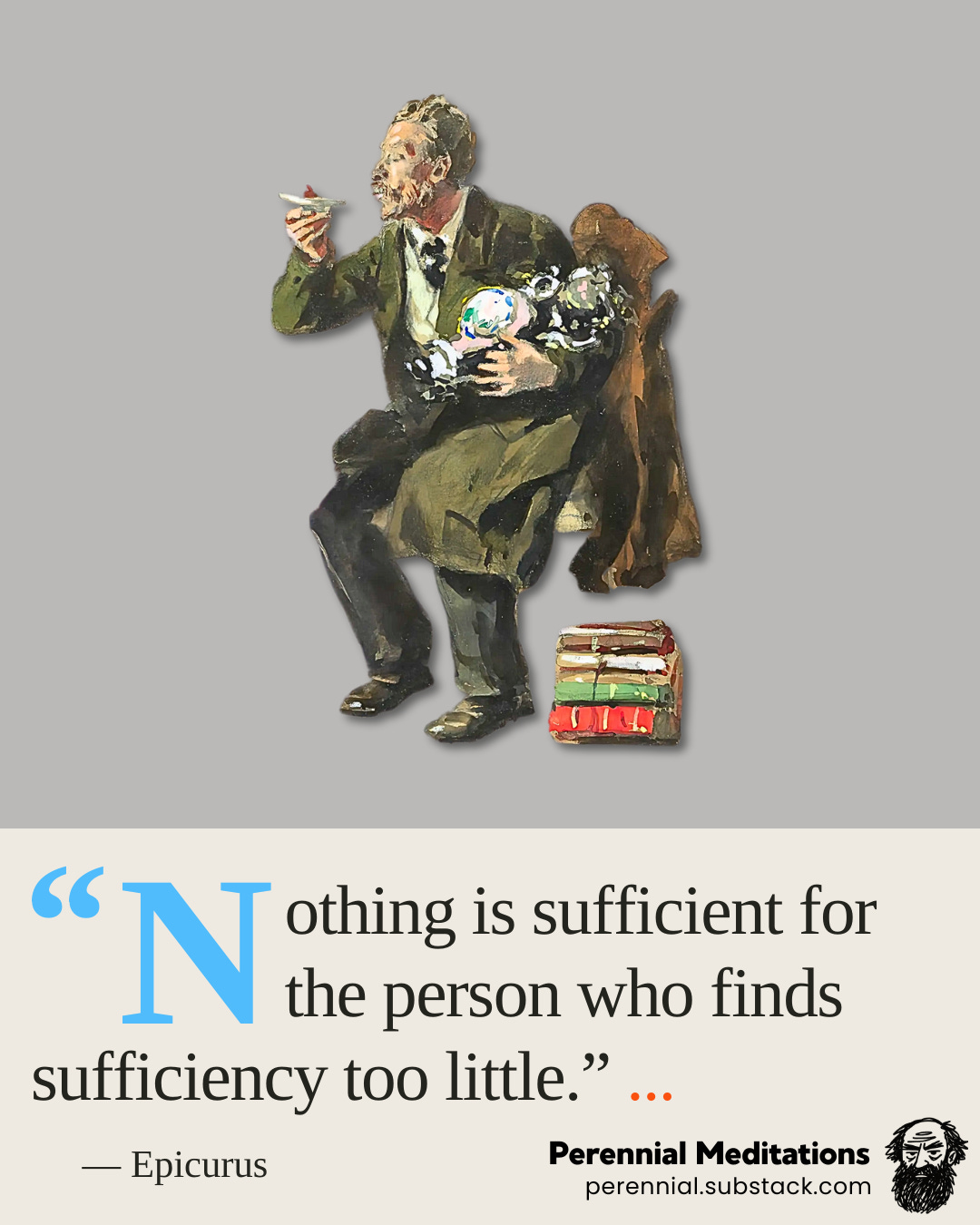
Even the philosopher Epicurus, so often miscast as a lover of indulgence, taught this same truth. He wrote,
If you wish to make a man rich, do not add to his money, but subtract from his desires.
For Epicurus, pleasure was not luxury but peace—a quiet state of sufficiency in which the mind no longer aches for what it lacks. To live wisely, he emphasized, is to distinguish between natural needs and imaginary wants.
Modern research reflects the wisdom of these ancient thinkers. Once our basic needs are satisfied, accumulating more wealth doesn’t lead to greater happiness.
The psychologist Albert Ellis described this as the tyranny of “musts”—the belief that we need more to feel secure, loved, or successful. He proposed that the answer is to change those “musts” into preferences, replacing the pursuit of more with the peace of having enough.
Practicing sufficiency isn't about rejecting comfort but about shifting the heart. It involves enjoying what we have without attachment, earning without greed, and giving without fear of loss.
The Stoics didn't look down on prosperity—they just refused to be controlled by it. According to Seneca, a free person isn't someone who owns nothing but someone who isn't owned by anything.
Here’s how Epictetus put it:
Wealth consists not in having great possessions, but in having few wants.
Seneca, Epicurus, and Epictetus all emphasize the same aim: the art of having enough. They suggest that a truly fulfilling life comes from minimizing endless desires rather than amassing possessions.
Living according to nature means to live with open hands—allowing each day to give what it will and accepting it as enough. The cup may not be full, but that isn't necessary. Its contents already satisfy what matters most.
Reflection Prompt
As you move through the day, consider noticing every time your mind says, “I need.” Write each of those “needs” in a notebook or on your phone.
In the evening, look back and ask:
Which of these are actual needs—essential to my well-being or peace?
Which are opinions disguised as necessities?
Seneca wrote that nature’s wants are small, but opinions are infinite. Seeing the difference is the first step toward freedom.
Listen on Apple Podcasts, Spotify, or YouTube
—
Thank you for reading/listening; I hope you found something useful.
Until next time, be wise and be well.
J.W.
P.S. Catch up on recent (and past) meditations in the archive!
Beautifully expressed! And it’s always good to be reminded of the simple truth about what is enough and the insatiability of desires. Thank you!
Brilliant!
Thank you.