

Perennial Wisdom
Perennial Wisdom is a podcast for seekers and curious minds. Each episode explores philosophical and spiritual traditions for universal truths and enduring ideas to help you (and me) never stop learning how to live.
Listen on Apple Podcasts, Spotify, or YouTube
A Meditation on the “Present” of Christmas
Christmas invites us to reflect on gifts, but the most meaningful one is the hardest to give. It isn’t bought or wrapped; it has nothing to do with ribbons or receipts. The true “present” of Christmas is presence itself—the quiet courage to be here, fully, without rushing past your own life.
Before we offer anything to others, Christmas calls us to accept this moment as a gift. But that’s not usually how the season feels.
The roads are jammed, inboxes fill with sales and invitations, and there’s always one more thing to buy, one more event to attend. Outwardly, everything speeds up. Inwardly, many of us feel scattered and thin. Precisely here, in the busyness and noise, the Christmas season can become a school for the inner life.
In his Thoughts on the Theology of Christmas, the Jesuit priest and theologian Karl Rahner (1904–1984) wrote:
Have the courage to be alone. Only once you have really managed to do this, and have achieved it in a Christian way, can you hope to give the present of a heart filled with the Christmas spirit–in other words, a gently patient, courageously collected, softly tender heart–to those whom you are striving to love.
Rahner adds:
This present is indeed something you should place under the Christmas tree, otherwise all other presents will simply be an unnecessary expense which could be incurred at any time of the year. And so, for once, try to endure your own company for a while. Perhaps you can find a room where you can be alone. Or you may know a lonely walk or a quiet church.
Rahner turns our usual logic of Christmas upside down. We assume the best gifts are the ones we can wrap and hand to others. He suggests that the real gift is the kind of heart we carry into the room: gently patient, courageously collected, softly tender. You can’t purchase that heart or rush it into existence.
It is formed, slowly, in silence and solitude.
For many, the thought of being alone at Christmas feels like the opposite of what they long for. Solitude can sound like abandonment or proof that everyone else is living a more joyful life somewhere else.
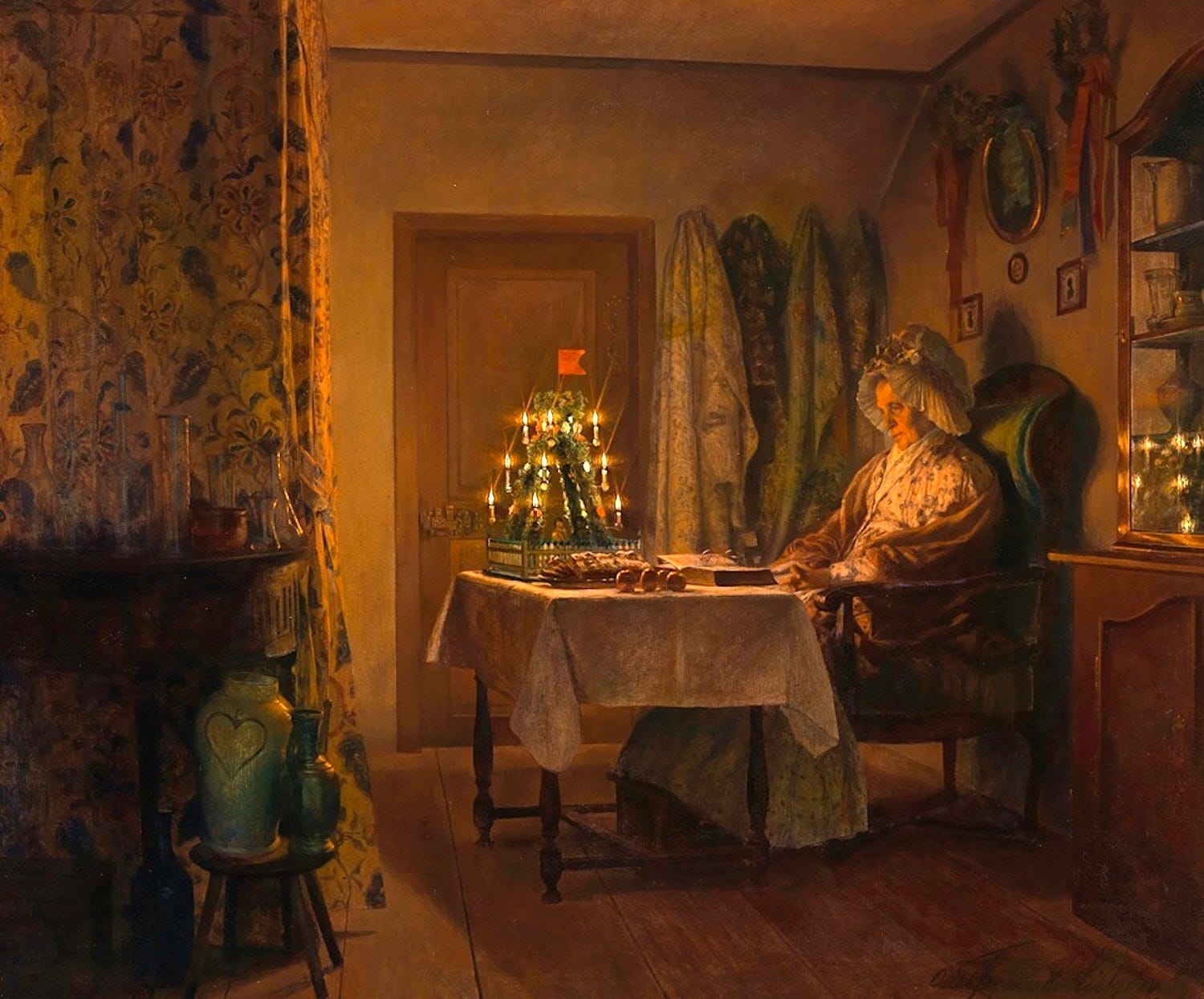
But Rahner is not urging us to withdraw from the people we love. He is inviting us to step back just enough to become truly present to them. Without that inner gathering, we arrive at the table physically but remain scattered inside.
This is where a contemplative approach to Christmas begins.
Even as the world moves quickly, we can practice moving more slowly on the inside. That might look like sitting in a quiet room before everyone wakes up, taking a short walk after dinner, or slipping into a side pew of a nearly empty church. The point isn’t a dramatic spiritual experience; it’s simply coming back to where you already are.
Rahner continues:
Wait. Listen. You must not keep quiet in this way simply in order to be able to speak about it later on. You must enter into this silence in such a way as to be resolved never to leave it again, in so far as you really make the appeal to this silence and into this silent infinity your last word standing on its own account and not existing for the sake of anything else, something which no one else need hear apart from the one to whom it is really addressed.
So: Stop, be silent, wait.
We’re used to treating every experience as potential content—something to tell later, to post, to turn into a story. Rahner gently challenges that impulse.
Sit in this season’s silence, he says, not to collect material, but to offer yourself. Let some moments exist for no other reason than that they are real, shared only between you and God—or you and your own heart.
The French philosopher and historian Pierre Hadot explained that the ancient Greeks paid particular attention to the present moment. For them, being content with the present meant accepting their finite, earthly existence rather than forever chasing a different life. At the same time, learning to use the present meant recognizing each fleeting instant as decisive: this word, this gesture, this act of patience or restraint.
The “present” is the place where a life is actually chosen.
Seen this way, Christmas is more than just a date or a collection of traditions. It becomes a season to practice being present. Every long line at a store acts as a small lesson in patience. Every awkward family moment offers a chance to show tenderness. Every quiet night, when the house feels less full than before, becomes an opportunity to sit with your own heart rather than run from it.
Presence does not mean pretending everything is cheerful.
The holidays often bring grief and disappointment closer to the surface: empty chairs at the table, strained relationships, hopes that did not unfold as we imagined. Being “present” can mean feeling these things more intensely, not less. It might mean letting yourself cry in that quiet room Rahner describes, or lighting a candle for someone you miss.
Presence is not about keeping a festive mask in place; it’s about refusing to abandon yourself, even when what you find is pain.
This work rarely feels easy or “productive,” the seventeenth-century monk Brother Lawrence put it plainly:
Do not be discouraged by the resistance you will encounter from your human nature; you must go against your human inclinations. In the beginning, you will often think you are wasting time, but you must go on, be determined, and persevere until death, despite all the difficulties.
Brother Lawrence reminds us that a practice is less about immediate results and more about faithful return. The early stages feel unproductive precisely because our habits of distraction are so strong.
Practicing presence might feel like mere boredom. You may sit in silence and meet only restlessness. You may go on a “contemplative walk” and spend most of it replaying old conversations or planning the next thing.
That’s all right.
The goal is not a perfectly calm mind.
The practice is to return, again and again, to this breath, this step, this person—and to the One who meets you here. By persevering, we slowly create space for a quieter, steadier way of being to take root.
Perhaps this year you could give one additional gift, one that won’t show up in any wrapping paper: a heart that has spent a little time in silence.
You might choose one simple practice for the season:
Ten minutes alone each day with a candle, noticing your breath and offering the day back to God.
A daily walk without your phone, attending to the cold air, the lights in windows, the sounds around you.
Or even a quiet pause before each gathering to say, “Help me be fully here,” and then to look—really look—at the faces in front of you.
Small practices, repeated, begin to reshape the way you inhabit your life.
The Christmas season is an opportunity to be where you are, not where you think you should be. It’s a chance to practice what you’ve learned, to resist constant distraction, and to live—if only for a few moments at a time—in the present.
So as the days fill up, you might gently ask yourself:
How do I want to live this Christmas season?
What principles and practices do I want to embody?
Most importantly, consider whether you will accept Rahner’s invitation and Brother Lawrence’s challenge—to “stop, be silent, wait,” and repeatedly return, patiently, to the only place where your life truly happens: this “present” moment.
—
Thank you for reading/listening; I hope you found something useful.
Until next time, be wise and be well.
J.W.
P.S. If you enjoyed it, consider supporting the podcast or leaving a rating on Apple Podcasts or Spotify.
Another great post! The importance of being present and giving yourself undivided time can’t be emphasized enough. Even as an extrovert, I’ve learned how essential it is to spend time alone to gather my thoughts, reflect, and recalibrate my mind, body, and soul so I can feel whole.
Appreciate the reminder beautifully done!